Search results for tag #DDD
![[?]](https://files.mastodon.social/accounts/avatars/109/287/544/375/696/500/original/eb0ac7eb4327043e.jpg)
How do you keep a culture of team autonomy while you scale, without losing coherence?
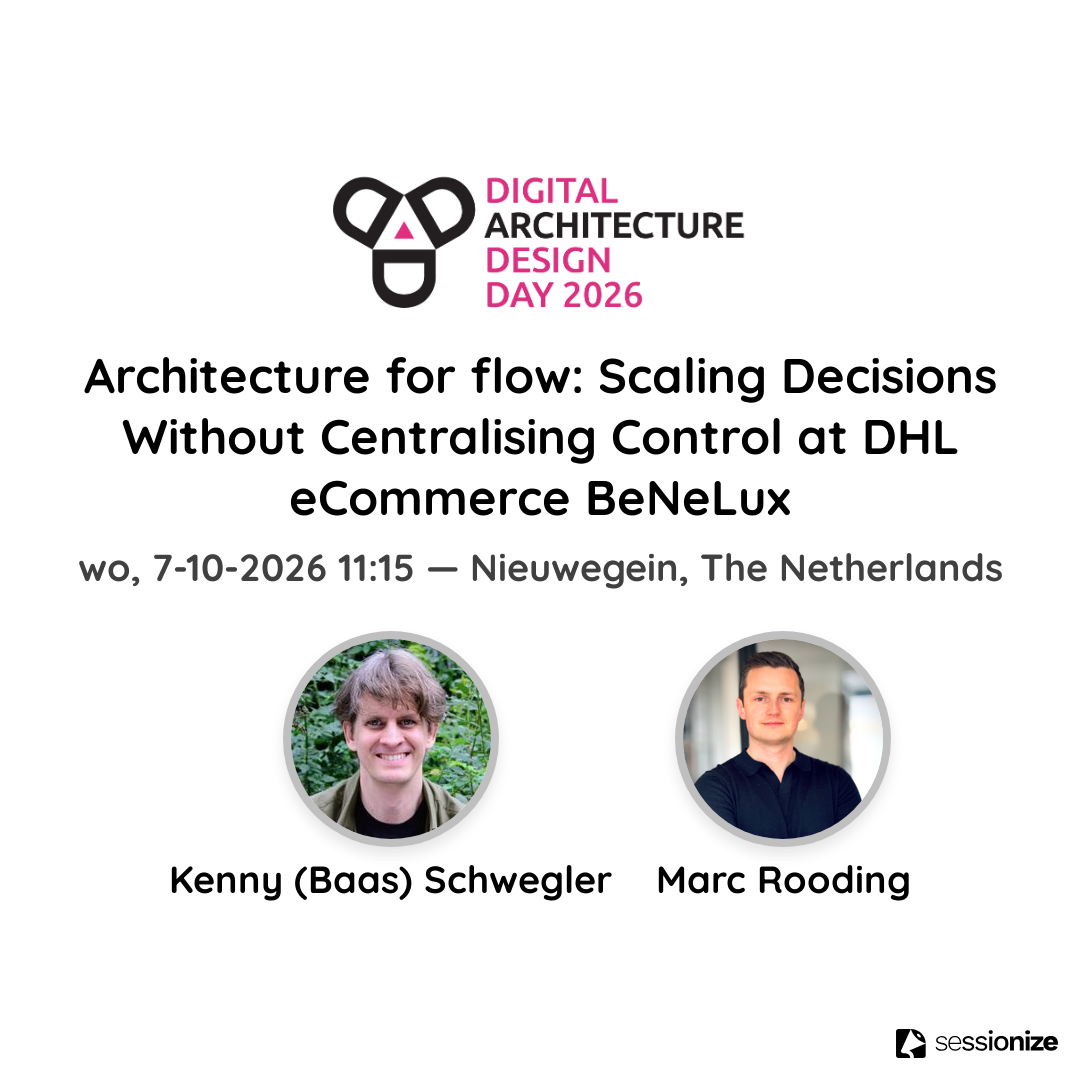
At DHL eCommerce Benelux we've been living with that question for 2.5 years, growing from a handful of engineers to 150+ people in 35 teams. This Wednesday Marc Rooding and I share the story at Digital Architecture Design Day in Nieuwegein. >>>
#SoftwareArchitecture #DDD #TeamTopologies
![[?]](https://files.mastodon.social/accounts/avatars/109/291/169/258/012/255/original/9dad2db18d348cdf.png)
This has been in the works since June. Glad to finally get it out the door!
#DomainDrivenDesign #DDD #UX #Product
2/2
![[?]](https://files.techhub.social/accounts/avatars/109/323/926/604/183/820/original/fb839d0d866a14eb.jpg)
Everyone agreed on the new architecture standard - docs, examples, even a helpful author on call - yet nobody adopted it. The lesson: consensus without ownership goes nowhere; energy and a felt "why" matter more than process. Wouter Lagerweij, Suzanne Lagerweij shared this.
Read, watch, or listen: https://virtualddd.com/facilitating-archdes/architecture-standards-adoption/
Domain experts can't read code, yet a good model must mirror how they talk. This session tackled that gap with Collaborative Data Modeling: a sticky-note technique for spotting sum and product types in everyday language, so function structure follows from data, not guesswork. Shared by Marco Schneider and Martin Günther.
#DDD #DomainDrivenDesign #EventStorming
Watch it: https://youtube.com/live/iHa6u4t-kOA
Why do good products slowly get worse even when teams keep shipping? That's the trap this session digs into. @charrett joined to talk systems thinking and what it takes to protect quality over time. Key insight: sustainable quality is a system property, not a feature list.
Watch or listen: https://virtualddd.com/sessions/escaping-the-enshittification-trap-systems-thinking-for-sustainable-quality/
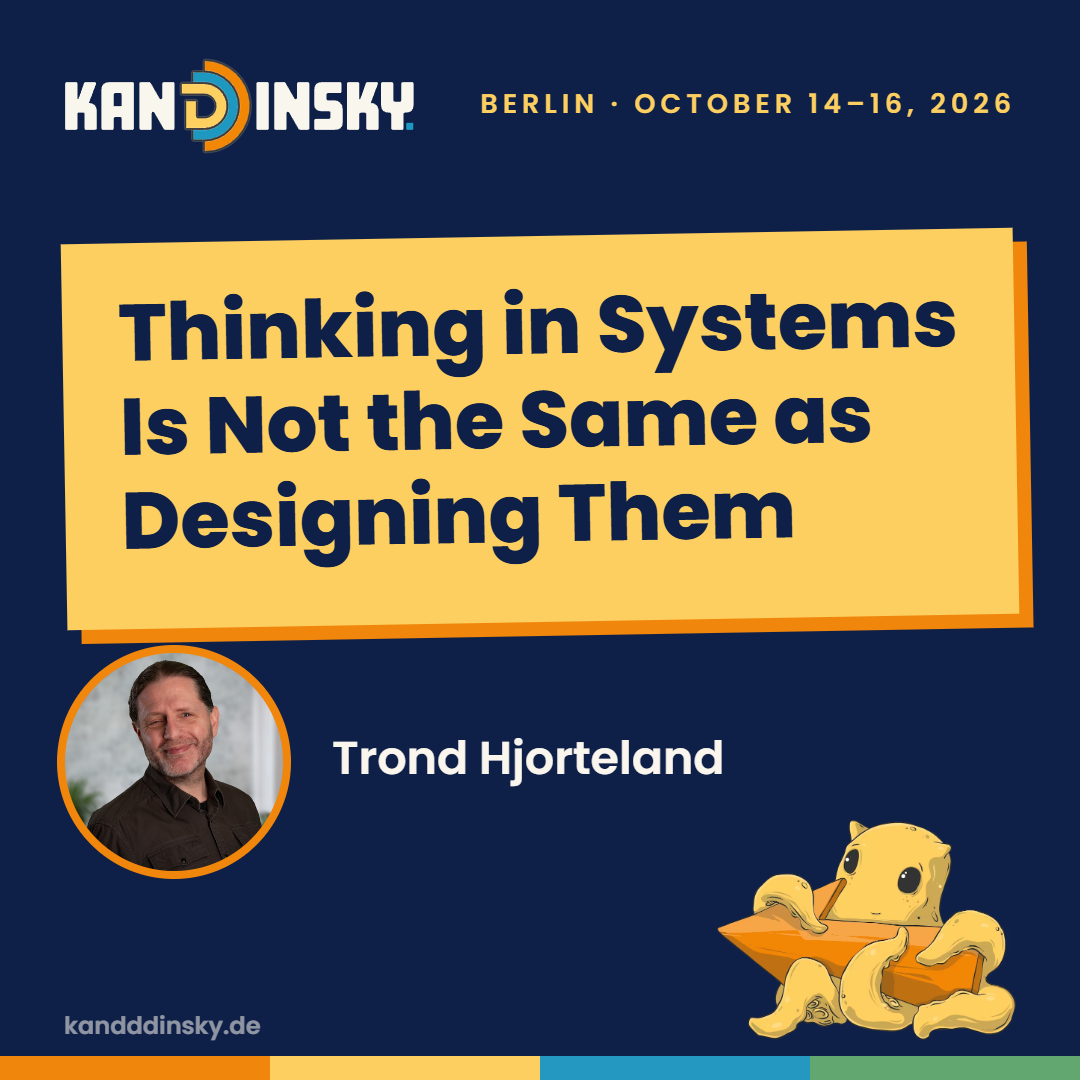
Teams often carry structural dysfunctions that no amount of process tweaking will fix, because the real causes sit deeper in how the organisation is designed as a system. One week from now, @trondhjort joins us to work through a live diagnosis using open systems theory.
Register: https://virtualddd.com/sessions/diagnosing-organisational-dysfunctions-open-systems-theory/
A grad hand-copied 200 report scripts, then handed a laptop over before holiday just to keep exports running. The fix wasn't more automation but noticing those 200 reports were really 5 shapes, and asking if customers wanted the report or just the reassurance it existed.
Shared by Kathryn Hempstalk.
Read, watch, or listen: https://virtualddd.com/facilitating-archdes/getting-data-out-export-architecture/
Modeling data collaboratively often breaks down when teams can't agree on what a "type" even means, and the words people use to describe their domain hold more clues than most models capture. This session with Marco Schneider and Martin Günther looks at how linguistic cues can surface hidden domain types before they cause confusion downstream. One week to go.
Register: https://virtualddd.com/sessions/collaborative-data-modeling-linguistic-cues/
#DDD #DataModeling #SoftwareArchitecture
Good ideas in software delivery often sound wrong at first, and that's exactly why they get ignored. This talk dug into why counter-intuitive practices tend to work better than the obvious ones. The takeaway: if an idea feels uncomfortable, that's worth a second look, not a dismissal.
Watch @hibri talk: https://virtualddd.com/sessions/decoding-paradoxes-why-are-many-good-ideas-in-software-delivery-counter-intuitive/
Translating concepts across bounded contexts often gets messy, meanings shift and teams talk past each other. @indu, @JulieLerman, @nick_tune and @bitboss got together to dig into why this happens and how to spot it before it causes real damage.
Watch or listen: https://virtualddd.com/sessions/lost-in-bounded-context-translations-with-julie-indu-michael-and-nick/
Being new or "just" accountable often means people doubt you belong at the front of the room. Katie Clark's fix: do the real work before the workshop even starts—corridor chats, consent, quietly handing out roles—so the room takes care of itself.
Read, watch, or listen: https://virtualddd.com/facilitating-archdes/workshop-preparation-rolling-the-pitch/
Context maps often stay static, drawn once and forgotten while the system keeps changing around them. In this session, @ziobrando looked at pushing context mapping further, making it a living, iterative tool instead of a one-off diagram. The insight: mapping is a practice, not a deliverable.
Watch: https://virtualddd.com/sessions/ddddd-20-extreme-context-mapping/
![[?]](https://assets.chaos.social/accounts/avatars/109/267/833/214/524/450/original/1e19b2b6c09dc968.jpeg)
RE: https://chaos.social/@BarbNerdy/116924457509955278
Übrigens:
Nachdem ich 6 Monate in diesem Set-Up gearbeitet hatte, wurde die Probezeit nicht verlängert.
Die Firma hat jetzt einen perfekten 1-Jahresplan, genannt „ #Agile Road to Heaven“, der CTO hat seine Reputation verbessert und das Zusammenspiel zwischen Product und Engineering wurde durch #ddd Methoden verbessert.
Tja... Nu. Such ich halt wieder was Neues... aber erst mal: Heilung. Mental und körperlich.
Reaching a "good" domain model is hard when domain experts can't read code. But their language already reveals type structure—sum types, product types—if you know how to listen. Marco Schneider, Martin Günther will share a sticky-note technique for turning those cues into visual models, so function structure follows from data.
Get info & RSVP: https://virtualddd.com/sessions/collaborative-data-modeling-linguistic-cues/
Most systems assume the cloud is always reachable. When a nationwide blackout hit Spain, Mercadona Online's warehouses had thousands of orders mid-fulfillment with central systems dark. Emilio Carrión shared how offline-first design, split-brain trade-offs, and post-outage reconciliation kept operations running.
Listen as a podcast: https://buff.ly/fsG3Dqn
#DDD #SoftwareArchitecture #ResilienceEngineering
Modelling a domain with functional programming sounds great in theory, but where do you actually start when types and pure functions meet real business rules?
In this hands-on session, the group worked through functional domain modelling in practice, testing ideas against real scenarios instead of abstractions.
Takeaway: types can capture domain constraints directly, making illegal states hard to represent at all.
Watch: https://virtualddd.com/sessions/ddddd-20-functional-domain-modelling-in-practice/
Most teams can list what's broken, but rarely explain why the same dysfunctions keep resurfacing. This session uses Open Systems Theory to trace symptoms back to their structural cause. Bring a dysfunction you're living through and work it through live. @trondhjort will share this lens and open the floor for discussion.
#DDD #OpenSystemsTheory #OrgDesign
Get info & RSVP: https://virtualddd.com/sessions/diagnosing-organisational-dysfunctions-open-systems-theory/
Four services on a diagram, but one tangled codebase underneath — the team couldn't see it because they were moving too fast to ask basic questions about what they actually owned.
Vanessa Formicola's fix wasn't a redesign. It was workshops to build shared understanding first, then ADRs, then a North Star — plus "Social Decision Records" for the people decisions that mattered just as much as the technical ones.
Read, watch, or listen: https://virtualddd.com/facilitating-archdes/social-decision-records-team-ownership/
![[?]](https://files.mastodon.social/accounts/avatars/000/006/792/original/DSC_0065_%28300x300%29.jpg)
I'm speaking at KanDDDinsky 2026 in Berlin this October.
14-15 October, Park Inn at Alexanderplatz. Early-bird tickets are 800 EUR until this Friday, 31 July. After that they go up to 950 EUR.
#KanDDDinsky #DDD #DomainDrivenDesign
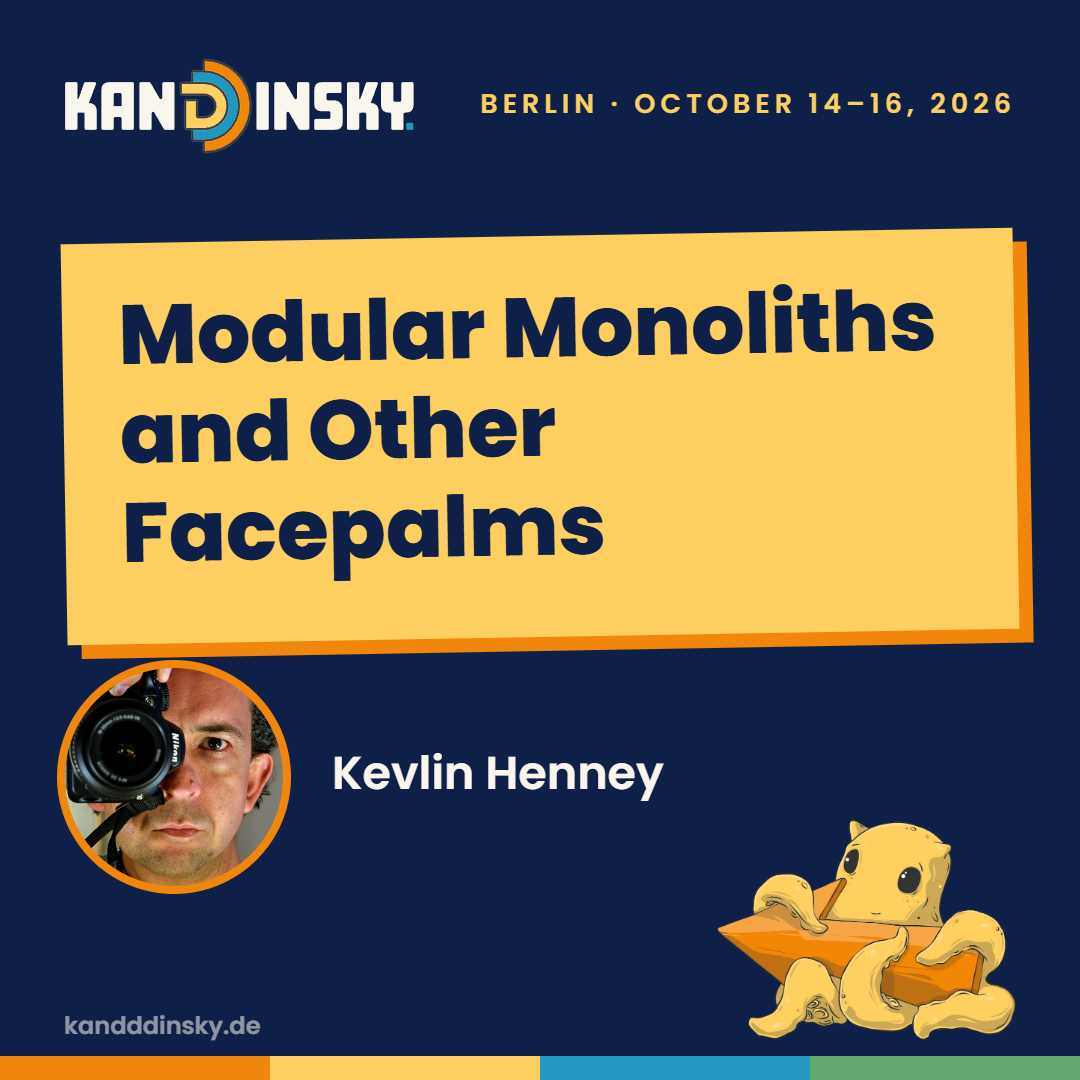
Alt...
Modular Monoliths and Other Facepalms
Kevlin Henney
When a national blackout hits, systems that assume constant connectivity fail fast, and users are left stranded. This session with Emilio Carrión looks at designing offline-first architecture that keeps working when the network doesn't. One week away.
![[?]](https://media.hachyderm.io/accounts/avatars/110/372/528/571/829/161/original/fff0f95f5580438f.jpg)
I'm speaking at KanDDDinsky 2026 in Berlin this October.
KanDDDinsky is one of the few conferences where the hallway conversations are as good as the ones on stage. That isn't an accident. The whole thing is set up so practitioners learn from each other rather than sit and listen. Working software, real problems, no vendor pitches.
A lot of this year's programme deals with AI in business software: what it actually gives us, and what it costs us. Both parts matter and both get discussed honestly. If you build business software for a living, this is your crowd.
14-15 October, Park Inn at Alexanderplatz. Early-bird tickets are 800 EUR until this Friday, 31 July. After that they go up to 950 EUR.
kandddinsky.com/
#KanDDDinsky #DDD #DomainDrivenDesign #SystemsThinking
Two people can leave a meeting thinking they agreed, then find out weeks later they didn't. Nobody wrote it down clearly enough to check. Michael shared a moment where writing a disagreement on a whiteboard changed everything—people stopped arguing at each other and started looking at the same thing.
Read, watch, or listen: https://virtualddd.com/facilitating-archdes/externalising-decisions-not-alignment/
We design for high availability assuming connectivity is always there. But what happens when a national blackout leaves warehouses dark and the cloud unreachable?
Emilio Carrión will share how Mercadona Online kept logistics running offline, and the hard reconciliation problems that followed once systems came back.
Get info & RSVP: https://virtualddd.com/sessions/surviving-a-national-blackout-with-offline-first-architecture-emilio-carrion/
Architects often start hopeful and end up worn down, watching their vision get stripped back by old systems and competing priorities. Larisa Feldman spent years avoiding the role for that exact reason, until she found a place where it could work differently.
Read, watch, or listen: https://virtualddd.com/facilitating-archdes/the-reluctant-architect/
It's hard when teams identify problems as technical, but the real issues are deeper. We interviewed nine practicioners at @dddeu and ask them: what's the hardest part of facilitating software architecture and design?
Read, watch, or listen: https://virtualddd.com/facilitating-archdes/problem-isnt-technical-ddd-europe/
![[?]](https://files.mastodon.social/accounts/avatars/109/250/771/214/407/944/original/0bf0a0277cfb2505.jpg)
A team can own an AI capability and still not own the decisions made inside it.
That is the heart of the latest post in my series on Context Maps in the age of AI called "Ghost Ownership: You Own the Capability, Not the Decision".
https://www.michael-ploed.com/blog/ghost-ownership-you-own-the-capability-not-the-decision