Search results for tag #SystemsThinking
![[?]](https://cdn.fosstodon.org/accounts/avatars/109/322/924/460/890/580/original/5721c20726f0217c.png)
This https://cognitiveinheritance.com/Posts/signals-and-levers.html is my applied reflection on the book "Signals & Levers" by Elisabeth Hendrickson (@testobsessed) and Joel Tosi (@joeltosi). I am very glad I got the opportunity to read this book. #SystemsThinking #book
![[?]](https://files.mastodon.social/accounts/avatars/109/355/050/369/648/745/original/01d3bd58da9b00e4.png)
From the Leanpub Blog: The Leanpub Podcast 🎙 Feat. Yevgen Nebesov, Author of The Architecture of Power: See what shapes outcomes. Find where you can act.
#books #leanpublishing #selfpublishing #systemsthinking #powerstructures #organizationalchange #sociotechnical #architectureofpower #changemanagement #softwarearchitecture #leanpub #techlead
NEW! The Leanpub Podcast 🎙 Feat. Yevgen Nebesov, Author of The Architecture of Power: See what shapes outcomes. Find where you can act.
#books #leanpublishing #selfpublishing #systemsthinking #powerstructures #organizationalchange #sociotechnical #architectureofpower #changemanagement #softwarearchitecture #leanpub #techlead
@RuthMalan @testobsessed @joeltosi I'm on chapter 5 and believe me, you want to read this book! #SystemsThinking
![[?]](https://files.techhub.social/accounts/avatars/109/323/926/604/183/820/original/fb839d0d866a14eb.jpg)
Why do good products slowly get worse even when teams keep shipping? That's the trap this session digs into. @charrett joined to talk systems thinking and what it takes to protect quality over time. Key insight: sustainable quality is a system property, not a feature list.
Watch or listen: https://virtualddd.com/sessions/escaping-the-enshittification-trap-systems-thinking-for-sustainable-quality/
Teams often carry structural dysfunctions that no amount of process tweaking will fix, because the real causes sit deeper in how the organisation is designed as a system. One week from now, @trondhjort joins us to work through a live diagnosis using open systems theory.
Register: https://virtualddd.com/sessions/diagnosing-organisational-dysfunctions-open-systems-theory/
From the Leanpub Blog: Leanpub Book LAUNCH 🚀 The Architecture of Power: See what shapes outcomes. Find where you can act. by Yevgen Nebesov
#books #leanpublishing #selfpublishing #systemsthinking #sociotechnical #powerstructures #organizationalchange #changeagent
NEW! Leanpub Book LAUNCH 🚀 The Architecture of Power: See what shapes outcomes. Find where you can act. by Yevgen Nebesov
#books #leanpublishing #selfpublishing #systemsthinking #sociotechnical #powerstructures #organizationalchange #changeagent
Why Your LLM Can't Be the Final Authorization Layer #AgenticAI
✔️ The Leanpub Podcast 🎙 Feat. Ediz Najim, Author of Systems Thinking for Agentic AI ✔️ Full interview: https://youtu.be/Cw-7P9KKaKU ✔️ Leanpub Podcast: https://www.youtube.com/playlist?list=PLUeW7hrYTk8yxF6XuKpwKPsVe5iiGHmKn ✔️ Subscribe to Leanpub on YouTube: https://www.youtube.com/leanpub ✔️
Link: https://www.youtube.com/shorts/c7TVBjx47e4
#AgenticAI #SystemsThinking #SoftwareArchitecture #LLMEngineering #AIReliability
From the Leanpub Blog: The Leanpub Podcast 🎙 Feat. Ediz Najim, Author of Systems Thinking for Agentic AI: A Software Architect’s Guide to Building Reliable LLM and Agent Systems
#books #leanpublishing #selfpublishing #AgenticAI #SystemsThinking #SoftwareArchitecture #LLMEngineering #AIReliability #RAG #ModelContextProtocol #BackendDevelopment #AIObservability #Leanpub
NEW! The Leanpub Podcast 🎙 Feat. Ediz Najim, Author of Systems Thinking for Agentic AI: A Software Architect’s Guide to Building Reliable LLM and Agent Systems
#books #leanpublishing #selfpublishing #AgenticAI #SystemsThinking #SoftwareArchitecture #LLMEngineering #AIReliability #RAG #ModelContextProtocol #BackendDevelopment #AIObservability #Leanpub
![[?]](https://files.mastodon.social/accounts/avatars/112/342/617/510/979/081/original/8bb6c11cb1111c15.png)
Ich habe für diesen Artikel zwölf Beispiele beschrieben, wie das Agile Manifest in der Praxis aussieht. Zehn davon fangen mit „statt" an.
Statt ein Ticket zu erstellen. Statt den Genehmigungsweg zu gehen. Statt sich auf den Vertrag zu berufen.
Das Manifest beschreibt keine Methode. Es beschreibt, was du tust, wenn du den Prozess umgehst. Deshalb kriegt der Dev, der direkt mit dem Kunden redet, Ärger statt Applaus.
Alle zwölf: https://no-bullshit-agile.de/was-bedeutet-das-agile-manifest-in-der-praxis.html?mtm_campaign=mastodon
#coding #systemsthinking #agile

Alt...
Plakat auf cremefarbenem Grund, schwarze Versalien: „Agiles Arbeiten ist Prozessverstoß", das Wort „Prozessverstoß" invertiert. Darunter: „Zehn von zwölf Beispielen fangen mit ‚statt' an."
Nimm eure letzten drei Retros. Zähl die Maßnahmen, die tatsächlich umgesetzt wurden.
Meistens ist die Antwort eine. Oft keine.
Das ist kein Motivationsproblem. Ihr erkennt die Probleme sauber, ihr könnt sie nur nicht schnell genug in veränderte Arbeit übersetzen. Feedback läuft schnell, die Arbeit langsam. Dieser Zustand hat einen Namen.
https://no-bullshit-agile.de/wfl/?mtm_campaign=mastodon#zwei-geschwindigkeiten-zustände-des-systems
#Programming #SystemsThinking #Agile

Alt...
Plakat auf hellem Papierton, schwarze Versalien: „Erkannt ist nicht geändert", das Wort „geändert" invertiert. Darunter: „Zwei Geschwindigkeiten, eine Engstelle."
@midzer schrieb, Scrum sei ein brutaler Scam, erfunden von Krawatten.
Ich halte den Satz für falsch. Die Wut dahinter für berechtigt.
Die meisten Devs, die agiles Arbeiten hassen, haben es nie erlebt. Sie kennen das Daily als Statusreport für den Chef und die Schätzung, aus der eine Deadline wird.
Ich hab fünf Jahre Scrum nach Lehrbuch gemacht und es sein lassen. Warum es trotzdem nicht an dir liegt:
https://no-bullshit-agile.de/es-liegt-nicht-an-dir-agiles-arbeiten-devs.html?mtm_campaign=mastodon
![[?]](https://media.hachyderm.io/accounts/avatars/110/372/528/571/829/161/original/fff0f95f5580438f.jpg)
I'm speaking at KanDDDinsky 2026 in Berlin this October.
KanDDDinsky is one of the few conferences where the hallway conversations are as good as the ones on stage. That isn't an accident. The whole thing is set up so practitioners learn from each other rather than sit and listen. Working software, real problems, no vendor pitches.
A lot of this year's programme deals with AI in business software: what it actually gives us, and what it costs us. Both parts matter and both get discussed honestly. If you build business software for a living, this is your crowd.
14-15 October, Park Inn at Alexanderplatz. Early-bird tickets are 800 EUR until this Friday, 31 July. After that they go up to 950 EUR.
kandddinsky.com/
#KanDDDinsky #DDD #DomainDrivenDesign #SystemsThinking
![[?]](https://media.infosec.exchange/infosec.exchange/accounts/avatars/111/761/911/748/460/484/original/a5e56be569eab405.png)
His tags: #infosec, #agile, #systemsthinking
Thank you very much for your work as a volunteer and your support in organizing the Open Security conference
![[?]](https://files.mastodon.online/accounts/avatars/109/262/550/643/164/718/original/117380847c2009bf.jpg)
What I’ve been reading (and watching) week ending 26 July 2026 https://jchyip.medium.com/what-ive-been-reading-and-watching-week-ending-26-july-2026-9c11a433eabc #politics #AI #SystemsThinking #economics #Lean #SoftwareEngineering
From the Leanpub Blog: Leanpub Book LAUNCH 🚀 Systems Thinking for Agentic AI: A Software Architect’s Guide to Building Reliable LLM and Agent Systems by Ediz Najim
#books #leanpublishing #selfpublishing #AgenticAI #LLMArchitecture #SystemsThinking #RAG #SoftwareArchitecture
NEW! Leanpub Book LAUNCH 🚀 Systems Thinking for Agentic AI: A Software Architect’s Guide to Building Reliable LLM and Agent Systems by Ediz Najim
#books #leanpublishing #selfpublishing #AgenticAI #LLMArchitecture #SystemsThinking #RAG #SoftwareArchitecture
From the Leanpub Blog: The Leanpub Podcast 🎙 Feat. Russ Miles, Author of The Sovereign Engineer: AI Literacy for Software Professionals
https://leanpub.com/blog/the-leanpub-podcast-feat-russ-miles-author-of-the-sovereign-engineer/
#books #leanpublishing #selfpublishing #ArtificialIntelligence #SoftwareEngineering #AILiteracy #LLMs #AgenticAI #SoftwareArchitecture #TDD #EngineeringLeadership #SystemsThinking #Leanpub
NEW! The Leanpub Podcast 🎙 Feat. Russ Miles, Author of The Sovereign Engineer: AI Literacy for Software Professionals
#books #leanpublishing #selfpublishing #ArtificialIntelligence #SoftwareEngineering #AILiteracy #LLMs #AgenticAI #SoftwareArchitecture #TDD #EngineeringLeadership #SystemsThinking #Leanpub
![[?]](https://files.mastodon.social/accounts/avatars/109/978/685/816/069/691/original/db1f6977adda1384.png)
Every time I struggle with something difficult and big, I rediscover the usefulness of #SystemsThinking 💎 and specifically causal-loop diagrams 🔄 and systems archetypes. Such a great tool.
From the Leanpub Blog: Leanpub Book LAUNCH 🚀 Thirst for Reality: How to see the task, find strong solutions, and act without self-deception by Anton Minin Baranovskii
#books #leanpublishing #selfpublishing #TRIZ #problemsolving #systemsthinking #inventivethinking #decisionmaking
NEW! Leanpub Book LAUNCH 🚀 Thirst for Reality: How to see the task, find strong solutions, and act without self-deception by Anton Minin Baranovskii
#books #leanpublishing #selfpublishing #TRIZ #problemsolving #systemsthinking #inventivethinking #decisionmaking
![[?]](https://files.mastodon.social/accounts/avatars/110/663/603/233/434/084/original/1e1b3ab20dfd710e.png)
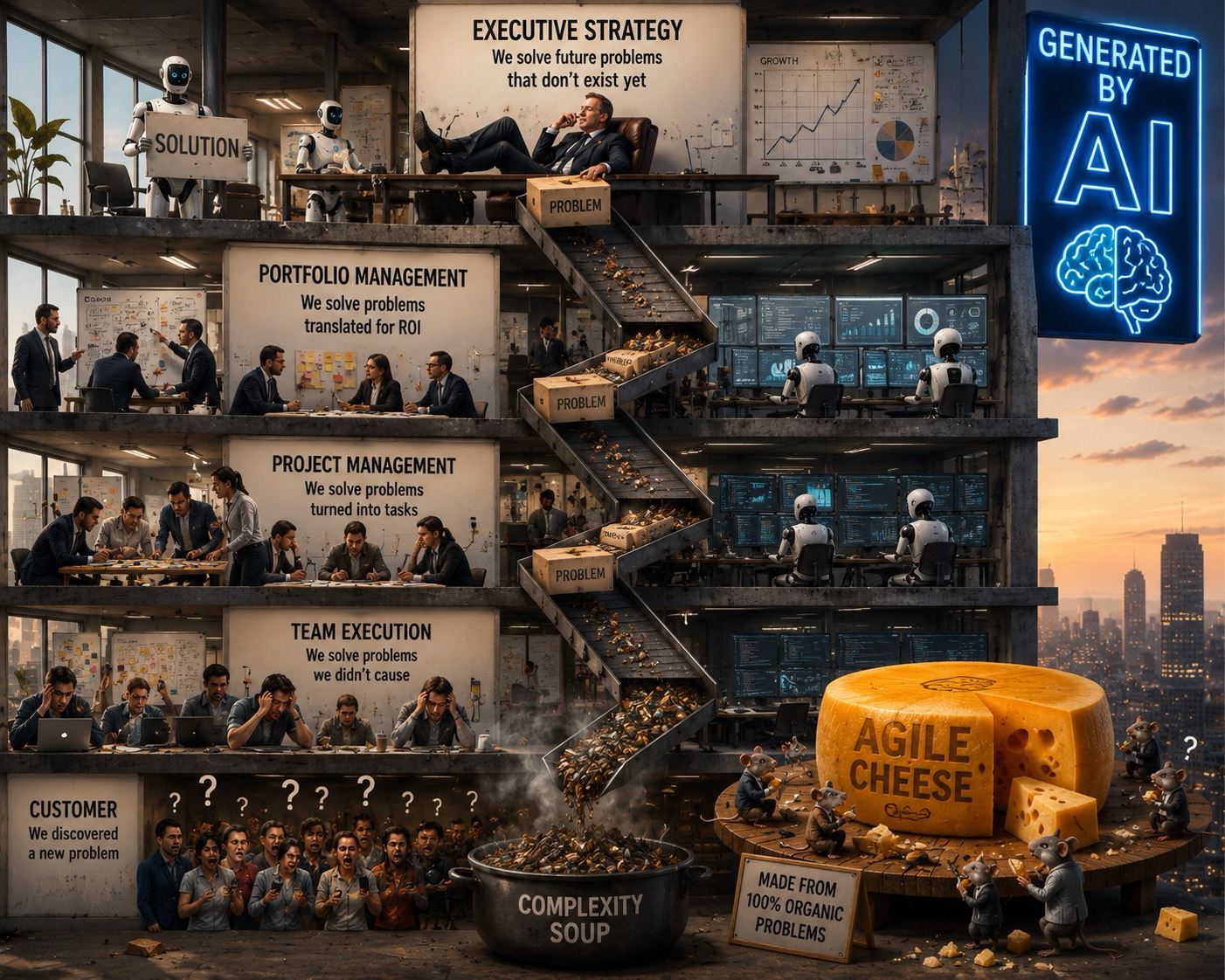
One person’s solution is another person’s problem.
That’s not a bug. It’s how requirements move through organizations.
Every layer solves a problem and creates a new one for the next layer.
#AI is accelerating this process dramatically.
#AgileCheese embraces it. We don’t optimize solutions. We optimize problem propagation.
The fastest way to solve a problem is to make it somebody else’s problem.
That’s why #agile scales so well.
And that’s where the #cheese comes from. 🧀🔥 #SystemsThinking
Alt...
A multi-level organization propagating problems.
![[?]](https://files.mastodon.social/accounts/avatars/109/412/363/141/473/820/original/baef18ef976b6a1e.jpg)
Is Conway's Law just a hunch? Or is it a law? Conway didn't include a proof in 1968.
However, decades later, research from the automotive/aerospace industries and the software industry tells a different story.
If organisations are misaligned with the product architecture, they will have quality problems and decision latency.
Part 2 of "Beyond the Shades of Conway's Law" is out now:
Validation: The Research and Reality Check
https://thinkinglabs.io/articles/2026/06/20/beyond-shades-of-conways-law-validation.html