Search results for tag #NetBSD
![[?]](https://mastodon.longlandclan.id.au/system/accounts/avatars/109/573/513/395/599/946/original/d9f62920e1e1edbb.jpg)
Playing around with #NetBSD again… so I have a Intel NUC running it. One of the thing I frequently have to deal with, being an embedded software developer *and* an amateur radio operator, is #SerialPorts.
More often than not, USB serial ports. Now, I'm used to the Linux way of doing things, where everything is accessed through a /dev/tty* device.
We used to do it the BSD way with a device like /dev/cua0 (16550 UART on ISA 0x3f8 IRQ 4; COM1 for you DOS people) being your serial port ignoring carrier detect, and /dev/ttyS0 was the same serial port but required CD to be up. This got deprecated years ago, so /dev/cua0 disappeared, and we were left with /dev/ttyS0.
I grabbed a test rig I made for work, this is Zephyr RTOS on a Raspberry Pi Pico. It enumerates two CDC-ACM serial ports, one with the Zephyr shell, and the other is a USB serial port. You use the shell port to tell it how to route the RXD/TXD lines on the other serial port, with the board supporting RS-485, RS-422 and TTL serial. On Linux, it shows up as `/dev/ttyACM${n}` and `/dev/ttyACM$(( ${n} + 1 )`. `udev` also creates these symbolic links:
```
stuartl@rikishi ~ $ ls -l /dev/serial/by-id
total 0
lrwxrwxrwx 1 root root 13 Jul 26 10:58 usb-WideSky.Cloud_Pty_Ltd_WideSky_Hub_Test_Rig_E663AC91D3665F30-if00 -> ../../ttyACM0
lrwxrwxrwx 1 root root 13 Jul 26 10:58 usb-WideSky.Cloud_Pty_Ltd_WideSky_Hub_Test_Rig_E663AC91D3665F30-if02 -> ../../ttyACM1
stuartl@rikishi ~ $ ls -l /dev/serial/by-path/
total 0
lrwxrwxrwx 1 root root 13 Jul 26 10:58 pci-0000:00:14.0-usb-0:2:1.0 -> ../../ttyACM0
lrwxrwxrwx 1 root root 13 Jul 26 10:58 pci-0000:00:14.0-usb-0:2:1.2 -> ../../ttyACM1
lrwxrwxrwx 1 root root 13 Jul 26 10:58 pci-0000:00:14.0-usbv2-0:2:1.0 -> ../../ttyACM0
lrwxrwxrwx 1 root root 13 Jul 26 10:58 pci-0000:00:14.0-usbv2-0:2:1.2 -> ../../ttyACM1
```
This is handy because if I have two of these, it doesn't matter which gets detected first, I know which device is which. The links ending in `-if02` or `.2` will be the data port, and the `-if00` / `.0` ones will be the shell control port.
In NetBSD, I plug this same MCU in and I get 4 devices:
- `/dev/dtyU0`
- `/dev/dtyU1`
- `/dev/ttyU0`
- `/dev/ttyU1`
The files actually always exist, but they get mapped to this physical device when the driver detects it and enumerates it on USB.
If I plug in another dongle, I get another pair, a `/dev/dtyU2` and a `/dev/ttyU2`. The choice of `/dev/dtyU[012]` is dependent on which order the devices is detected… which on USB is indeterminate as they can be hotplugged.
The only clue I get is the `usbdevs -v`; it shows a device number and serial number information.
```
vk4msl-nbsd# usbdevs -v
Controller /dev/usb0:
addr 0: super speed, self powered, config 1, xHCI root hub(0x0000), NetBSD(0x0000), rev 1.00(0x0100)
port 1 disabled
port 2 disabled
port 3 disabled
port 4 disabled
Controller /dev/usb1:
addr 0: high speed, self powered, config 1, xHCI root hub(0x0000), NetBSD(0x0000), rev 1.00(0x0100)
port 1 powered
port 2 addr 17: full speed, power 100 mA, config 1, USB-Serial Controller D(0x2303), Prolific Technology Inc.(0x067b), rev 4.00(0x0400)
port 3 addr 1: low speed, power 100 mA, config 1, CASUE USB KB(0x6a21), vendor 2a7a(0x2a7a), rev 0.01(0x0001)
port 4 addr 18: full speed, self powered, config 1, WideSky Hub Test Rig(0x5678), WideSky.Cloud Pty Ltd(0x1234), rev 4.03(0x0403), serial E663AC91D3665F30
port 5 powered
port 6 powered
port 7 addr 3: full speed, self powered, config 1, product 0a2a(0x0a2a), Intel(0x8087), rev 0.01(0x0001)
port 8 powered
port 9 powered
port 10 powered
port 11 powered
…
```
lacking is the knowledge that there are *two* devices allocated to device 18 (the test rig).
Given a `/dev/ttyU${n}` or `/dev/dtyU${n}` device node, how do I find out about the device attached to it? Seems assuming a device node is fraught with danger.
![[?]](https://6-28.mastodon.xyz/accounts/avatars/000/001/517/original/39211d84ecf6c396.png)
![[?]](https://media.bsd.cafe/bsdmmedia01/accounts/avatars/110/740/169/477/916/693/original/dfa8f1b9beefa405.png)
The Blog Option in littleFedi
...and yes, this is build and served by the Raspberry Pi Zero W, powered by NetBSD
https://rpi0w.stefanomarinelli.it/@stefano/blog/691cb62e-e7a1-434b-ba65-d059ee58ac41/
![[?]](https://rpi0w.stefanomarinelli.it/media/e7ed6ce8-3995-439e-8168-674a22629598/image.jpg)
The Blog Option in littleFedi
littleFedi, like many social platforms, had both a strength and a limit. Posts, by their nature, are ephemeral. They get published, federated (unless local-only, which littleFedi handles) and then, over time, lost. Partly through self-deletion, partly through their normal blending in with the thousands of other posts that pile up over time. Sometimes, though, we want something to stay. And not just stay as a social post, but as an actual blog. A bit like with BSSG, I had thought it would be convenient to have a minimal system. Not to compete with WordPress or other solutions, but to have a small blog, integrated into littleFedi, that would produce and serve a blog updated every now and then, whenever the person writing felt like doing it.
And that's why the blog option was born.
The idea is simple: when you write a post, from the web UI or from the CLI, there's a checkbox, "blog post". If you check it, that post stops being just a status that will scroll past and disappear. littleFedi renders it into a real static site. No JavaScript, just HTML and CSS, an Atom feed, tag pages, a chronological archive. Nothing exotic, nothing that needs maintenance five years from now.
The blog isn't a parallel system you have to feed separately. It's not an export, not an import, not a bridge to some other CMS. The post you wrote is the blog post. Same database, same act of writing, still boostable, still repliable, still part of the conversation on the fediverse side. The blog is just a second representation of the same content, generated automatically. Every time you create, edit, or delete a blog post, the whole static site for your account gets rebuilt from scratch, and the new version replaces the old one atomically, so nobody ever lands on a half-built page. If the build fails, the previous version stays in place. Simple, but it has to work reliably, or the whole idea is pointless.
That's the core of it: two representations of the same post. As a status, it lives in the fediverse, interactive, part of the conversation, subject to replies and boosts like anything else. As a static page, it lives on the web, durable, indexable, with a permalink, something an RSS reader can hold onto. You don't have to decide in advance which posts deserve to last. You write normally, and if something turns out to be worth keeping, you flag it, and it gets its own page.
One detail I cared about while thinking this through: the generated site has to be self-contained. When littleFedi builds it, media gets copied or hard-linked into the generated directory - images, audio, video. If it's stored on S3, it keeps its public URL directly. Either way, the point is that the site on disk doesn't depend on the instance staying up. If the server goes down tomorrow, the blog files are still a complete, working website. That wasn't an afterthought, it was one of the requirements from the start.
Not every account gets a blog, and that's intentional. The instance admin has to enable the feature globally ([blog] enabled = true), and then grant it per account. It's not meant to be a CMS, and I didn't want it to become one. Blog posts can't be replies, can't be boosts, have to be public and top-level. These are constraints, not missing features: the blog is for your own writing, not for threads or reshared content.
There's no JavaScript anywhere in the generated site. That was deliberate too. It loads fast, it works offline if you cache it, and it will still render correctly in ten years without anyone having to update a dependency.
In the end, the blog option doesn't ask you to choose between writing socially and writing something permanent. You keep writing the way you always do, on littleFedi, and if a post is worth keeping, you check a box. No separate platform, no migration, no vendor lock-in. Just your own posts, some of them rendered into a small static site you can host anywhere, built out of something that already existed on the open web.
Remember: all this is being currently served by a Raspberry PI Zero W powered by NetBSD
#littleFedi #SSG #BSSG #OwnYourData #Blogging #Fediverse #NetBSD
![[?]](https://cache.treehouse.systems/accounts/avatars/116/642/085/088/196/892/original/011357afd84f2f9c.png)
Hey, #netbsd folk. Forgive my ignorance on this topic. But
I need to build a NetBSD port for a distribution that doesn't have one ready to go.
Can NetBSD be built from source *on Linux* or does it need to be built from within a NetBSD environment itself?
Just so I know if I need to spin up a NetBSD build VM first
![[?]](https://media.bsd.cafe/bsdmmedia01/accounts/avatars/114/439/967/181/871/365/original/9c94f4a4076e444d.jpg)
![[?]](https://polymaths.social/fileserver/01HCMX6M1CZNEVJ4F5H58TT5XJ/attachment/original/01JHC5KM5K0V0J0436SPD3F86H.jpeg)


 🍵
🍵  [
[
![[?]](https://files.hear-me.social/accounts/avatars/116/879/478/989/974/921/original/2a2d853411b3aa5c.png)
RE: https://seattle.pink/@mxchara/116975985790351552
@mxchara is running an X11 window manager poll.
#poll #freebsd #openbsd #netbsd #alpinelinux #voidlinux #slackware #archlinux #manjaro #gnu #polls
![[?]](https://mastodon.sdf.org/system/accounts/avatars/000/005/463/original/a54b1acc2e3ae4b1.jpg)
Since I am an idiot, let's just download RC7 on the RC6 machine, reformat the USB drive and reinstall from that.
Friday night is all right for reinstalling #NetBSD 
![[?]](https://mastodon.sdf.org/system/accounts/avatars/109/564/857/456/913/094/original/651ab60302ce5d82.png)
![[?]](https://pxscdn.com/cache/avatars/577318934691438136/avatar_ijyhj4.jpg)
![[?]](https://mastodon.pirateparty.be/system/accounts/avatars/110/200/667/690/541/925/original/49eff86e10614feb.png)
I'm using 'sysupgrade' to update my RasPi1 from #NetBSD 11.0rc4 to 11.0rc7 and the extraction of the sets is very slow, at about 0.5 MiB/sec. it's not CPU bound and this is on a brand new industrial SD card.
I have to wonder if there aren't a ton of optimizations left on the floor somewhere in the data path of the type which tend to end up added to Linux because the codebase has a ton of eyeballs on it.
#FDE / #FullDiskEncryption on board, hopefully! :D

Alt...
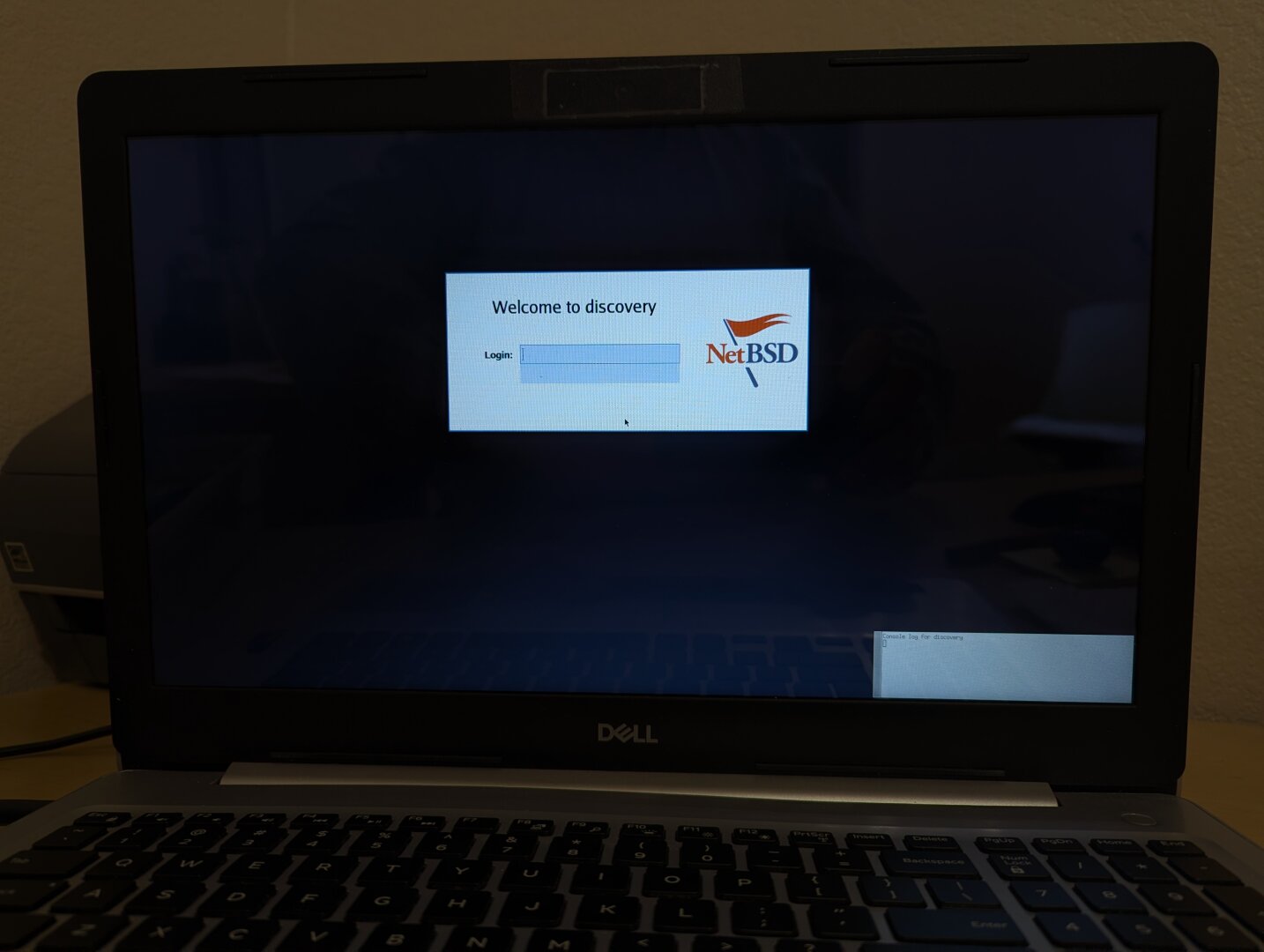
A Dell laptop is seen on the left with the blue NetBSD setup screen background a bunch of green kernel messages over it. On the right is the existing setup with a 1080p monitor, mechanical keyboard, and mouse. The monitor is showing a web broswer displaying https://netbsd.org/docs/guide/en/chap-tuning.html, and three terminal windows:
1: vi for my notes
2: a root ssh session to set up the laptop
3: an ssh session to tilde.pink so I can look up NetBSD manpages.
The laptop driving the monitor is behind it, not visible.
Between the monitor and the laptop being set up is some post-it notes, an R2-D2 Tamagotchi, some USB cables, a Teracotta Lamy Safari, and a small bottle of idoine.
There is a USB hard disk seen in the background.
If you've read this far, you're cool. If you reply to this post with questions that were answered in this alt text, you're not. 😂
![[?]](https://fedi.bobadin.icu/fileserver/01JW8FA8KA9818YWHHBPPZ7TCK/attachment/original/01J0DHDSP9WC6YXEWC97N7TXKR.webp)


NetBSD 11.0 RC7 available!
July 23, 2026 posted by Martin Husemann
The NetBSD project is pleased to announce the seventh release candidate of the upcoming 11.0 release, please help testing!
See the release announcement for details.
The netbsd-11 release branch is nearly a year old now, so it is high time the 11.0 release makes it to the front stage.
https://blog.netbsd.org/tnf/entry/netbsd_11_0_rc7_available
#bsd #netbsd #unix # runbsd #guufxmpp #guuf #guufITA @guuf_italia @livellosegreto.it
![[?]](https://mastodon.sdf.org/system/accounts/avatars/109/290/926/576/891/681/original/71bc290d328f9830.jpg)

Alt...
Futurama "0 days since last ..." image, with the completion of "NetBSD 11 RC"
![[?]](https://media.bsd.network/accounts/avatars/000/006/949/original/9592eac6e5018e39.png)
@david_chisnall That's why I trust #NetBSD and #Zig currently only these are sensible projects rejecting LLM code

My first PR for #NetBSD -- feeling very proud of myself:
Thank you very much for your problem report.
It has the internal identification `pkg/60480'.
The individual assigned to look at your
report is: pkg-manager.
> Category: pkg
> Responsible: pkg-manager
> Synopsis: Multiple packages fail install with pkgin on NetBSD 11.0 RC6
> Arrival-Date: Wed Jul 22 21:50:00 +0000 2026
And just as I was completing it, I was able to install emacs without any issue... 🤦♂️
 boosted
![[?]](https://masto.bike/system/accounts/avatars/109/298/328/498/155/315/original/70dbdf0cef9f4ef2.png)
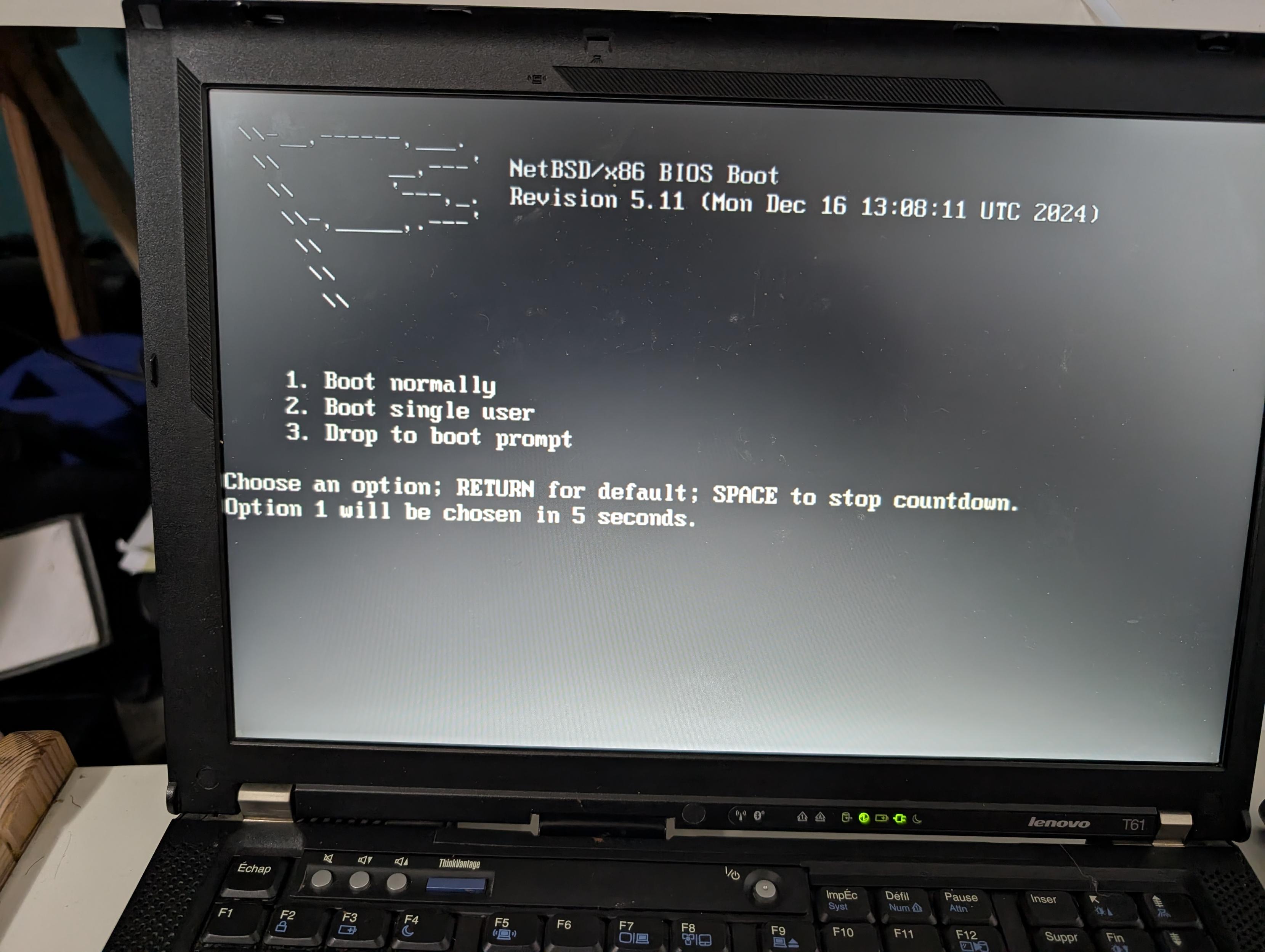
première installation de NetBSD sur une machine physique. j'ai réussi à la première fois.
tout fonctionne.
vieux laptop, 2Go de RAM.
Alt...
photo de l'écran d'un laptop qui affiche les options de démarrage d'un NetBSD.
![[?]](https://media.bsd.cafe/bsdmmedia01/accounts/avatars/113/698/673/569/488/272/original/1fc827cf6cff37d6.png) boosted
boosted![[?]](https://federate.me.uk/system/accounts/avatars/109/309/886/224/077/101/original/5413a04479190d6c.jpg)
@bpl a better tip is to just install pkg_alternatives and then the wrappers are automatically created and updated regardless of which version of ffmpeg you choose to have installed.
I'll concede that the user interface for pkg_alternatives is .. sub-optimal, but once installed it's mostly fire and forget
boosted![[?]](https://snac.bsd.cafe/bpl/s/avatar-b605f1db31dc57fe49b6eb2033dc306c.jpg)
if you need to use ffmpeg to merge video with music, you can symlink ffmpegX
(where is X is version of installed software) and ffprobeX to ffmpeg and ffprobe
respectively in /usr/pkg/bin, then yt-dlp will be able to find binaries.
reasons do not use corporate web browsers. Of course if you use simple web
browser like #Dillo, #Links2, #Lynx, #w3m and any other, you may still want to block
connections with 3rd party sites. If you run #OpenBSD or #NetBSD then you have
few options:
(1) Use PiHole, Blocky, Gravastar - but this will not help if you are out of
home.
(2) Use unwind - if you are running OpenBSD.
(3) Use hblock or tblock.
Hblock and tblock are bash/python scripts which update /etc/hosts file using
blocklists available in the Internet. Hblock depends only on bash, so it will
work after some tweaks even on OS/2. Tblock depends on python and few its
modules, so on BSDs it needs manual installation, but it is a little more
user-friendly. Refer to: https://github.com/hectorm/hblock and
https://codeberg.org/tblock/tblock for more information! Remember: running
tblock in aggresive mode on Atom N210 will drain computing powers
enough to block your Internet conenction totally.
Google Summer of Code 2026 Reports: Testing Compat Linux: Syscall testing
https://blog.netbsd.org/tnf/entry/gsoc2026_testing_compat_linux

 boosted
![[?]](https://gyptazy.com/fedi/gyptazy/s/avatar-1aa83a84ee47c864bc90216a89d0efcf.png)
Some journeys don't end where you expect them to. Sometimes they bring you right back to where everything began, only with a lot more experience and a much better ecosystem waiting for you.
That's exactly what is happening with BoxyBSD!
In my (longer) blog post I cover my circuit, where I moved from bhyve to Proxmox, developed many tools for Proxmox and now moved back to FreeBSD with bhyve and Sylve.
More details in my blog post: https://gyptazy.com/blog/boxybsd-moving-from-proxmox-to-bhyve-with-sylve/
#RUNBSD #bsd #freebsd #boxybsd #openbsd #netbsd #sylve #bhyve #opensource #vps #vpshosting #opensource #community #bsdcafe #boxybsd

Alt...
BoxyBSD Returns to FreeBSD and bhyve with Sylve
@brubarwal @ParadeGrotesque Yeh it's a common issue, especially when you add CDNs into the mix. The only way for pkgin to work reliably is if entire package directories are only ever updated atomically. I do this for https://pkgsrc.smartos.org/ so you'll never see similar errors there, but I don't know that everyone else is so careful. If you just run naive rsync then files and pkg_summary will be out of sync until the entire directory has finished uploading. #netbsd #pkgsrc
![[?]](https://d35e9bfo1msux2.cloudfront.net/accounts/avatars/109/535/770/898/980/239/original/fe47a9c6a062442b.png)
The sad thing is, as I was saying last year, all of this is unnecessary. The kernels, #FreeBSD, #NetBSD, #OpenBSD, and #Linux, all maintain almost all of the stuff that 'who' needs, and have done since the switch to POSIX sessions and process groups in the 1980s.
There aren't any needs for a parallel database outwith the kernel. A few sysctl/procfs extensions for reading the kernel's own list of sessions, and we'd be away.
Hmm...
I have a lot of issues downloading stuff with 'pkgin' which makes it difficult to install what I want... A lot of downloads end in: "package not found".
On the other hand, I think I'll only need to install emacs 30 to have a productive little #NetBSD machine.
![[?]](https://assets.merveilles.town/accounts/avatars/112/983/564/149/770/724/original/1d5215760cb9055d.png)
Look, I just moved (almost) all of my website build to #POSIX #Make <https://www.man7.org/linux//man-pages/man1/make.1p.html>!
https://codeberg.org/aartaka/pages/commit/9f6daf6676f8b25b7859d7af46bf5a34fb606f03
It was fun, because POSIX Make is super restrictive! But the end result is that all the website now builds on #GNU Make, #NetBSD Make, and pdpmake <https://github.com/rmyorston/pdpmake>!
Next stop: writing #sysvinit services with POSIX make!