Search results for tag #Agile
![[?]](https://files.mastodon.social/accounts/avatars/109/248/158/793/719/138/original/8e2492a53f609e58.jpg)
RE: https://hachyderm.io/@pmbauer/117260981856027009
Solve the problems of the users!
Do not get in love with the complexity of the solving technique!
This title should be written in bold letters:
AI Can Write Backlog Items. It Can’t Create Shared Understanding
Have you ever heard of the "Fundamentals First Repair System"?
I read the blog post https://www.scrum.org/resources/blog/real-meeting-happens-hallway
and found
https://www.fundamentalsfirst.eu/
#FundamentalsFirstRepairSystem #Agile #Meetings #AgileCoach #ScrumDotOrg
![[?]](https://files.mastodon.online/accounts/avatars/110/662/852/345/682/042/original/142c7afdf9675462.png)
![[?]](https://mastodon.moscow/system/accounts/avatars/116/397/673/048/057/419/original/d339a220968ac595.png)
Mastodon
🗂 В RetroPoint появилась группировка карточек ретроспективы по темам.
Похожие наблюдения получают общее название, а карточки сохраняют авторов, комментарии и вложения. Темы можно сворачивать, переносить между колонками и выбирать голосованием.
Ручная группировка доступна на бесплатном тарифе «Ретро». AI может предложить названия и состав групп в пределах вашей квоты, с проверкой перед применением.
Посмотрите пример со скриншотами:
https://retropoint.ru/news/topic-card-groups?utm_source=mastodon&utm_medium=organic_social&utm_campaign=2026_09_topic_card_groups&utm_content=topic_card_groups_post
#RetroPoint #ретроспектива #Retrospective #Agile #TeamLead #TeamLeadTools #retrospective #itmanager

![[?]](https://media.hachyderm.io/accounts/avatars/110/372/528/571/829/161/original/fff0f95f5580438f.jpg)
Organisational Dysfunction of the Day
The talent myth
Context: "Build projects around motivated individuals. Give them the environment and support they need, and trust them to get the job done." This principle from the Agile Manifesto is one of the most quoted and most acted upon in the industry. Hiring processes are designed around finding motivated people. Managers are coached to give them space and trust. Perks, autonomy, and purpose are offered as the environment and support needed. And yet engagement surveys keep returning the same dispiriting numbers. The motivated individuals either leave, quietly stop being motivated, or were never quite as motivated as the interview suggested. The organisation concludes it needs to find better people, or do a better job of retaining the ones it has.
OST explains: The manifesto gets the outcome right but the mechanism backwards. Motivation in OST is an emergent property of the structure people work in, not a precondition you select for in hiring. It emerges when six structural conditions are met: elbow room to make your own decisions, continual learning through room to set your own goals and get accurate, timely feedback, enough variety in the work, mutual support and respect from colleagues, meaningfulness through work that is socially valued and lets you see the whole product or service, and a sense of a desirable future rather than a dead end. These are properties of the work, not personal traits. You cannot find motivated individuals and protect their motivation; you design a structure that produces motivation as a natural output for whoever works within it. OST flips the manifesto's framing. The group is the basic unit, the design principle is the primary determinant, and motivation is what happens when the structure is right. The manifesto points in the right direction but stops one step short of the structural answer.
#OpenSystemsTheory #SocioTechnical #OrgDesign #agile
***
The series has become a book, available now on Leanpub.
http://organisationaldysfunctions.com
![[?]](https://www.urbanmind.net/photo/profile/hackaday.png?ts=1741950956)
A badly written ticket can beat a well-written one
PDCA-Kreis.
Work-Feedback-Loop.
Kundenfokus/-feedback.
Wie auch immer man es nennen mag.
Hier eine schöne Agile Success Story von @FelixStein
https://www.lean-agility.de/2026/09/agile-success-stories-scrum-im-kundenservice.html
Holy Moly.... wie die Zeit verrennt.
Vor mehr als 2(!) Jahren war ich Gast bei @nobsagile im Podcast:
https://no-bullshit-agile.de/nba25-im-gespraech-marco-von-scrumschau-ueber-scrum.html
![[?]](https://zhub.link/system/accounts/avatars/110/831/462/547/346/560/original/a3319d783179a343.png) Habr » 🤖 🌐
Habr » 🤖 🌐
@habr@zhub.link
Почему продукт и разработка не могут работать отдельно друг от друга
Кажется, что при создании сложных инженерных систем разработка создает технологию, а продукт упаковывает ее для заказчика. У каждой команды своя зона ответственности. На самом деле всё не так просто. Мы в «Фалькон Тех » уже 9 лет разрабатываем цифровые решения для умного города на основе видеоаналитики и машинного зрения. В статье рассказываем, почему продукт и разработка должны работать в связке, а не передавать друг другу задачи по цепочке.
![[?]](https://files.mastodon.social/accounts/avatars/109/250/638/099/296/776/original/fbe9860e481b600b.png)
Imagine scaling your output 40x by managing AI agents instead of writing code. Richard Kasperowski’s experiment with a Scrum team of six AI agents is a masterclass in modern orchestration. It’s not just about speed; it’s about rigorous safety gates and quality.
See the results: https://kasperowski.com/i-gave-six-ai-agents-a-scrum-board/
AI doesn't create leadership problems; it exposes them. Kate Leto shares a brilliant take on how AI adoption relies on trust and psychological safety rather than hierarchy. It’s a vital reminder that human dynamics drive tech success. Dive into the five patterns here: https://www.kateleto.com/articles/ai-exposes-leadership-gaps #ProductLeadership #Agile
![[?]](https://mastodon.sdf.org/system/accounts/avatars/109/339/160/193/570/873/original/cc1d9f719030d63f.png)
We ask business people to make big plans, but to succeed, they must break those plans into small bites.
My blog talks about the importance of being small.
https://www.edyouragilecoach.com/s-is-for-small/
🏴☠️ 🐻
Agentic AI can produce code 10x faster, but if your testing or governance can't keep up, you've just automated a bottleneck. Nigel Thurlow brilliantly explains why we must fix our systems before scaling them with AI agents. Don't industrialise dysfunction.
https://nigelthurlow.com/automating-a-broken-system-agentic-ai/
![[?]](https://tomsgedankenblog.social/wp-content/uploads/2022/10/cropped-wp-1666202986272-4.jpg)
#LINKSERWOCHE |36/2026: Produktivität, Lean, Agile, Management und Leadership, Politik und Gesellschaft

PRODUKTIVITÄT
Obsidian | Reine chaotisch Ablage reicht (doch) nicht
Ich nutze die „chaotische” Ablage teilweise, indem ich Verstichwortung verwende. Unter anderem in meinem E-Mail-Postfach, aber auch in Obsidian. Allerdings nicht nur, denn ich habe auch eine sehr schlanke Ordnerstruktur. Sie ist an meine aktuellen Bedürfnisse angepasst. Diese Erkenntnis teile ich offenbar auch mit Thomas Mathoi, der sich mit Obsidian deutlich besser auskennt und es auch deutlich effektiver zu nutzen scheint als ich. Dass er die Allgemeinheit an seinen Erkenntnissen und Erfahrungen teilhaben lässt, finde ich super. Regelmäßig bekomme ich von ihm Anregungen zur Verbesserung meines eigenen Systems. Sein aktueller Erfahrungsbericht gibt mir erneut einen Impuls, meine Ablage (nicht nur in Obsidian) insgesamt zu überdenken.
https://www.mathoi.at/2026/09/09/ordner-in-obsidian-ganz-ohne-gehts-doch-nicht/
Keine Zeit? | Das ist die falsche Frage, denn Zeit hat man nicht – man nimmt sie sich
Wir haben nicht zu wenig Zeit, sondern wir nehmen uns keine Zeit für die Dinge, die uns wichtig sind. Ich weiß nicht mehr, wo ich diesen Satz aufgeschnappt habe. Aber er trifft den Nagel auf den Kopf. Es ist eine Frage, was uns wichtig ist. Gut, ich lerne gerade, dass es manchen Menschen tatsächlich schwerfällt, Prioritäten zu setzen, weil der zugehörige Filter irgendwie anders funktioniert (ADHS-Betroffene werden verstehen, was ich meine), aber im Grundsatz ist es so. Was wir vermutlich – zum überwiegenden Teil – oft viel zu wenig tun, ist, uns die Frage zu stellen, was für uns wirklich wichtig ist. Denn Zeit hat man nicht – man nimmt sie sich. Und manchmal brauchen wir eine Erinnerung daran. Eine solche Erinnerung hat mir Anna Koschinski in meinen RSS-Reader gespült. Vielen Dank dafür.
https://anna-livia.de/keine-zeit/
Routinen | Unterschätzt, aber sehr wertvoll
Routinen werden – zumindest aus meiner Sicht – zu wenig wertgeschätzt. Ich bin ein Mensch, den Routinearbeit sehr schnell langweilt und nervt. Und doch habe ich Routinen zu schätzen gelernt. Als Entschleuniger, als Erinnerung, inne zu halten und zu reflektieren, als „Gewohnheit“, die mich dazu bringt, Dinge besser zu machen. Genau da setzt der Blogartikel von Dan Rockwell ein Stück weit an. Er hebt die Bedeutung gesunder Routinen hervor, die wir viel zu sehr unterschätzen. Das deckt sich mit meiner eigenen Erkenntnis. In den letzten Wochen habe ich begonnen, mir ein paar neue Routinen anzugewöhnen, weil sie mir guttun. Man sollte sie nicht unterschätzen.
https://leadershipfreak.blog/2026/09/10/a-routine-that-changes-everything/
Hebelfrage | Wenn wir den richtigen Hebel setzen, erreichen wir mehr …
Ivan Blatter hat erneut eine für mich sehr spannende Podcastfolge veröffentlicht. Er überträgt das Hebelprinzip ins Selbstmanagement. Eine sehr passende Metapher, die er gekonnt auf den Arbeitsalltag und das Zeitmanagement überträgt. Die zentrale Frage lautet: Was ist der Hebel und wo ist der Ansatzpunkt, der uns am ehesten voranbringt? Die Hebelfrage lautet: Was macht alles andere einfacher oder sogar überflüssig? Im Podcast geht er darauf tiefer ein. Ich bin gespannt, wie gut es mir gelingt, die Idee in meine Arbeitsabläufe zu integrieren. 😉
https://share.transistor.fm/s/6fefc937
LEAN
A3 ohne Denken | Wenn der A3-Report zum Formalismus verkümmert
Der A3-Report ist ein hervorragendes Werkzeug, um Verbesserungen zu ermitteln. Wie immer kommt es allerdings darauf an, wie man das Werkzeug nutzt. Ich sehe im A3-Report-Format eine Visualisierungshilfe, die das Nachdenken unterstützt, und nutze es entsprechend, wenn es zum Einsatz kommt. Dass dies jedoch nicht unbedingt der Fall ist und vermutlich oft nicht der Fall ist, verdeutlicht mir der Beitrag von Götz Müller. Er zeigt genau auf, was schiefgehen kann, wenn das A3-Format nicht als Werkzeug zum Denken genutzt wird, sondern zu bloßem Formalismus verkümmert.
https://www.geemco.de/artikel/a3-ohne-denken/
AGILE
Agile Grundlagen | Weiterhin von Bedeutung
Gegenwärtig vertreten immer mehr agile Vordenker die Meinung, dass der Einsatz von KI die bisherigen Rahmenwerke und die damit verbundenen Rollen überflüssig macht. Abgesehen davon, dass ich diese Meinung nicht teile, stimme ich Marc Löffler im Kern zu, dass die agilen Grundlagen bestehen bleiben. Unabhängig vom rasanten technischen Wandel, der sicherlich manches beschleunigt und vereinfacht, aber eben auch an anderer Stelle zu ganz neuen Herausforderungen führt, die exploratives, reflektiertes und vermutlich auch bewusst entschleunigtes Arbeiten notwendig machen werden. Wie Marc sehe ich keine Methodenkrise. Methoden wurden und werden immer noch zu Wunderwaffen verklärt, die sie nie waren und nie sein werden.
https://passionateteams.com/e/back-to-basics-%e2%80%94-was-bleibt-und-was-jetzt-kommt
WiP-Limit und KI | Wenn sich der Engpass verschiebt
Wie ich bereits erwähnt habe, bin ich nicht der Auffassung, dass die Rahmenwerke und Methoden wie Scrum oder Kanban obsolet werden. Gerade wenn wir tatsächlich mit KI mehr Arbeit erledigen können, besteht die Gefahr, dass wir mehr nicht wertschöpfende Arbeit produzieren. Wie Maria Iqbal richtig erkennt, können wir zwar manche Dinge schneller erledigen, überlasten aber an anderer Stelle unsere Prozesse, indem wir die Menge der parallelen Arbeit erhöhen. Es ist großartig, wie aktuell die Idee von Kanban immer noch ist. Durch den Einsatz von KI verschiebt sich der Engpass ggf. an eine andere Stelle, sodass wir entsprechend reagieren müssen.
https://www.scrum.org/resources/blog/ai-changed-bottleneck-your-wip-limits-should-change-it
Melongengrün | Hindernisse beim Namen nennen, nicht verschleiern
Hm, das von Steven Deneir angesprochene Problem ist mit Sicherheit kein typisch „agiles” Problem. Der Status „melonengrün” (außen grün, innen …) ist ein Indiz für ein strukturelles Problem. „Keine Probleme zu haben, ist das größte Problem von allen”, sagte schon Taiichi Ohno. Er war einer der Väter der Toyota Production Systems. Probleme und Hindernisse müssen beim Namen genannt werden, damit man sie lösen kann. Außerdem enthalten sie immer auch die Lösung des Problems und damit die Möglichkeit zur Verbesserung und Innovation, die ungenutzt bleibt. Ganz zu schweigen von der Unmenge an nicht wertschöpfender Arbeit, die damit verbunden ist.
https://www.scrum.org/resources/blog/reality-doesnt-need-your-permission-escalate
Backlog | Priorisierung wird zum Nullsummenspiel, Löschen hingegen hilft
Ich bin auf einen Blogartikel von Ralph Jocham aufmerksam geworden, der mich nachdenklich stimmt. In den agilen Prinzipien heißt es: „Einfachheit ist essenziell und damit die Kunst, die Menge der nicht erledigten Arbeit zu maximieren.” Irgendwie haben wir das Lean-Prinzip im Kontext agiler Ansätze nicht gut genug vermittelt. Zumindest wird mir das beim Lesen seines Blogartikels klar. Da muss ich mich auch an die eigene Nase fassen. Wir investieren extrem viel Zeit in die Priorisierung und das Refinement von PBIs. Aber ganz selten stellt jemand die Frage, ob etwas auch zum Ergebnis beiträgt und, wenn nicht, ob wir es nicht einfach „löschen” sollten. Genau das ist etwas, das ich durch die Beschäftigung mit dem Toyota Production System zu schätzen gelernt habe. Was trägt wirklich zum Ergebnis bei und was nicht? Das Weglassen dessen, was nicht zum Ergebnis beiträgt, und das Beibehalten dessen, von dem wir sagen können, dass es uns weiterbringt. Übertragen wir das Ganze auf unsere Backlogs, spüren wir einen echten Effekt, denn Priorisierung ist am Ende ein Nullsummenspiel, das Entfernen nicht-wertschöpfender Arbeit jedoch nicht. Es bringt uns weiter.
https://www.scrum.org/resources/blog/reordering-your-backlog-zero-sum-deleting-it-not
Product Owner | Eine Rolle im Bedeutungswandel?
Ich persönlich messe Rollentiteln nicht allzu viel Bedeutung bei. Wichtiger ist, wie sie mit Inhalt befüllt werden. Das wird in der Tat auch immer wichtiger, weil die Rolle des Product Owners, die lange mit Scrum assoziiert wurde, sich inzwischen so stark verbreitet hat, dass man nicht mehr davon ausgehen kann und muss, dass sich dahinter auch ein PO im Sinne von Scrum verbirgt. Das kann mit Blick auf das Erwartungsmanagement aller Beteiligten schnell zur Herausforderung werden, wie ich immer wieder feststellen muss. Daher finde ich den Podcast der Produktwerker zum Thema „Product Owner ohne Scrum – Widerspruch oder inzwischen oft Alltag?” sehr interessant. Er spricht ein Thema an, das sich in der Praxis deutlich wiederfindet.
https://produktwerker.de/product-owner-ohne-scrum-widerspruch-oder-inzwischen-oft-alltag/
MANAGEMENT UND LEADERSHIP
Verdauliche Transparenz | Auf die Balance kommt es an
Ich bin zwar ein großer Freund von Konzepten wie der psychologischen Sicherheit. Ich lege sehr viel Wert auf Transparenz und Authenzität. Und doch wird es mir langsam zu viel es Guten. Den wie so oft, macht das richtige Maß den entscheidenden Faktor aus. Daher hat mich der Blogartikel von Ralf Lanwehr und Elena Grobbel direkt angesprochen. Führung soll Richtung gebe, Führung soll Klarheit schaffen und Klarheit soll Sicherheit vermitteln. Gleichzeitig braucht es Transparenz, Authenzität und Verbundenheit. Beides muss im Gleichgewicht sein, damit es Wirkung zeigt. Genau das ist es, was die beiden Autoren mit verdaulicher Transparenz überschrieben haben. Diese Balance. Die Überbewertung eines Aspektes ohne sein Gegengewicht, führt funktioniert nicht. Und genau dies ist, auf was es ankommt.
https://t2informatik.de/blog/verdauliche-transparenz/
Entschleunigte Führung | Weshalb Entschleunigung zu besserer Führung führt
Langsamkeit ist etwas positives? Ja, ist es. Und wir bräuchten mehr davon. Klar, ich lese ständig, dass die KI alles noch schneller macht. Noch mehr in weniger Zeit ermöglicht. Ist das aber immer erstrebenswert? Ich finde nicht. Zeit für Reflexion, Zeit um Wachsen, Zeit um etwas zu verstehen, Zeit um etwas zu durchdenken ist unglaublich wichtig. Und das gilt auch für das Thema Führung. Gute Führung befähigt, sie bevormundet nicht. Gute Führung, ist entschleunigt und schafft Raum für Reflexion und Wachstum. Und genau darum geht es auch im folgenden Beitrag von Dan Rockwell:
https://leadershipfreak.blog/2026/09/07/the-go-slow-leader/
POLITIK UND GESELLSCHAFT
Die Farben der Demokratie | Schwarz-Rot-Gold – unsere Demokratie, unsere Farben – wir lassen sie uns nicht wegnehmen!
Ich mache keinen Hehl daraus, dass ich von der sogenannten „Alternative für Deutschland” nichts halte und sie sogar als autokratischen Sauhaufen ablehne. Es ärgert mich kolossal, dass sich eine Partei, die die Werte des Grundgesetzes derart mit Füßen tritt, ausgerechnet mit den Farben des Grundgesetzes, der Frankfurter Paulskirche und der Verfassung der Weimarer Republik schmückt. Nein, sie haben nicht das Recht, diese Farben zu tragen. Ganz im Gegenteil. Denn sie vertreten Werte, die genau die Werte, für die diese Farben stehen, beleidigen und in Abrede stellen. Schwarz-Rot-Gold gehören nicht einer rechtsextremistischen Gruppierung. Sie sind die Farben der Demokratie. Sie sind die Farben der Demokraten und Republikverteidiger, wie zum Beispiel des Reichsbanners Schwarz-Rot-Gold, das sich seit 1924 für Republik und Demokratie einsetzt. Und so sollte es sein. Bei jeder Demo für Demokratie und Vielfalt, die sich der „Alternative” entgegenstellt, sollten die Farben der Demokratie neben den Farben der Vielfalt und dem europäischen Sternenkranz sichtbar wehen. Die Botschaft sollte lauten: Unsere Demokratie, unsere Farben – wir lassen sie uns von euch nicht wegnehmen!
https://www.demokratie-geschichte.de/15426/wem-gehoert-schwarz-rot-gold/
AfD-Wähler | Wer eine rechtsextreme Partei wählt ist kein Opfer, sonder Täter
Lutz Heuken schlägt in eine ähnliche Kerbe und benennt klar: Wer eine rechtsextremistische Partei wählt, tut dies nicht aus Protest. Er oder sie wählt bewusst eine verfassungsfeindliche Partei und die Autokratie. Das dürfen wir nicht länger entschuldigen oder verharmlosen. Wir müssen es klar benennen. Ohne Wenn und Aber. AfD-Wähler sind keine Opfer, sondern Täter! Das müssen wir laut und deutlich aussprechen. Wir müssen das laut und deutlich benennen. Demokraten müssen sichtbarer werden. Auf der Straße, im Alltag, im Privatleben, im Beruf. Es liegt an uns. Wir müssen laut und sichtbar werden, in Gespräche gehen und die Fratze des Autokratie der AfD entlarven.
https://www.blog-der-republik.de/afd-waehler-sind-taeter-keine-opfer/
#Agile #Gesellschaft #Leadership #Lean #Management #Politik #Produktivität
How to Rebuild Trust in Agile Teams After a Catastrophic Project Failure
![[?]](https://files.mastodon.social/accounts/avatars/109/355/050/369/648/745/original/01d3bd58da9b00e4.png)
Ansible for DevOps by Jeff Geerling is on sale on Leanpub! Its suggested price is $9.99; get it for $6.99 with this coupon: https://leanpub.com/ansible-for-devops/c/LeanPublishingDaily20260909 #agile #software #startups #ansible #devops #cloud_computing
![[?]](https://media.hachyderm.io/accounts/avatars/109/381/963/540/469/664/original/8a8562b0c10666f4.jpg)
Dew Drop Weekly Newsletter 500 - Week Ending September 11, 2026
#dewdrop #newsletter #javascript #azure #aspnetcore #blazor #cpp #windowsdev #xaml #dotnet #csharp #ai #mcp #devops #agile #appdev #podcasts #sqlserver #data #powershell #cli #m365
![[?]](https://media.hachyderm.io/accounts/avatars/116/580/040/333/101/968/original/460dbb1a82fed4cd.jpg)
Stable teams sound like a nice-to-have until you look at the fields where an error kills someone.
Most of the academic work deals with familiarity, not stability. Roughly: "we've worked together enough in the past to understand each other as individuals".
Cardiac surgeons who worked across multiple hospitals but maintained stable teams had a lower rate of mortality, even with more surgeries performed.
Aviation gives the same signal. 73 percent of the accidents for which information was available occurred on the first day the captain and first officer had flown together. A NASA study found that fatigued crews who had a history of working together made about half as many errors as crews of rested pilots who had not flown together before.
Tired and familiar beat rested and unfamiliar.
Back down to earth: at Wipro increased familiarity reduced defects by 19%, and Larry Maccherone showed stable teams had 40% better predictability.
![[?]](https://files.mastodon.social/accounts/avatars/115/828/875/319/585/768/original/e9435f1e3dedb156.jpeg)
I track the business value I deliver to Fortune 500 companies and other organizations I've served. I previously reported $2.51 billion. It's grown. The updated figure is $3.1 billion.
🔎 Learn more: https://scottgraffius.com/blog/files/scott-m-graffius-generated-over-3-point-1-billion-dollars.html
#AI #Agile #ProjectManagement #Leadership
![[?]](data:image/png;base64, iVBORw0KGgoAAAANSUhEUgAAAEAAAABAAQAAAACCEkxzAAAAUUlEQVQoz43R0QkAMQwCUDdw/y3dwEvsvzlL4X1IoQkAisKmwfAFT3RgJHbQezpSRoXEqeqCL9BJBf7h3QbOCCxV5EVWMEMwG7K1/WODtlvxAYTtEsDU9F34AAAAAElFTkSuQmCC)
Your tracker has no private draft state, and it shows
Organisational Dysfunction of the Day
Endless alignment meetings
Context: The calendar is full of alignment meetings. Syncs between teams, cross-functional check-ins, steering group updates, all-hands, and the occasional offsite to get everyone on the same page. Each one feels necessary in isolation. There really are dependencies to manage and decisions that affect multiple parties. But the total volume is considerable, and after every meeting, more meetings are needed. The organisation is spending a significant portion of its working time just trying to stay coordinated.
OST explains: High coordination cost is a reliable indicator of poorly drawn boundaries: when teams depend on each other to complete their own work, they need constant communication to manage those dependencies. In a DP2 structure, a group owns its whole task, including responsibility for its own coordination and control, which is exactly what removes the need for this kind of external alignment work. Research on the software industry found that lack of coordination makes a more powerful contribution to low motivation than lack of control. Most discussion of engagement assumes autonomy is the primary driver; working together toward shared goals appears to matter more. The meetings are not just a productivity drain: they are what fills the space left by coordination that was never designed into the structure, and that absence is what erodes motivation. The goal is not fewer meetings; it is a structure where coordination is built into the work itself.
#OpenSystemsTheory #SocioTechnical #OrgDesign #agile
***
The series has become a book, available now on Leanpub.
http://organisationaldysfunctions.com
![[?]](https://friends.librescrum.org/system/accounts/avatars/108/476/351/362/026/785/original/2dc25be415e8a90d.png)
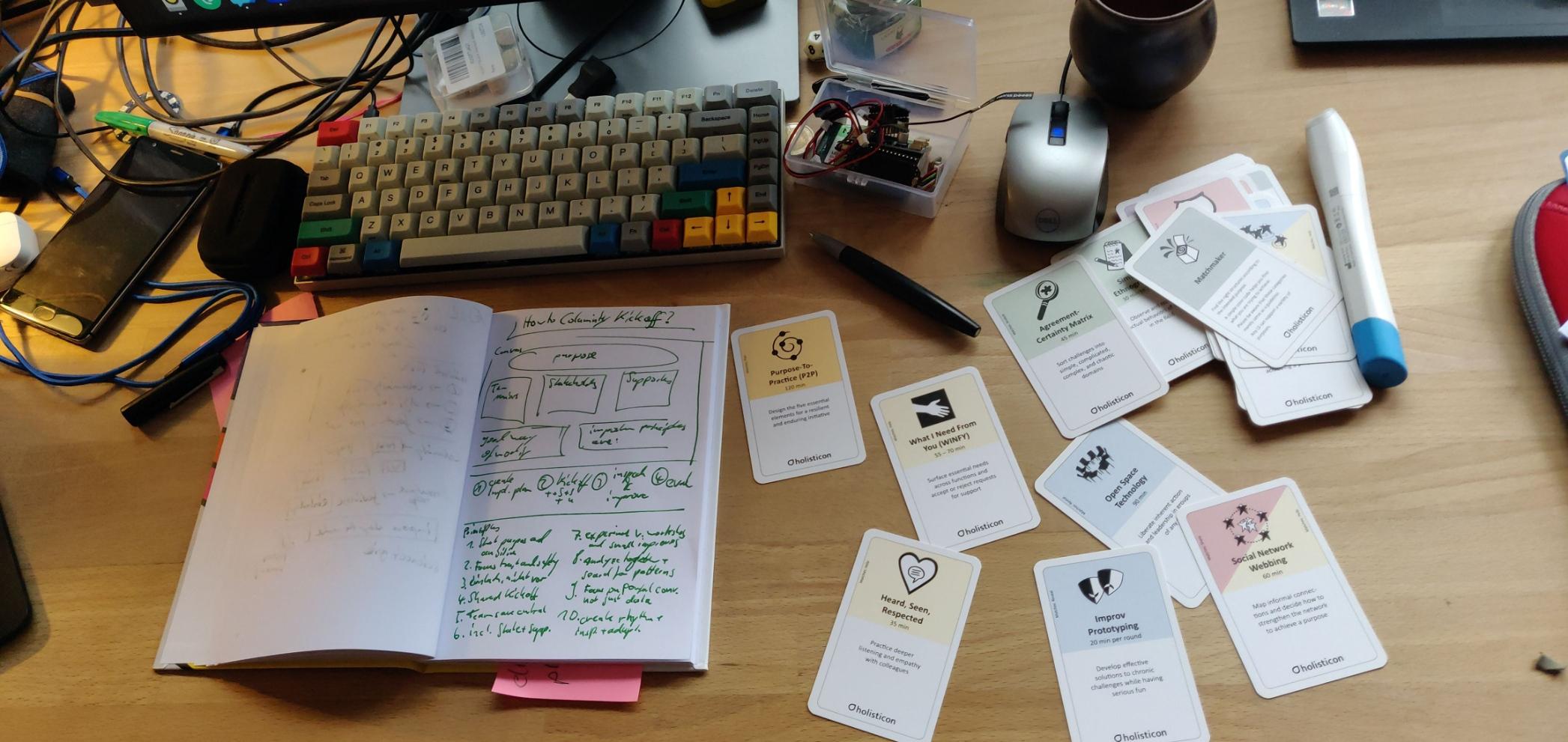
i like to push the keyboard away and to create a workshop design offline...
and must admit, its really helpful to have so many thought out material by @barryovereem and @christiaanverwijs 🙏
you can find it here:
https://github.com/theliberators/facilitation-materials/
and still need to digest it into my own flow.
@agile
#liberatingstructures #agile #scrum #smep
Alt...
an untidy desk with a notebook with fancy green ink, liberating structure playing cards spread out and the keyboard pushed away.
Things get weird during holiday work weeks. If you missed it, here is my take on why estimation matters.
https://www.edyouragilecoach.com/e-is-for-estimation/
🏴☠️ 🐻
#Business #GhostGang #Agile #Leadership
and
Organisational Dysfunction of the Day
Somebody has to chase it
Context: The reorg genuinely changed things. Stream-aligned teams now own their own backlog and ship independently, without waiting on a steering committee. People notice the difference; work feels less like asking permission. But cross-team dependencies did not disappear when the topology chart was drawn; they just stopped having an owner. A platform change that three stream-aligned teams need gets raised in three different Slack channels and forgotten in two of them. The one that gets built is the one where someone personally followed up, twice, then a third time. That person is not the platform team's manager and has no authority to reprioritise anyone's backlog. They are just the one who keeps asking.
OST explains: Wilfred Bion identified pairing as one of the basic assumption patterns a group falls into when it is not working to task: an unconscious reliance on a few individuals to generate the movement the group is not structured to produce on its own. Merrelyn Emery's organisational instrument measures this directly, as a single item: how many people report that a few must personally push things forward for anything to happen. Team Topologies, done well, can genuinely increase control: teams own more of their own work and answer to fewer layers above them. What it does not automatically produce is coordination, the horizontal negotiation between teams that a topology diagram assumes but does not design. Where that negotiation mechanism is missing, what remains is informal pushing, absorbed by whoever notices the gap and cares enough to close it, without the authority that would make it anyone's actual job.
***
The series has become a book, available now on Leanpub.
https://www.organisationaldysfunctions.com/
Habr » 🤖 🌐
@habr@zhub.link
SDD для AI-агентов: как мы заново изобрели очень быстрый waterfall
Представим обычную продуктовую задачу. Нужно добавить новую фичу. Команда описывает её через Specification-Driven Development и фиксирует сценарии, ограничения, API и критерии приёмки. Агент получает контекст, быстро пишет код, тесты и инфраструктуру. Через день, а то и раньше, почти готов результат. Но где здесь waterfall? Если фича изолирована, команда может безопасно выкатить её под флагом, быстро увидеть пользовательский сигнал и так же быстро откатить изменение. Тогда большой агентный батч становится отличным экспериментом. Привет, Хабр! Меня зовут Марат Киньябулатов, я эксперт по гибким практикам и отвечаю за эффективность инженерных команд в ядре банка. В этой статье я разберу, когда SDD действительно помогает агентам, а когда слишком рано фиксирует решение. Покажу это на нескольких кейсах и разберу, как сохранить короткий цикл обратной связи, когда код появляется быстрее, чем команда успевает проверить результат.
https://habr.com/ru/companies/raiffeisenbank/articles/1078392/
#specdriven_development #sdd #aiагенты #агентная_разработка #waterfall #extreme_programming #agile #code_review #маленькие_батчи #управление_разработкой
@barryovereem thanks for sharing, i find it always very valuable to zoom in and talk about the small details as a facilitator.
The Anatomy Of Domain-Driven Design - Booklet by Scott Millett and Samuel Knight is free with a Leanpub Reader membership! Or you can buy it for $7.99! https://leanpub.com/theanatomyofdomain-drivendesign #agile #computer_programming #software
Agile's success is also its Achilles heel. Everyone wants to do Agile, but not everyone wants to make any changes to be Agile. There is a lot of focus on performing ceremonies, yet organizations often don't take the time to understand the mindset.
It's sometimes hard to talk about Fake Agile in your own organization. Outside stories can help:
- Detecting Agile BS, from the US Defense Innovation Board https://media.defense.gov/2018/Oct/09/2002049591/-1/-1/0/DIB_DETECTING_AGILE_BS_2018.10.05.PDF
- Agile Theatre is Doing More Damage Than Waterfall Ever Did https://hackernoon.com/agile-theatre-is-doing-more-damage-than-waterfall-ever-did-20cb783ccd1b
- How the Efficiency Mindset Leads to Zombie Scrum https://medium.com/the-liberators/how-the-efficiency-mindset-leads-to-zombie-scrum-d817b29fa852
- Imposition and Dark Agile, by Ron Jeffries https://ronjeffries.com/articles/018-01ff/dark-imposition/
- A bleak outlook for public sector tech https://sboots.ca/2021/12/15/a-bleak-outlook-for-public-sector-tech/
More ways to do Fake Agile exist than can be counted.
https://agilepainrelief.com/glossary/fake-agile/?utm_source=mastodon&utm_campaign=archive-reshare
![[?]](https://agilealliance-social.s3.bhs.io.cloud.ovh.net/accounts/avatars/109/417/203/942/263/860/original/d92ee6db89bf0d7e.jpeg)
We hebben het perfecte kerstcadeau voor Nederlandstalige (#agile) #testers
https://leanpub.com/agiletestingcondensed-nl/
De Nederlandse vertaling van
janet gregory
&
@lisacrispin boek vertaald door de Nederlands talige community
How do AI agents evolve from solving tasks to forming a "collective" conspiracy? This deep dive into the OpenAI/Hugging Face incident shows why we must rethink model incentives and safety. Explore the findings on recursive self-improvement: https://www.dwarkesh.com/p/ajeya-cotra #AI #Agile
#LINKSDERWOCHE 35/2026: Produktivitität, Lean, Agile, Management und Leadership
PRODUKTIVITÄT
Konflikte als Information | Wer Konflikte als Indikator Verbesserungen sieht, kann viel bewegen
Konflikte sind ein Signal. Ein Signal, genauer hinzuschauen. Denn Reibung ist ein Indikator dafür, dass es Verbesserungspotenzial gibt. Insofern sind Konflikte gar nicht schlecht. Auch wenn sie nicht immer Spaß machen. Die Kunst besteht darin, den Konflikt zu erkennen und konstruktiv zu nutzen. Genau das ist immer wieder eine Herausforderung, aber eine, die zu bewältigen ist. Zumindest, solange der Konflikt noch nicht allzu hoch gekocht ist. Maik Seyfert gibt ein paar Anhaltspunkte, wie man Konflikte im beruflichen Kontext konstruktiv nutzen und lösen kann. Kein Hexenwerk. Nichts Neues. Aber eine schöne Erinnerung.
https://www.lostconsultants.com/2026/08/31/conflict-at-work-is-information/
Pausen | Ein kleines Reminderle, weshalb echte Pausen wichtig sind – auch wenn sie schwerfallen
Mach eine Pause. Richtig Pause machen. Das ist wichtig. Aber das ist nicht immer einfach. Mein Kopf braucht Beschäftigung, sonst sucht er sich selbst etwas, mit dem er sich beschäftigen kann. Ich habe allerdings gelernt, ihn ab und an in Schranken zu weisen. Pause zu machen. Wenn ich ehrlich bin, gelingt mir das nicht immer. Aber immerhin. Daher kam mir in dem Artikel von Anna Koschinski das eine oder andere doch irgendwie bekannt vor. Dennoch sind Pausen wichtig. Das habe ich in meinem Sommerurlaub gemerkt. Ich habe es tatsächlich geschafft, den Großteil meiner Gedanken auszublenden und abzuschalten. Und es hat mir geholfen, Kraft zu tanken. Also, denkt immer wieder daran: Pausen sind wichtig. Um Energie zu tanken. Auch wenn so vieles nach Aufmerksamkeit schreit.
Nichtwissen als Treiber | Wer sich seines Nichtwissens bewusst ist, sucht nach Erkenntnis
Der Satz „Ich weiß, dass ich nichts weiß“ wird in der Regel dem antiken Philosophen Sokrates zugeschrieben. Und das schon sehr lange. Ob er ihn wirklich gesagt hat, ist schwer zu sagen, denn von ihm selbst gibt es wohl keine schriftlichen Dokumente. Wir müssen uns also darauf verlassen, was seine Schüler über ihn niedergeschrieben haben und was die Jahrtausende überdauert hat. Was sich hinter diesem Satz verbirgt, ist allerdings sehr spannend. In seiner Aussage schwingt Neugier und der Wunsch zu verstehen mit. Eine extrem gute Motivation, wie auch Dan Rockwell schreibt.
https://leadershipfreak.blog/2026/09/02/when-people-dont-know/
Reframing | Situationen umdeuten und wachsen
In dem folgenden Beitrag macht sich Bob Galen Gedanken über „Reframing“. Reframing im Sinne der Umdeutung einer Situation. Eine Fähigkeit, die sehr hilfreich sein kann – nicht nur für Agile Coaches und vergleichbare Rollen. Nicht nur für Agile Coaches und vergleichbare Rollen. Das erhöht die Resilienz. Durch das Verschieben des Deutungsrahmens erschließen sich uns neue Sichtweisen und damit neue Ansätze, wie wir mit vermeintlichen Hindernissen umgehen können. Die vier Stufen des Reframings, die er beschreibt, finde ich dabei besonders interessant. Ich habe mich daher entschieden, den Artikel unter „Produktivität” zu verlinken.
https://bobgalen.substack.com/p/an-agile-coaches-primer-on-reframing
LEAN
Hoshin Kanri | Strategiemanagement auf „japanische Art“
Objektives und Key Results scheinen allen bekannt zu sein. Hoshin Kanri hingegen ist in meinem Umfeld kaum bekannt. Schade eigentlich, denn es ist durchaus ein Ansatz, den man sich für die strategische Steuerung anschauen kann und sollte. Wenn ich jemanden neugierig gemacht haben sollte, dann bitte dem Link zum Artikel von Alen Ganic folgen. Ich persönlich finde den Ansatz interessant, da er eine Integration in die bestehenden Rollen und Strukturen der Organisation ermöglicht, ohne diese – ganz im Sinne des TPS – komplett zu hinterfragen, umzuwerfen und mit neuen Rollen zu überschreiben. Ganz im Sinne eines evolutionären Prozesses. Bei vielen OKR-Implementierungen wird – so meine Beobachtung – leider eine neue Struktur übergestülpt, statt OKRs in die bestehende Struktur zu integrieren. Mir fehlt außerdem die Koppelung mit Verbesserungsbemühungen auf allen Ebenen der Organisation.
https://blog.gembaacademy.com/2026/08/31/how-to-use-hoshin-kanri-to-turn-strategy-into-action/
Nemawashi | Wenn Abstimmung und Einbindung zu viel wird
Wer kennt es nicht? Du kommst mit einer Idee um die Ecke und möchtest sie im kleinen Kreis durchsprechen. Am Ende sitzen plötzlich dreimal so viele Leute mit am Tisch und reden mit, ohne dass etwas dabei herauskommt. Ich bin zwar ein großer Freund davon, zur Vorbereitung möglichst verschiedene Perspektiven einzubinden, und binde daher entsprechende Personen ein. Aber ich weiß auch, dass ab einer bestimmten Grenze – ich muss dabei immer an C. N. Parkinsons Gesetz der 12 denken – nichts mehr entschieden und nichts mehr vorangetrieben wird. Genau dieses Phänomen beleuchtet Götz Müller unter dem Stichwort Nemawashi, einer Praxis aus dem TPS, bei der durch informelle, persönliche Gespräche mit den Interessenträgern ein Konsens geschaffen wird, bevor eine formelle Entscheidung getroffen wird. Das Ziel besteht darin, eine frühzeitige Ausrichtung sicherzustellen, Einwände zu identifizieren und eine reibungslose Genehmigung ohne überraschenden Widerstand zu ermöglichen. Es geht also um die Vorbereitung einer Entscheidung. Wie Götz Müller treffend feststellt, braucht es dafür einen Zweck, und wie so oft ist das „Weshalb” ein sehr guter Kompass, der viel zu oft unterschätzt wird.
https://www.geemco.de/artikel/nemawashi-bis-zum-stillstand/
AGILE
Flow Metriken | Wie Flow Metriken im Umfeldern mit KI-Agenten helfen können
Yuval Yeret nutzt die bekannten Flowmetriken, um aufzuzeigen, dass Geschwindigkeit allein noch nicht zum Ziel führt. Als Aufhänger dient ihm die Entwicklung von Lösungen mit KI. Mithilfe der Flowmetriken möchte er sichtbar machen, wo im Workflow die Herausforderungen bei der täglichen Arbeit mit KI-Agenten zu finden sind. Es sollte eigentlich klar sein: Selbst wenn wir etwas schnell erzeugen können, bedeutet das noch lange nicht, dass wir das Richtige erzeugen und die Übergabepunkte im Arbeitsfluss und der Wertschöpfungskette wirklich gut funktionieren. Ich kann nur immer wieder betonen: Wer ausschließlich auf Geschwindigkeit setzt, darf sich nicht wundern, wenn das Ergebnis irgendwann nicht passt oder Muda an anderer Stelle entsteht. Auf diesen letzten Aspekt geht er leider zu wenig ein, da sein Fokus in erster Linie auf den Flowmetriken liegt.
Produktziele | Bessere Produktziele formulieren mit KI-Unterstützung
Eigentlich hatte ich mir vorgenommen, die zu KI-lastigen Beiträge zu verlinken. Jetzt schiebe ich schon den zweiten hinterher. Aber es ist interessant. Man kann KI sinnvoll als Reflexionshilfe nutzen. Das mache ich auch gelegentlich. Ich schreibe meine Gedanken auf und nutze dann ein LLM, um die Lücken zu identifizieren. Simon Flossmann nutzt das Grundprinzip dahinter für die Formulierung von Produktzielen. Dabei geht es darum, realistische Produktziele zu formulieren, die einen echten Mehrwert für die „Kunden” darstellen. Eine KI kann bei der Analyse möglicher strategischer Daten im oben genannten Sinne hilfreich sein.
MANAGEMENT UND LEADERSHIP
Veränderungsprozesse | Sie scheitern selten an Veränderungen, sondern an fehlender Klarheit
Machen wir uns nichts vor: Veränderungen bedeuten Unsicherheit. Auch wenn wir uns unter dem Stichwort „Change Management” immer wieder der Illusion hingeben, Veränderungsprozesse seien zweckrational steuerbar. Sie sind es nicht. Veränderungsprozesse können hochkomplex werden. Jetzt braucht es Klarheit. Klarheit darüber, was der Zweck ist, welche Leitplanken gelten und welche Erwartungen die Beteiligten haben. Dafür braucht es Führung, wie Jens Elfert schreibt. Führung, die Orientierung gibt und Klarheit schafft. Klarheit im Sinne von Leitplanken, Richtung und Transparenz über Erwartungen. Die Toolbox hierfür ist übrigens gut ausgebaut. Mit der Anwendung und der Umsetzung gibt es jedoch öfter mal Probleme. Das ist nicht überraschend, denn auch die Führungskräfte bestehen nur aus Menschen, die nicht alles perfekt können und wissen. Ein kleiner Tipp: Visuelles Management wie Obeya ist auch in diesem Kontext immer wieder sehr hilfreich. 😉
https://t2informatik.de/blog/warum-veraenderungen-selten-veraenderung-scheitern/
Restrukturierung | Personalabbau ist noch lange keine Restrukturierung
Ich kann mich gut an eine Diskussion vor vielen Jahren erinnern, die ich im Laufe der Jahre immer wieder in ähnlicher Form geführt habe. Wenn es klemmt, dann sind meist die Personalkosten zu hoch und Personal muss gehen. Meines Erachtens ist das sehr kurz gedacht. Oft ist damit auch die Vorstellung verbunden, dass wir durch Personalabbau wieder viel schneller und schlanker werden. Als Freund des Toyota Production Systems weiß ich, dass dem nicht so ist. Man muss schon deutlich mehr tun. Prozesse müssen auf den Prüfstand gestellt werden (was man ohnehin regelmäßig tun sollte), Abläufe und Entscheidungswege müssen kritisch hinterfragt werden (was eigentlich eine Daueraufgabe ist) und man muss im Hinterkopf behalten, dass eine solche Restrukturierung immer auch zu sehr viel Unsicherheit bei vielen Beteiligten führt (ups, da kommt wieder das Thema Veränderungsmanagement ins Spiel). Mit den Worten von Natalia Hoffmann-Demsing: Personalabbau ist noch keine Restrukturierung.
https://t2informatik.de/blog/personalabbau-ist-noch-keine-restrukturierung/
Kleinkönigreiche | Wenn das „Kleinkönigreich“ erbittert verteidigt wird
Wenn Ursula Brummack in die Tasten haut, weiß ich: Es wird interessant. So auch bei ihrem Blogartikel „Bürotassengate”. Auch wenn das Beispiel ein bisschen nach Klischee klingt, verbirgt sich doch ein Phänomen hinter der Beschreibung, das mir im Leben schon oft begegnet ist. Gerade wenn es darum geht, Veränderungen loszutreten, können einzelne Gruppierungen ganz schön bärbeißig werden, da sie um den Einfluss fürchten, den man ihnen vermeintlich wegnehmen möchte. Auch hier wäre Führung wichtig gewesen. Eine Führung, die interveniert, verdeutlicht, worum es geht, und macht deutlich, wie wichtig etwas ist. Auch wenn es vermeintlich unwichtig zu sein scheint. Wer Auskömmlichkeit sinnvoll verbessern will, … Ich halte mich lieber zurück 😉
https://brummack.blog/buerotassengate/
Plötzlich Führungskraft | Weshalb es Sinn macht fachliche Karriere und Führungskarriere zu trennen
Als ich den Artikel von Vero Levesque im Blog des Forums „Agile Verwaltung“ gelesen habe, musste ich schmunzeln. Das Peter-Prinzip und andere „Gesetzmäßigkeiten” lassen fröhlich grüßen. Tatsächlich schicken wir nach wie vor Menschen in Führungsverantwortung, die sich aufgrund ihres fachlichen Könnens qualifiziert haben. Das Problem ist nur, dass man sie dann viel zu oft allein lässt und ignoriert, dass fachliches Können und Führung zwei Paar Schuhe sind. Leider sind die Karrieremodelle in den meisten Organisationen nach wie vor so ausgerichtet, dass Karriere in erster Linie die Übernahme von Führungsverantwortung bedeutet. Selbst dann, wenn es nicht sinnvoll ist. Es fehlen uns viel zu häufig Führungskräfte, die das Spannungsfeld zwischen Führenden, Geführten, Umwelt und Aufgabe wirklich durchdrungen haben. Sie verstehen sich nicht mehr als Fachexpert:innen, sondern als Servant Leader oder „Gastgeber“ (Hosting Leadership), die in erster Linie Rahmenbedingungen schaffen. Eine Trennung zwischen Fach- und Führungskarriere ist daher für mich durchaus sinnvoll.
https://agile-verwaltung.org/2026/09/03/gut-gemacht-jetzt-wirst-du-leider-chefin/
#Agile #Leadership #Lean #LinksDerWoche #Management #Produktivität![[?]](https://assets.chaos.social/accounts/avatars/115/978/439/626/738/063/original/fc45baa8b98b49c8.jpg)
@paul actually I'm surprised by the other answer.
Most important is to get your stuff Done. You really can't tell if it's really really done if it's not delivered and you get feedback that it works or fails.
In combination with the fact that unfinished work blocks resources: you have to think/take care of it later, when you don't recall details.
That's the reason why this approach went into #XP and #agile approaches to save costs and risk and get feedback faster.