Search results for tag #netbsd

At EuroBSDcon 2026:
FreeBSD in Bioinformatics: The Good, The Bad and The Ugly https://events.eurobsdcon.org/2026/talk/CEZMMY/
Talk by Varinka Ohanyan
2026-09-13 15:15:00
To register: https://tickets.eurobsdcon.org/eurobsdcon/brussels/
About EuroBSDcon 2026: https://2026.eurobsdcon.org
@eurobsdcon #eurobsdcon #freebsd #netbsd #openbsd #conference #brussels #bruxelles #freesoftware #libresoftware
At EuroBSDcon 2026:
Bringing memory safety to BSD with CHERI https://events.eurobsdcon.org/2026/talk/AU3F7S/
Talk by Brooks Davis
2026-09-13 14:15:00
To register: https://tickets.eurobsdcon.org/eurobsdcon/brussels/
About EuroBSDcon 2026: https://2026.eurobsdcon.org
@eurobsdcon #eurobsdcon #freebsd #netbsd #openbsd #conference #brussels #bruxelles #freesoftware #libresoftware
At EuroBSDcon 2026:
What has (can) the EU Cyber Resilience Act done (do) for you? https://events.eurobsdcon.org/2026/talk/9NVQAD/
Talk by Peter N. M. Hansteen
2026-09-12 10:30:00
To register: https://tickets.eurobsdcon.org/eurobsdcon/brussels/
About EuroBSDcon 2026: https://2026.eurobsdcon.org
@eurobsdcon #eurobsdcon #freebsd #netbsd #openbsd #conference #brussels #bruxelles #freesoftware #libresoftware
At EuroBSDcon 2026:
Hands On experience Chaos Education: Challenge your FreeBSD sysadmin skills by solving real world scenarios https://events.eurobsdcon.org/2026/talk/7KWLK9/
Tutorial Half Day by Andreas Kirchner 2026-09-11 10:30:00
To register: https://tickets.eurobsdcon.org/eurobsdcon/brussels/
About EuroBSDcon 2026: https://2026.eurobsdcon.org
@eurobsdcon #eurobsdcon #freebsd #netbsd #openbsd #conference #brussels #bruxelles #freesoftware #libresoftware
At EuroBSDcon 2026:
Running stock FreeBSD on Windows Subsystem for Linux 2 https://events.eurobsdcon.org/2026/talk/39G3BV/
Talk by Balaje Sankar 2026-09-12 11:15:00
To register: https://tickets.eurobsdcon.org/eurobsdcon/brussels/
About EuroBSDcon 2026: https://2026.eurobsdcon.org
@eurobsdcon #eurobsdcon #freebsd #netbsd #openbsd #conference #brussels #bruxelles #freesoftware #libresoftware


 [
In case any of you has missed it RC 7 of NetBSD 11 is out

The Blog Option in littleFedi
littleFedi, like many social platforms, had both a strength and a limit. Posts, by their nature, are ephemeral. They get published, federated (unless local-only, which littleFedi handles) and then, over time, lost. Partly through self-deletion, partly through their normal blending in with the thousands of other posts that pile up over time. Sometimes, though, we want something to stay. And not just stay as a social post, but as an actual blog. A bit like with BSSG, I had thought it would be convenient to have a minimal system. Not to compete with WordPress or other solutions, but to have a small blog, integrated into littleFedi, that would produce and serve a blog updated every now and then, whenever the person writing felt like doing it.
And that's why the blog option was born.
The idea is simple: when you write a post, from the web UI or from the CLI, there's a checkbox, "blog post". If you check it, that post stops being just a status that will scroll past and disappear. littleFedi renders it into a real static site. No JavaScript, just HTML and CSS, an Atom feed, tag pages, a chronological archive. Nothing exotic, nothing that needs maintenance five years from now.
The blog isn't a parallel system you have to feed separately. It's not an export, not an import, not a bridge to some other CMS. The post you wrote is the blog post. Same database, same act of writing, still boostable, still repliable, still part of the conversation on the fediverse side. The blog is just a second representation of the same content, generated automatically. Every time you create, edit, or delete a blog post, the whole static site for your account gets rebuilt from scratch, and the new version replaces the old one atomically, so nobody ever lands on a half-built page. If the build fails, the previous version stays in place. Simple, but it has to work reliably, or the whole idea is pointless.
That's the core of it: two representations of the same post. As a status, it lives in the fediverse, interactive, part of the conversation, subject to replies and boosts like anything else. As a static page, it lives on the web, durable, indexable, with a permalink, something an RSS reader can hold onto. You don't have to decide in advance which posts deserve to last. You write normally, and if something turns out to be worth keeping, you flag it, and it gets its own page.
One detail I cared about while thinking this through: the generated site has to be self-contained. When littleFedi builds it, media gets copied or hard-linked into the generated directory - images, audio, video. If it's stored on S3, it keeps its public URL directly. Either way, the point is that the site on disk doesn't depend on the instance staying up. If the server goes down tomorrow, the blog files are still a complete, working website. That wasn't an afterthought, it was one of the requirements from the start.
Not every account gets a blog, and that's intentional. The instance admin has to enable the feature globally ([blog] enabled = true), and then grant it per account. It's not meant to be a CMS, and I didn't want it to become one. Blog posts can't be replies, can't be boosts, have to be public and top-level. These are constraints, not missing features: the blog is for your own writing, not for threads or reshared content.
There's no JavaScript anywhere in the generated site. That was deliberate too. It loads fast, it works offline if you cache it, and it will still render correctly in ten years without anyone having to update a dependency.
In the end, the blog option doesn't ask you to choose between writing socially and writing something permanent. You keep writing the way you always do, on littleFedi, and if a post is worth keeping, you check a box. No separate platform, no migration, no vendor lock-in. Just your own posts, some of them rendered into a small static site you can host anywhere, built out of something that already existed on the open web.
Remember: all this is being currently served by a Raspberry PI Zero W powered by NetBSD
#littleFedi #SSG #BSSG #OwnYourData #Blogging #Fediverse #NetBSD

Hey, #netbsd folk. Forgive my ignorance on this topic. But
I need to build a NetBSD port for a distribution that doesn't have one ready to go.
Can NetBSD be built from source *on Linux* or does it need to be built from within a NetBSD environment itself?
Just so I know if I need to spin up a NetBSD build VM first


 🍵
 [



Since I am an idiot, let's just download RC7 on the RC6 machine, reformat the USB drive and reinstall from that.
Friday night is all right for reinstalling #NetBSD 

Is there actually a record of the number of release candidates for an operating system?
If there is, I'm sure #NetBSD is about to break this record.
NetBSD 11.0 RC7 is available.


NetBSD 11.0 RC7 available!
July 23, 2026 posted by Martin Husemann
The NetBSD project is pleased to announce the seventh release candidate of the upcoming 11.0 release, please help testing!
See the release announcement for details.
The netbsd-11 release branch is nearly a year old now, so it is high time the 11.0 release makes it to the front stage.
https://blog.netbsd.org/tnf/entry/netbsd_11_0_rc7_available
#bsd #netbsd #unix # runbsd #guufxmpp #guuf #guufITA @guuf_italia @livellosegreto.it


Alt...
Futurama "0 days since last ..." image, with the completion of "NetBSD 11 RC"

@david_chisnall That's why I trust #NetBSD and #Zig currently only these are sensible projects rejecting LLM code

My first PR for #NetBSD -- feeling very proud of myself:
Thank you very much for your problem report.
It has the internal identification `pkg/60480'.
The individual assigned to look at your
report is: pkg-manager.
> Category: pkg
> Responsible: pkg-manager
> Synopsis: Multiple packages fail install with pkgin on NetBSD 11.0 RC6
> Arrival-Date: Wed Jul 22 21:50:00 +0000 2026
And just as I was completing it, I was able to install emacs without any issue... 🤦♂️

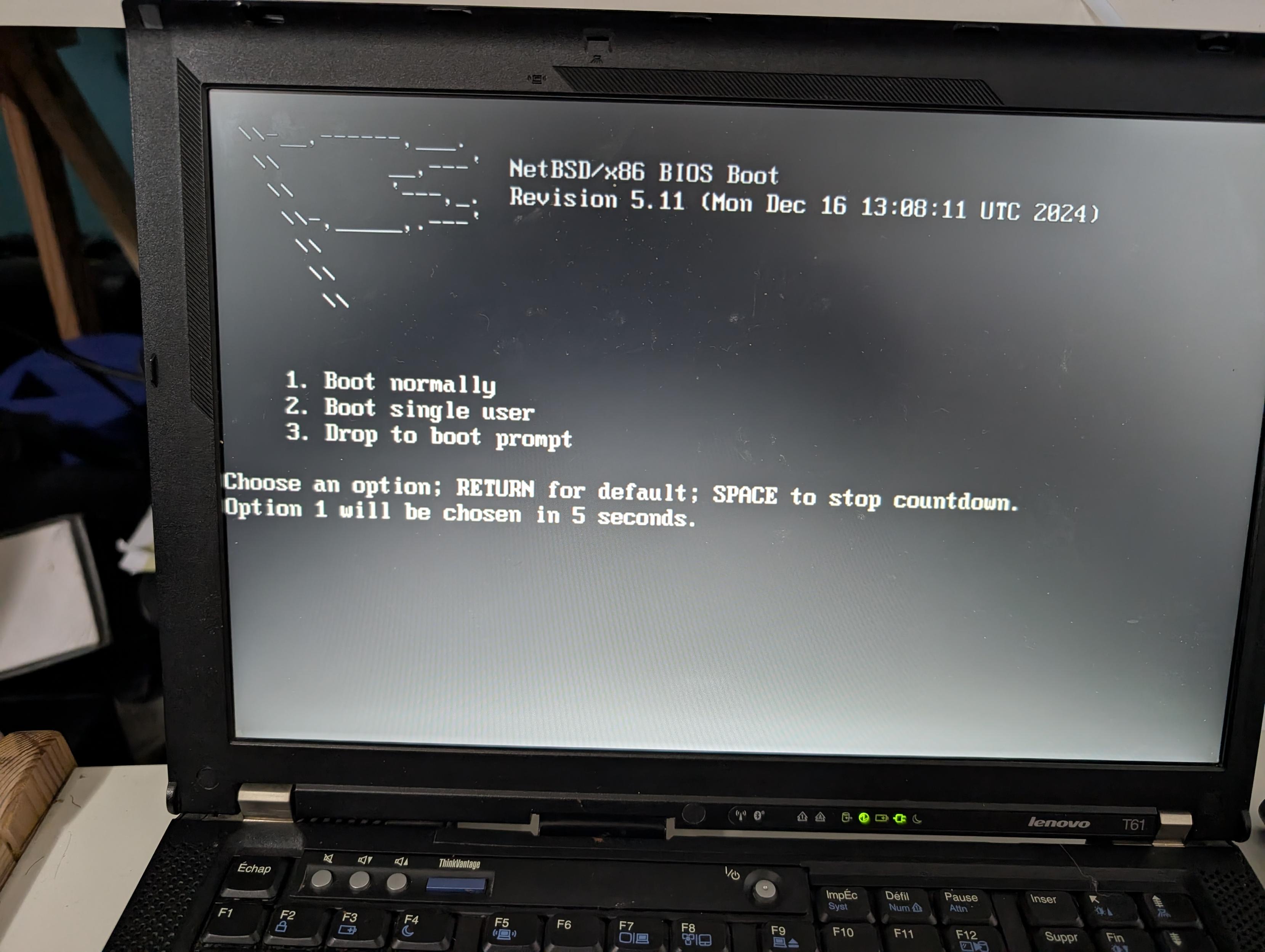
première installation de NetBSD sur une machine physique. j'ai réussi à la première fois.
tout fonctionne.
vieux laptop, 2Go de RAM.
Alt...
photo de l'écran d'un laptop qui affiche les options de démarrage d'un NetBSD.

 boosted

@bpl a better tip is to just install pkg_alternatives and then the wrappers are automatically created and updated regardless of which version of ffmpeg you choose to have installed.
I'll concede that the user interface for pkg_alternatives is .. sub-optimal, but once installed it's mostly fire and forget
Google Summer of Code 2026 Reports: Testing Compat Linux: Syscall testing
https://blog.netbsd.org/tnf/entry/gsoc2026_testing_compat_linux