Search results for tag #Agile
![[?]](https://alvinashcraft.com/img/md-light-1024.png)
Dew Drop - August 24, 2026 (#4739)
Top Links
Today I will… Modernize a .NET application (Matt Soucoup & Pablo Lopes)
The New MCP Roadmap (David Soria Parra & Den Delimarsky)
Microsoft Agent Framework for .NET v1.19.0 Release (Roger Barreto)
Build AI agents without leaving VS Code, join our 3-part Reactor Series (b…
![[?]](https://mastodon.sdf.org/system/accounts/avatars/109/339/160/193/570/873/original/cc1d9f719030d63f.png)
This week, I am discussing the INVEST model and negotiation.
🏴☠️ 🐻
https://www.edyouragilecoach.com/n-is-for-negotiation/
User stories are not the final word, and we talk about them.
![[?]](https://media.hachyderm.io/accounts/avatars/116/580/040/333/101/968/original/460dbb1a82fed4cd.jpg)
🏥 The Resource Utilization Trap plays out beyond software. A hospital at 100% bed capacity has no room to absorb demand, faster triage barely helps. Same dynamic: treat people as resources meant to be kept maximally busy, and the system loses its ability to adapt or innovate.
Eli Goldratt: "Striving to ensure that no resource be idle is the biggest generator of waste."
Where is 100% utilization being treated as a win in your org?
![[?]](https://zhub.link/system/accounts/avatars/110/831/462/547/346/560/original/a3319d783179a343.png) Habr » 🤖 🌐
Habr » 🤖 🌐
@habr@zhub.link
AI-native Tiny Teams — правильный вектор или хайп 2026 года?
В 2026 году из каждого утюга звучит тезис: несколько сильных инженеров с агентами теперь способны делать работу, для которой раньше требовалась полноценная продуктовая команда. Его подогревают прогнозы Сэма Альтмана о «единороге из одного человека» , заголовки о tiny-team moment Кремниевой долины и истории вроде Lovable: $100 млн ARR за восемь месяцев при 45 сотрудниках . В такой подаче tiny team выглядит чуть ли не как будущее разработки и почти панацея. В этом есть частичка правды. AI ускоряет исследование, прототипирование, написание кода, тестов и документации. Полевые исследования фиксируют рост производительности разработчиков , а CircleCI в State of Software Delivery 2026 показывает существенный рост throughput у наиболее эффективных команд.
https://habr.com/ru/articles/1073596/
#tiny_team #маленькие_команды #agile #ai #ainative #java #javascript #менеджмент
![[?]](https://files.mastodon.social/accounts/avatars/109/355/050/369/648/745/original/01d3bd58da9b00e4.png)
The Gap: Why Software Delivery Gets Harder, Slower, and More Expensive—and What Stops It by Luniel de Beer is the featured book 📖 on Leanpub!
Missed deadlines, defects, technical debt, rework, and rising costs are usually treated as separate problems. The Gap shows what connects them and why the usual remedies only go so far.
Link: https://leanpub.com/thegap
#Software_engineering #Business_architecture #Agile #Behavior_driven_development

![[?]](https://media.hachyderm.io/accounts/avatars/110/372/528/571/829/161/original/fff0f95f5580438f.jpg)
Something has genuinely been gained, though. Thorsrud and Emery described being met with open scepticism in the 1960s: the idea that workers could manage their own work, or would even want to, was widely doubted. That particular argument is over. Nobody today seriously claims that people on the floor are incapable of running their own work. But Thorsrud, twenty years into the project, made a sharper point that still holds: most people had still not understood that self-managing groups, followed all the way, are a frontal attack on the hierarchical and bureaucratic organisation, not a technique that can be adopted inside it. Emery would have put the same point differently: DP2 is not a set of practices layered onto DP1. It is a different genotype, and adopting a few of its features while leaving the genotype untouched changes very little. Progress has been real in what people believe is possible. The diagnosis of what has to change has not caught up.
Agile is not the first movement to discover that the bottom of the hierarchy is broken. It is the latest in a line that has fixed the symptom it could reach, and left the structure that produces it untouched. The coal miners' grandchildren are running retrospectives now, in much the same position: closer to being heard, no closer to the people above them changing anything.
***
This argument is explored further in my book, Organisational Dysfunctions: Open Systems Theory Explains, out now.
https://organisationaldysfunctions.com/
#OpenSystemsTheory #SocioTechnical #OrgDesign #agile
(2/2)
Ansible for DevOps by Jeff Geerling is on sale on Leanpub! Its suggested price is $9.99; get it for $6.99 with this coupon: https://leanpub.com/ansible-for-devops/c/LeanPublishingDaily20260819 #agile #software #startups #ansible #devops #cloud_computing
Dew Drop - August 21, 2026 (#4738)
Top Links
WPF Hot Reload in Rider | JetBrains (Michael Hawker)
GitHub: The August 17 outage, and the work ahead (Vlad Fedorov)
terminal-code - VS Code Inside Your Terminal (Rob Pruzan) - Source on GitHub here
The Hanselminutes Podcast - Compile after Class Crossover Episode (Scot…
![[?]](https://media.hachyderm.io/accounts/avatars/109/381/963/540/469/664/original/8a8562b0c10666f4.jpg)
Dew Drop Weekly Newsletter 497 - Week Ending August 21, 2026
#dewdrop #newsletter #azure #javascript #aspnetcore #css #blazor #cpp #windowsdev #xaml #dotnet #csharp #ai #mcp #python #devops #agile #appdev #IoT #podcasts #m365 #data #sqlserver #terminal #devtools
Habr » 🤖 🌐
@habr@zhub.link
Почему гибкие подходы не дают ожидаемой скорости. Серия 1. «Код замедления»
Всем привет. Мы решили попробовать нестандартный формат, чтобы поговорить о важных для нас и индустрии ИТ темах. Предлагаем вашему вниманию экспериментальный детектив. Все герои вымышлены, а ситуации собирательны. Не ищите точных совпадений :)
https://habr.com/ru/companies/T1Holding/articles/1072552/
#agile #кино #нуар #производственный_детектив #офисная_история #случай_из_практики
The Anatomy Of Domain-Driven Design - Booklet by Scott Millett and Samuel Knight is free with a Leanpub Reader membership! Or you can buy it for $7.99! https://leanpub.com/theanatomyofdomain-drivendesign #agile #computer_programming #software
![[?]](https://mastodon.moscow/system/accounts/avatars/116/397/673/048/057/419/original/d339a220968ac595.png)
Новый релиз RetroPoint для тимлидов и команд 🎯
Единый центр действий собирает договоренности из ретроспектив, 1‑2‑1, OKR и Performance Review. В карточках видны ответственный, срок, приоритет, статус и источник.
В разделе команды доступен общий список, а в «Моих действиях» каждый участник видит задачи из разных команд. Действие можно начать, заблокировать с причиной, завершить или вернуть в работу. Комментарии и история изменений остаются рядом 🧭
Меньше ручных переносов, больше ясности между встречами ✅
https://retropoint.ru/news/team-action-center
#RetroPoint #TeamManagement #Agile #управлениекомандой #тимлид
Dew Drop - August 17, 2026 (#4734)
Top Links
Windows App Development CLI v0.6 – create new WinUI applications, sign packages with Azure, and more (Zachary Teutsch) - *Release notes available on *GitHub
Uno Apps Inside of Uno Apps (Steve Bilogan)
How to bring your software delivery workflow into GitHub with agent a…
Habr » 🤖 🌐
@habr@zhub.link
Как перестать имитировать Agile и начать получать результат
На Хабре немало статей о том, почему Agile не работает. И в большинстве из них авторы справедливо отмечают, что ритуалы превратились в формальности, Scrum выродился в бюрократию, команды имитируют активность. Всё так. Я хочу поговорить про другое - про глубинные причины неудач во внедрении Agile и конкретные способы наконец-то получить от методологии тот результат, который она способна дать. Предлагаю пошаговый алгоритм, построенный на принципах поведенческой психологии. Он работает не с ритуалами и артефактами, а с тем, что действительно движет изменениями, — с людьми, их привычками и поведением. Эта статья — не про то, что Agile плох. Она про то, как сделать его работающим.
https://habr.com/ru/companies/smartvalues/articles/1069860/
#изменения #scrum #change_management #поведение #agileтрансформация #поведенческая_психология #процессы #управление_проектами #agile
Ansible for DevOps by Jeff Geerling is on sale on Leanpub! Its suggested price is $9.99; get it for $6.99 with this coupon: https://leanpub.com/ansible-for-devops/c/LeanPublishingDaily20260812 #agile #software #startups #ansible #devops #cloud_computing
Kaizen of the Day by Gareth Holebrook is on sale on Leanpub! Its suggested price is $19.00; get it for $9.99 with this coupon: https://leanpub.com/KOTD100/c/LeanpubWeeklySale20260811 #agile #organizational_psychology #selfhelp #well_being #personal_transformation
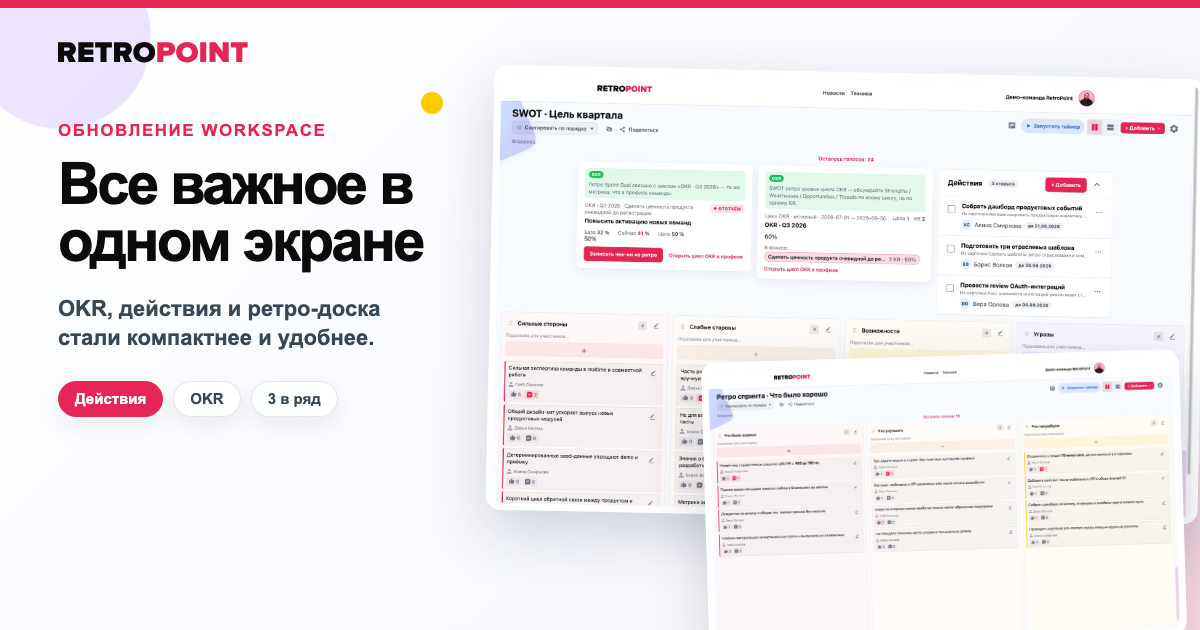
Обновили workspace ретро-доски ✨
Теперь связанные с доской KR, цикл OKR и Действия собираются в компактную сетку. На широком экране три блока помещаются в один ряд и не забирают место у самой ретро-доски.
Панель «Действия» тоже стала практичнее: открытые пункты видны сразу, рядом исполнитель и срок, а закрытые можно развернуть отдельно. Добавлять действия теперь можно как самостоятельно, так и из конкретной карточки.
Меньше прокрутки, больше полезного контекста перед глазами 👀 Уже можно пробовать в RetroPoint 🚀
#RetroPoint #ретроспектива #OKR #управлениекомандой #тимлид #Agile
![[?]](https://files.mastodon.social/accounts/avatars/112/342/617/510/979/081/original/8bb6c11cb1111c15.png)
In einer Agile User Group erzählte jemand, wie er sich eine Steinmauer in den Garten bauen ließ. Er hat bewusst keinen Werkvertrag genommen, sondern einen Dienstleistungsvertrag.
Er wollte nicht irgendeine Mauer. Er wollte seine.
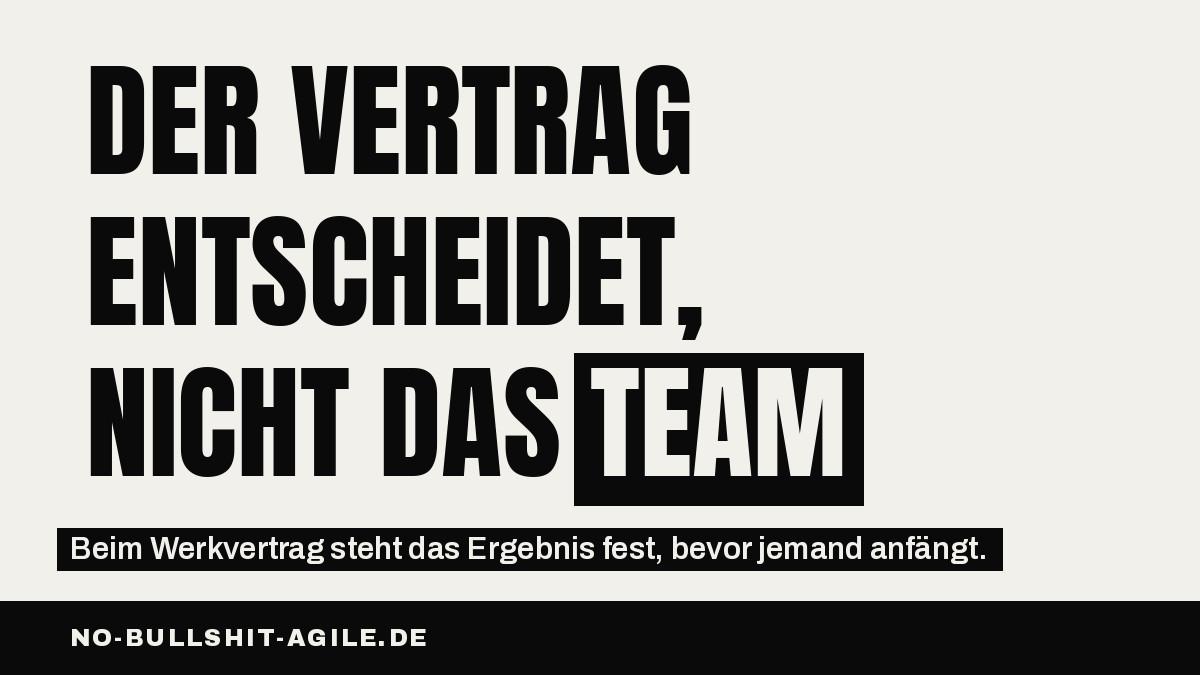
Beim Werkvertrag steht am Anfang fest, was am Ende rauskommt. Genau das wird oft beauftragt. Und dann wundert sich jemand, warum das Team nicht iterativ arbeitet.
#Softwareentwicklung #Projektmanagement #Agile
Alt...
Plakat auf hellem Papierton, schwarze Versalien: „Der Vertrag entscheidet, nicht das Team“, das Wort „Team“ invertiert. Darunter: „Beim Werkvertrag steht das Ergebnis fest, bevor jemand anfängt.“
Habr » 🤖 🌐
@habr@zhub.link
Почему Agile убивает стратегию, когда его масштабируют
Agile легко превращается в ловушку, когда спринты идут по плану, метрики растут, а стратегические задачи месяцами стоят на месте. Разбираемся, почему так происходит при масштабировании и где руководителю вернуть фокус на реальный результат.
https://habr.com/ru/companies/otus/articles/1068628/
#Agile #Scrum #масштабирование_Agile #стратегия #спринты #Velocity #Story_Points #управление_проектами #бизнесрезультат #стратегическое_управление
![[?]](https://cdn.masto.host/mastodonie/accounts/avatars/109/287/644/790/067/714/original/5e277c239abea519.jpg)
The teams that deliver consistently don't have fewer specialists.
They have more people willing to help outside their usual comfort zone.
That's what turns a collection of experts into a real development team.
![[?]](https://files.mastodon.social/accounts/avatars/109/248/158/793/719/138/original/8e2492a53f609e58.jpg)
Plane: Update of the open-source alternative to Jira
https://www.heise.de/en/news/Plane-Update-of-the-open-source-alternative-to-Jira-11399212.html
![[?]](https://cdn.masto.host/aoirsocial/accounts/avatars/111/240/142/489/209/762/original/be235d97c4ca530b.jpeg)
But like a disavowed Jungian shadow, if we suppress complexity in our conscious experience of creating tech, it’ll surface elsewhere and be harder to deal with. Now we have attack surfaces the agents didn’t know or care about; we have bugs that pass into production; we have infrastructural failures that were too hard to catch ahead of time. Just like last time, we’ll have to learn humility, empiricism, communalism, and all the rest. If we can.
#TDD #usercentereddesign #Agile #LLM #technology
In response to those demands we had developed #TDD, #usercentereddesign, #Agile and more, which all have in common a willingness to change ourselves as technologists in order to collaborate better with technology. But the immature dream of putting all the burden on tech survived. Now what we’ve apparently done is bury the resistance and complexity under indeterminacy so we don’t have to look at it up front. #LLM #technology
Habr » 🤖 🌐
@habr@zhub.link
Как я стал настоящим опытным CTO и понял, что управляю отделом
Я CTO в Арлифте — мы сдаём в аренду и продаём спецтехнику: подъёмники, мини-краны и вакуумные захваты. Наши машины работают на стройках Газпрома, Росатома, Сибура. Меняли стеклопакет на небоскрёбе Лахта весом в 2,1 тонны. Мы остекляли и помогали строить Москва-Сити. 25 городов, 3 страны, оборот 6 млрд в год и основной стек — платформа 1С и Битрикс24. С 2021 года компания начала развивать новое направление — аренду AWP (самоходных подъёмных платформ для подъёма людей на высоту). Раньше такой техники на рынке почти не было, но она быстро стала востребованной в строительной отрасли. Арлифт начал импортировать AWP из Китая и за 5 лет сформировал собственный арендный парк более чем из 2000 машин. За последние три года оборот компании вырос в 10 раз! Мы очень сильно и быстро выросли: компания открыла много новых филиалов, количество заказов увеличилось в 3 раза. И у меня, как у руководителя ИТ, возникли сложности: — Мы жили в мире разработки 1С, где нет таких процессов, как оценка фичи, код-ревью, автоматизированное и регрессионное тестирование и так далее. Обычный процесс — заказчик принёс фичу, я или аналитик пишем ТЗ, а разработчик реализует задачу. — Нас засыпали фичами, бэклог разросся на десятичные порядки. Аналитики брали фичи по тому, какая им нравится, или по тому, где есть личные отношения с заказчиками, а не то, что было реально нужно аналитикам или бизнесу. — Сроки реализации никто точно не знал. Это приводило к конфликтам с бизнесом: мы не могли ничего обещать и ответить на входе, сколько фича будет делаться. Говорили: «Как будет, так будет». Чтобы хоть как-то управлять процессом, решили использовать модуль Скрам в нашей тикет-системе Битрикс24. Это позволило начать планирование спринтов, но я не чувствовал, что управляю бизнес-бэклогом. Да и что происходит в разработке, было непонятно. В тот момент у меня возник синдром самозванца: я чувствовал себя скорее аналитиком и архитектором, чем руководителем отдела разработки. Что делать? Для начала — то, что раньше держалось на негласных договорённостях, надо было приводить в порядок и делать управляемыми процессами. За 2 года я пересобрал принципы работы, и получилось обещать и чётко выполнять сроки внутренним заказчикам, реалистично оценивать важность фичей, не пропускать стратегические вещи, контролировать, кто над чем и насколько эффективно работает, прямо реально видеть каждый статус каждой задачи. И бизнес, и я, и команда почувствовали, что стало понятнее и лучше. Сейчас расскажу, как.
https://habr.com/ru/companies/kaiten/articles/1069210/
#CTO #1С #Битрикс24 #Kaiten #Agile #Kanban #оценка_задач #бэклог #DataLens #эффективность_команды
![[?]](data:image/png;base64, iVBORw0KGgoAAAANSUhEUgAAAEAAAABAAQAAAACCEkxzAAAAUUlEQVQoz43R0QkAMQwCUDdw/y3dwEvsvzlL4X1IoQkAisKmwfAFT3RgJHbQezpSRoXEqeqCL9BJBf7h3QbOCCxV5EVWMEMwG7K1/WODtlvxAYTtEsDU9F34AAAAAElFTkSuQmCC)

Mythos: „Als PO sollst du während des Sprints nicht mit den Devs sprechen."
Der Gedanke ist nicht böse. Devs sollen in Ruhe arbeiten. Nur verschwindet die Rückfrage dadurch nicht, sie wartet. Aus zwei Minuten werden zwei Wochen, und im Review heißt es: konnten wir nicht fertigstellen, es waren Fragen offen.
Individuen und Interaktionen über Prozesse. Steht im Manifest an Stelle eins.
https://no-bullshit-agile.de/nba41-die-devs-bitte-nicht-ansprechen.html?mtm_campaign=mastodon
#softwaredevelopment #productowner #agile

Alt...
Plakat auf hellem Papiergrund, schwarze Versalien: „Zwei Minuten Frage, zwei Wochen Wartezeit", das Wort „Wartezeit" invertiert. Darunter: „Wer Rückfragen verbietet, verschiebt sie nur ins Review."
Dew Drop - August 12, 2026 (#4731)
Top Links
.NET 11 Preview 7 is now available! (.NET Team)
Agentic Skills Demystified (Sam Basu)
MAI-Code-1-Flash Highlights Microsoft’s Lower-Cost Approach to Coding AI (Ali Farhat)
Today I will… manage Git Submodules without leaving the IDE (Harshada Hole)
Scott & Mark Learn To.…
![[?]](https://media.hachyderm.io/accounts/avatars/110/039/660/970/956/767/original/eac2959ff9bc1d85.png)
What's the purpose of an epic? Not what it is, but why it is. (Serious-ish answers if possible) #agile
A Practical Guide to Testing in DevOps by Katrina Clokie is free with a Leanpub Reader membership! Or you can buy it for $7.99! https://leanpub.com/testingindevops #agile #software #devops #testing
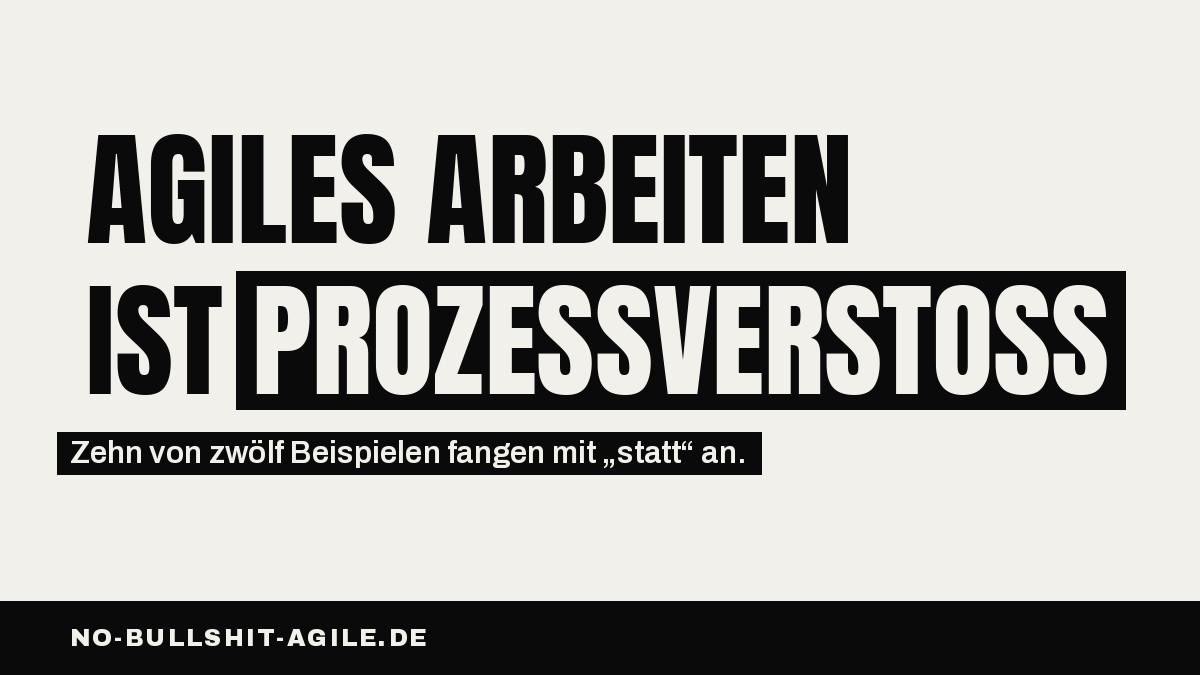
Ich habe für diesen Artikel zwölf Beispiele beschrieben, wie das Agile Manifest in der Praxis aussieht. Zehn davon fangen mit „statt" an.
Statt ein Ticket zu erstellen. Statt den Genehmigungsweg zu gehen. Statt sich auf den Vertrag zu berufen.
Das Manifest beschreibt keine Methode. Es beschreibt, was du tust, wenn du den Prozess umgehst. Deshalb kriegt der Dev, der direkt mit dem Kunden redet, Ärger statt Applaus.
Alle zwölf: https://no-bullshit-agile.de/was-bedeutet-das-agile-manifest-in-der-praxis.html?mtm_campaign=mastodon
#coding #systemsthinking #agile
Alt...
Plakat auf cremefarbenem Grund, schwarze Versalien: „Agiles Arbeiten ist Prozessverstoß", das Wort „Prozessverstoß" invertiert. Darunter: „Zehn von zwölf Beispielen fangen mit ‚statt' an."
![[?]](https://files.mastodon.online/accounts/avatars/110/662/852/345/682/042/original/142c7afdf9675462.png)
The Anatomy Of Domain-Driven Design - Booklet by Scott Millett and Samuel Knight is free with a Leanpub Reader membership! Or you can buy it for $7.99! https://leanpub.com/theanatomyofdomain-drivendesign #agile #computer_programming #software
![[?]](https://files.mastodon.social/accounts/avatars/109/250/638/099/296/776/original/fbe9860e481b600b.png)
What lies ahead for product leadership? Predicting the next five years requires us to bridge the gap between AI disruption and human-centric design. This survey captures our industry's collective pulse. Help shape the future of our craft: https://next-five-years.vercel.app/ #ProductMgmt #Agile
Dew Drop - August 10, 2026 (#4729)
Top Links
Multi-Language Support for Cross-Platform .NET (Sam Basu)
How to keep thinking (Sean Goedecke)
7 Powerful Ways to Automate PowerPoint Generation in C# (Arun Kumar Chandrakesan)
Implement BFF using Auth0, Angular and ASP.NET Core (Damien Bowden)
ZoomIt for Mac: How AI Po…
It is back to school, and I talk about how an early Bill Murray movie influenced my leadership.
https://www.edyouragilecoach.com/what-bill-murrays-meatballs-taught-me-about-agile-leadership/
🏴☠️ 🐻
Specialists matter.
But if every ticket has to wait for one specific person, the whole team becomes slower.
The bottleneck isn't the technology.
It's the dependency.
![[?]](https://media.newsbeep.org/accounts/avatars/114/866/803/315/323/827/original/767fe3e633c6f7f5.png)
Comprehension as an Architectural Characteristic: A System That Is Not Understood Cannot Evolve Safely
Key Takeaway…
#NewsBeep #News #Artsanddesign #Agile #Architecture #Architecture&Design #ArchitectureICSAET #ArtificialIntelligence #Arts #ArtsAndDesign #CodeReviews #Culture&Methods #Design #Development #Entertainment #EvolutionaryArchitecture #generativeai #InfoQCertificationProgram #Leadership #systemcomprehensionevolutionaryarchitecture #UK #UnitedKingdom
https://www.newsbeep.com/uk/733491/

![[?]](https://assets.chaos.social/accounts/avatars/109/267/833/214/524/450/original/1e19b2b6c09dc968.jpeg)
RE: https://chaos.social/@BarbNerdy/116924457509955278
Übrigens:
Nachdem ich 6 Monate in diesem Set-Up gearbeitet hatte, wurde die Probezeit nicht verlängert.
Die Firma hat jetzt einen perfekten 1-Jahresplan, genannt „ #Agile Road to Heaven“, der CTO hat seine Reputation verbessert und das Zusammenspiel zwischen Product und Engineering wurde durch #ddd Methoden verbessert.
Tja... Nu. Such ich halt wieder was Neues... aber erst mal: Heilung. Mental und körperlich.