Search results for tag #selfhosting
![[?]](https://snac.smithies.me.uk/justine/s/avatar-270304302821a87b50026a5768a00c56.png)
![[?]](https://files.mastodon.social/accounts/avatars/109/246/411/862/197/824/original/1586f1125b5f9786.jpg)
Good morning Fedi friends,
I have been feeling a rising anxiety over the state of the open web and the fediverse - after seeing efforts by politicians all over the world (in Europe too!) to introduce age verification laws for social media.
My way of coping?
Teaching people how to self-host their own Fediverse profile (using the superb #GoToSocial) via #YunoHost.
Chapter 1 in this series is available here:
![[?]](https://aseachange.com/fileserver/01ENCW3D083ATDAP5WGJEMSJC8/attachment/original/01JG469Y8X2DXVNGTWEZ8BPAGX.jpeg)
📣 New post 📝
"A newbie's guide to self-hosting: GoToSocial part 1 (installation and set-up)"
Basically a visual guide showing how to install #GoToSocial via #YunoHost and set it up with some basic security.
⏱️ From start to finish, it should take about 25-30 minutes.
It's my act of resistance against tech bros... I love the idea of teaching people how to self-host their own social media instance, connected to the fediverse ✌️❤️ 
Thank you @yunohost and @gotosocial for empowering us all!
#SelfHosting #Fediverse #newbie #MySoCalledSudoLife #blog #resist
![[?]](https://media.bsd.cafe/bsdmmedia01/accounts/avatars/116/268/246/190/462/981/original/62500699fca4854a.png)
"Twasn't me..."
"Well... it was teh case's fault!!!11!!!"
🤡
If you ever wanted a good reason to keep around your failed hard drives, scavenging screwed up logic boards is a good reason. Ha!
#Linux #RunBSD #SelfHosting #SelfHosted #Hardware #HDD

Alt...
Image of a HDD with the logic board removed and showing broken and bent interface pins.
![[?]](https://partychickens.net/system/accounts/avatars/114/497/877/473/966/497/original/20944529383fba51.jpg)
I saw a terrible message from DigitalOcean yesterday. I was helping a co-worker learn to do SASL authentication with Postfix, using Dovecot to do the heavy lifting, (second co-worker this week! Breaking people free from Google!) and we got to the point where we were ready to have him send out a test email - a reply to an email I'd just sent him that exercised all the moving parts of his inbound path.
But when he tried to send, he couldn't talk to my email server. I checked to make sure he wasn't being firewalled, but he didn't show up in my abuse listing. But then on poking around, it became clear he couldn't talk to ANY port 25 ANYWHERE. And I thought, "Oh, right, they've got that blocked. Le'ts find an article talking about how to unblock it." Not too uncommon. So I looked for their docs on unblocking 25.
Turns out, there's no automated way - not even a support ticket type for the purpose. You have to open a general request.
But man, they REALLY don't want you opening a general request! This is a masterpiece of Fear, Uncertainty, and Doubt:
https://www.digitalocean.com/community/tutorials/why-you-may-not-want-to-run-your-own-mail-server
Without meaning to, they've eloquently captured the essence of everything we're seeing with the destructive corporatization and centralization of online services. They say:
"In many ways, mail server stacks represent a collision between the tools and values of the early internet — self-hosting open source software using well-defined standards and interoperable protocols — and the reality of the modern internet — a few centralized, trusted authorities."
This, not to put too fine a point on it, is BAD FOR US.
We need *more* selfhosting. I was a customer of theirs for a few years, but I stopped after they had some catastrophe that prevented me from accessing my server console for more than a week. Their support was underwater and I didn't get any movement until I decided to publically name and shame them with details of the incident.
This kind of attitude should make anyone hesitant to sign up for services with DigitalOcean.
The amazing folks at @yunohost are running a fundraising campaign to cover their operating costs for 2026.
I personally make a monthly recurring donation to them but wish I could give more 🥲
If you use their services and you can afford it, please consider donating to their project. Every Euro / Dollar / Yen counts:
🔗 : https://yunohost.org/donate.en.html
#NotAllHeroesWearCapes #SelfHosting #empowerment #resist #YunoHost
![[?]](https://object.ceph-waw3.hswaw.net/mastodon-prod/accounts/avatars/109/360/274/978/913/890/original/30fe75c6bcdfe430.gif)

![[?]](https://media.bsd.cafe/bsdmmedia01/accounts/avatars/115/015/302/977/472/157/original/42ad1d8b0f4dbf22.png)
 [
[Pretty funny that the most often requested file from my small kitchen-server is "/robots.txt". Pretty surprising, since a lot of LLM-bots usually ignores this file 
The other requested files are just some js crap, which is obviously don't exist on my server — possibly some script-kiddies tried to find some entrypoint (see "config.js" and "env.js").
The funny part: the referrer URLs. Hope, the default content of NetBSD /etc/passwd from inside the sandbox was made someone happy 
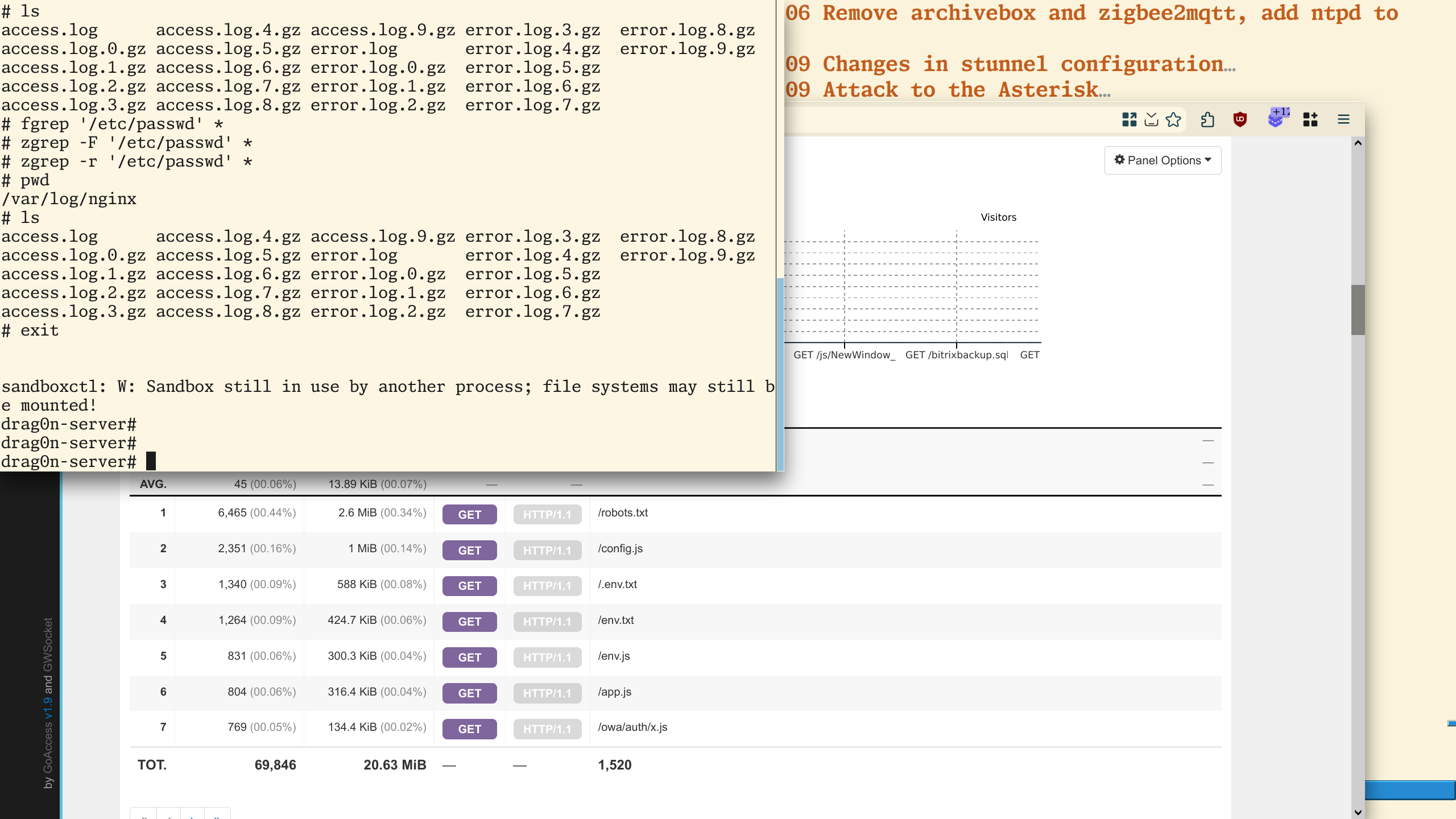
Alt...
A cwm with 3 windows. On the top window there is an xterm with ssh client connected to the my server. Inside the window there are some lines from /var/log/nginx/ from inside sandbox (mostly the list of files and gzipped files in this catalog). On the middle window there is a GoAccess web interface with list of most-requested static files from my server. There are: /robots.txt (2.6 MiB of traffic), /config.js (1 MiB), /.env.txt (588 KiB), /env.txt (300.3 KiB), /app.js (316.4 KiB), /owa/auth/x.js (134.4 KiB).
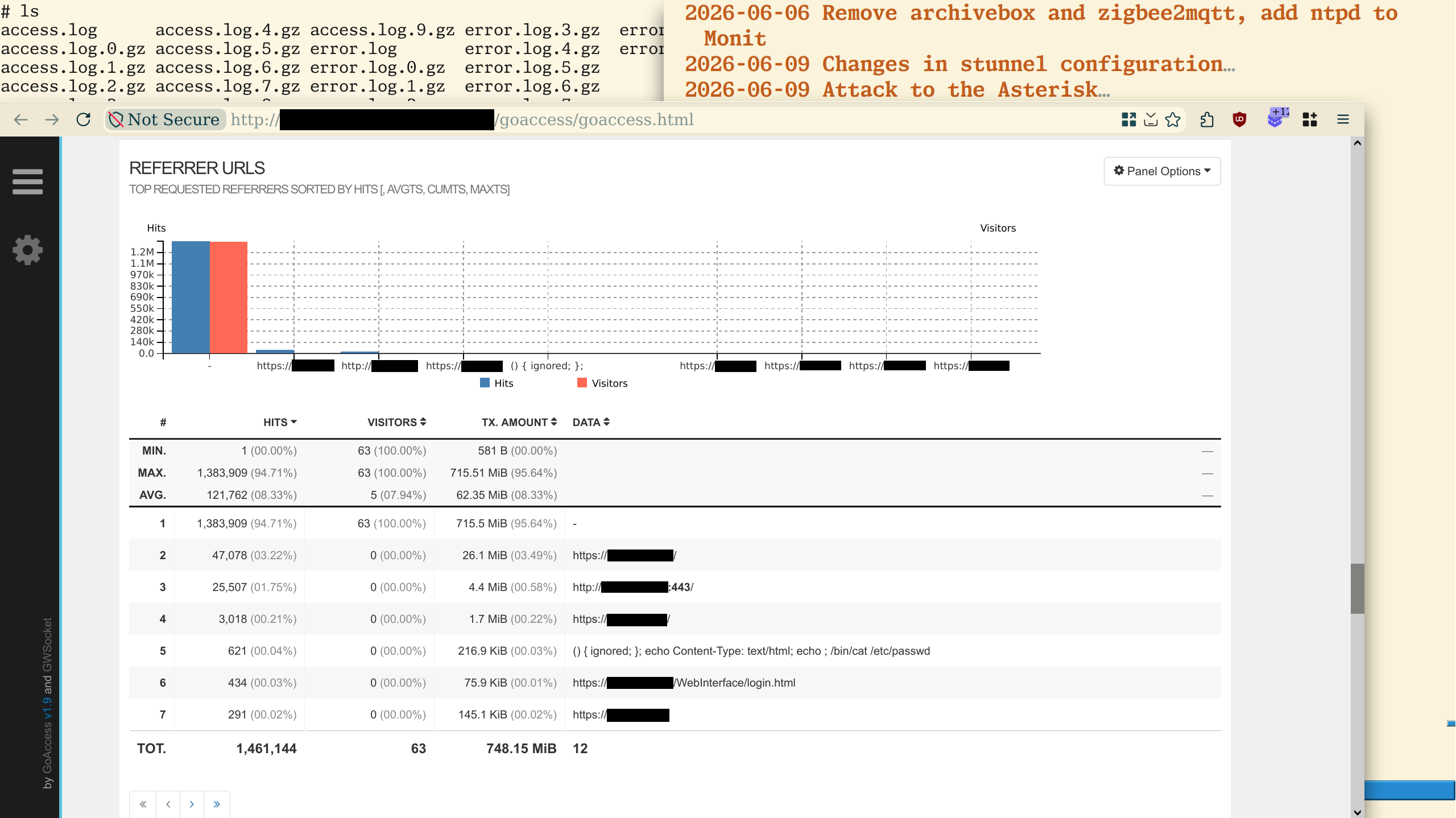
Alt...
The screenshot of cwm with a Librewolf window on top. It displays the GoAccess web interface with a list of referrer URLs, from requests to my server. There are: https://MyIP/ (47078 hits), http://MyIP:443/ (25507 hits), https://MyIP (3018 hits), () { ignored; }; echo Content-Type: text/html; echo ; /bin/cat /etc/passwd (621 hits), https://MyIP/WebInterface/login.html (434 hits) and https://myhostname (291 hits). On the two other windows on the bottom there are: xterm window with ssh client connected to my server and an Emacs frame with log of actions made with server.
European institutions seem to be all in when it comes to introducing age verification mandates for citizens in member states: https://digital-strategy.ec.europa.eu/en/library/commission-sets-out-common-approach-eu-wide-age-verification-technologies
I now have daily anxiety thinking about the future of the fediverse.
So how do I channel this fear and turn it into something constructive? I'm going back to writing #selfhosting guides for newbies.
It's a great distraction, which gives me a bit of hope. Especially the next guide, which will cover my favorite fediverse software - #GoToSocial (which is powering this instance) - and how to install and configure it. Your own little home on the fediverse! Lightweight and features-packed.
Surely something like this would fall outside the scope of regulation. Right? Right?
#MySoCalledSudoLife #YunoHost #VPS #AgeVerification #privacy #EUBigTech
![[?]](https://social.veltens.org/system/accounts/avatars/109/275/232/097/758/579/original/3cad263c75471a8f.png)
Doing a mastodon *minor* update is still a mess in 2026 requiring manual steps to trigger db migrations pre and post update. And that's using docker. Without containerization its even more steps to do. Just in case anybody is still wondering why people do not "just self-host"...
![[?]](https://media.mementomori.social/accounts/avatars/109/293/050/593/156/468/original/149d4fe6c4f85509.png)
What many people misunderstand about hosting your own content (like this social media instance) is thinking we somehow NEED a big audience or Big Tech involvement.
I'm perfectly fine if the world faded away and it was just the thousand of us here. It's like the early days of the web when we had small forums, nobody missed Reddit back then. Federation is a big plus, not a requirement.
It's the same with websites or IRC for me. I know people use Discord, but I still stick to IRC even if there are only about a hundred of us left. I know people use AI now and website visitors are dropping, but who cares? I still keep doing it for those who like to read.
I don't need the whole world involved for this to feel worthwhile. It's mine, I own it, and I host it for as long as I breathe. After that, it won't matter to me anymore, but I hope other admins keep things running the way I did.
#SelfHosted #SelfHosting #OpenSource #Fediverse #Mastodon #OpenWeb #SocialWeb
![[?]](https://cdn.fosstodon.org/accounts/avatars/000/186/507/original/d6235003bb2d678e.jpg)

RE: https://mastodon.bsd.cafe/@subnetspider/116758330967344651
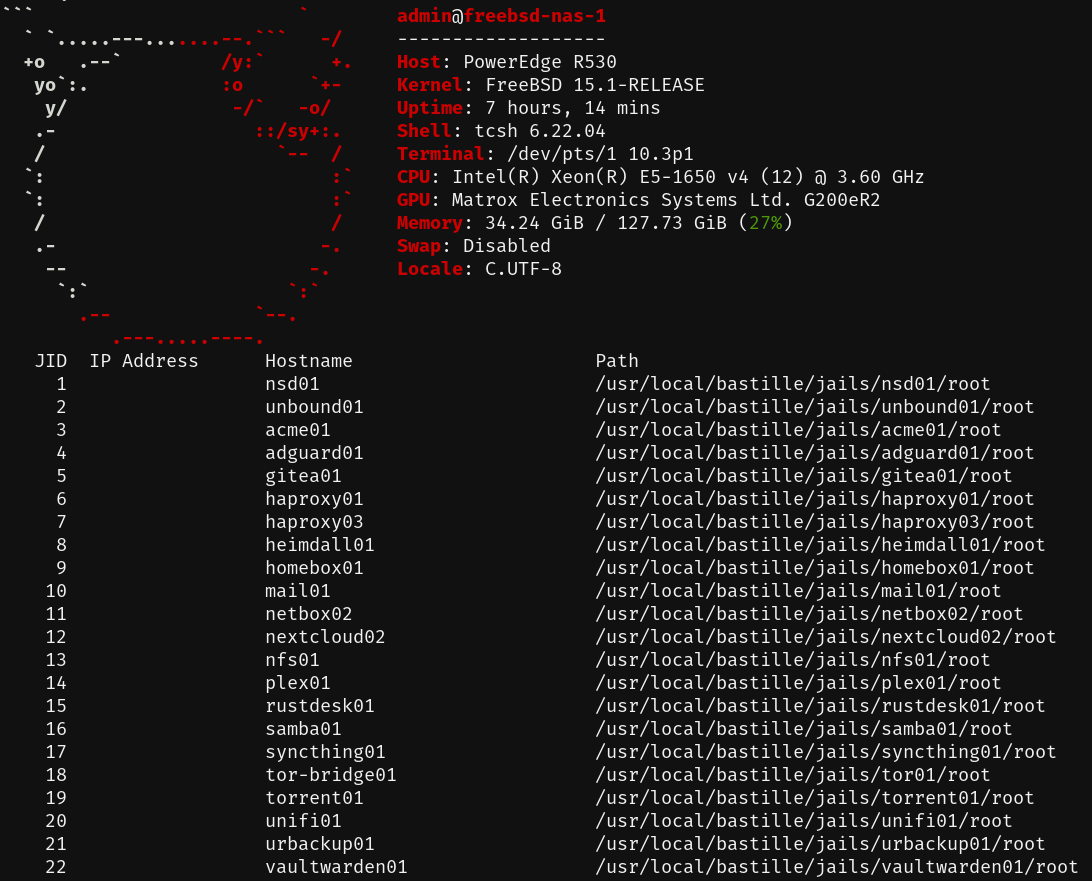
Bastille makes a great self-hosting platform! Look at this absolute list of self-hosted software ⬇️
nsd, unbound, acme, adguard, gitea, haproxy, homebox, mail, netbox, nextcloud, plex, rustdesk, samba, syncthing, tor, unifi, vaultwarden, and more on one box.
#FreeBSD #BastilleBSD #selfhosted #selfhosting
![[?]](https://media.bsd.cafe/bsdmmedia01/accounts/avatars/112/333/060/238/284/470/original/1c072481f6f94ff9.png)
![[?]](https://schmonz.com/snac/schmonz/s/506a4e5be3c4eba4d0539c833aea957a.jpg)
:; jq -r '.id' < $(ag -l 'six thirty twelve meters' ~/sites/schmonz.com/snac/data/user/schmonz/public)
https://schmonz.com/snac/schmonz/p/1743383179.235112
Let's see how this setup pans out: https://schmonz.com/2025/04/15/sensible-basic-minecraft-hosting/