Search results for tag #NetBSD
![[?]](https://media.bsd.network/accounts/avatars/000/006/949/original/9592eac6e5018e39.png)
 boosted
![[?]](https://todon.eu/system/accounts/avatars/108/195/195/683/530/949/original/8174cd7215c979ba.png)
Love booting to a Free/Libre operating system entirely made by humans. #NetBSD 😊 ❤️
#NoAI
Alt...
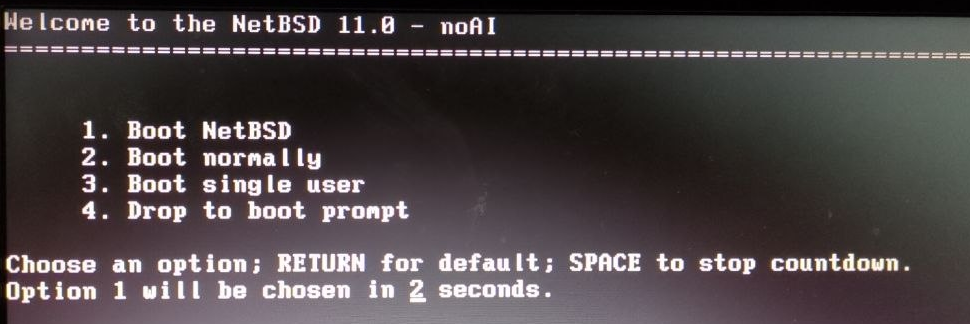
Boot screen from NetBSD 11 "customized" with the message "Welcome to the NetBSD 11.0 - noAI"
Below the different boot options options:
1. Boot NetBSD
2. Boot normally
3. Boot single user
4. Drop to boot prompt
![[?]](https://media.nerdculture.de/accounts/avatars/109/274/692/598/892/436/original/768e4668071143b1.png)
@mason Same here. #Debian is my OS since the 90s and now and then I used #FreeBSD, too. The Debian AI decision really annoys me and I would switch to #FreeBSD if I could be sure that their current policy will not change. From this point of view, #NetBSD would be the obvious choice. But I am not sure if NetBSD really can handle my needs (Data Science with Python, Polars, Jupyter, some proprietary software like Omnissa Horizon which I need for work etc...).
boosted![[?]](https://zia.io/media/73f8b57df59d9e60491c2f17dda35f7da87b0cb509ccf119ffe3a70d89251985.jpg)
@grahamperrin Multiplayer Mario Kart is awesome! There’s also this nifty game called #NetBSD that lets you start a game and let it run for as long as you want, and you can even configure it to let you connect to it over the Internet.
The last time I saw a Wii console in a Goodwill (in the Untied States), it was listed as $20, if that helps give you a smidge of an idea.
![[?]](https://cdn.fosstodon.org/accounts/avatars/109/860/465/494/023/450/original/eb2faa9c8053bd7a.jpg)
Day 5
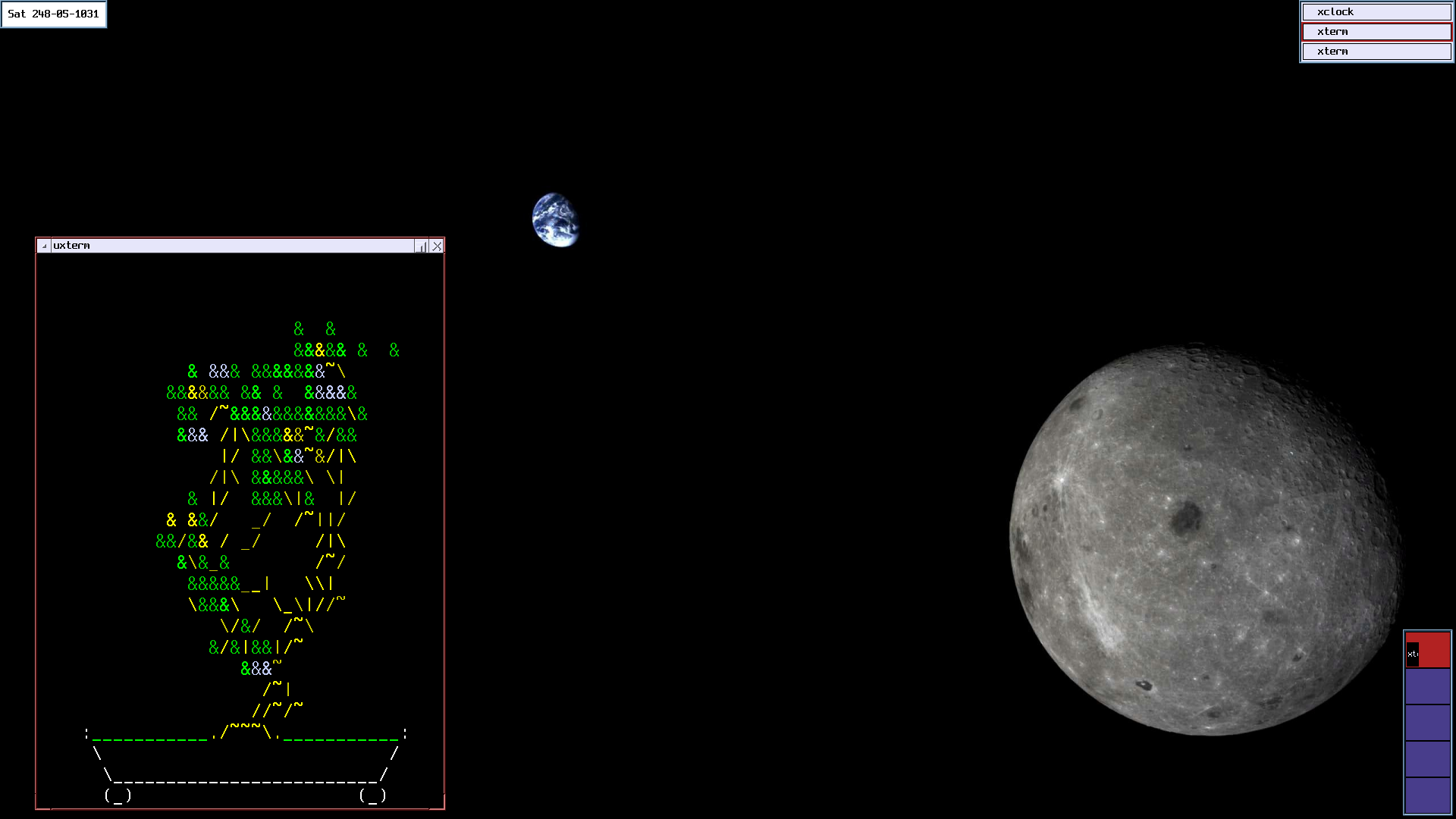
Today is a first look at the 'ctwm' window manager which, along with X11, are included in the base system of NetBSD (if you chose the X sets during install).
#ctwm #X11 #40DaysOfNetBSD #NetBSD #RunBSD
Alt...
Screenshot of the ctwm window manager, with the Earth and Moon as background image, and cbonsai, xclock, app list, and desktop pager running in the foreground.
![[?]](https://masto.bike/system/accounts/avatars/109/298/328/498/155/315/original/70dbdf0cef9f4ef2.png)
iocaine configured!
we have:
netbsd - caddy - iocaine
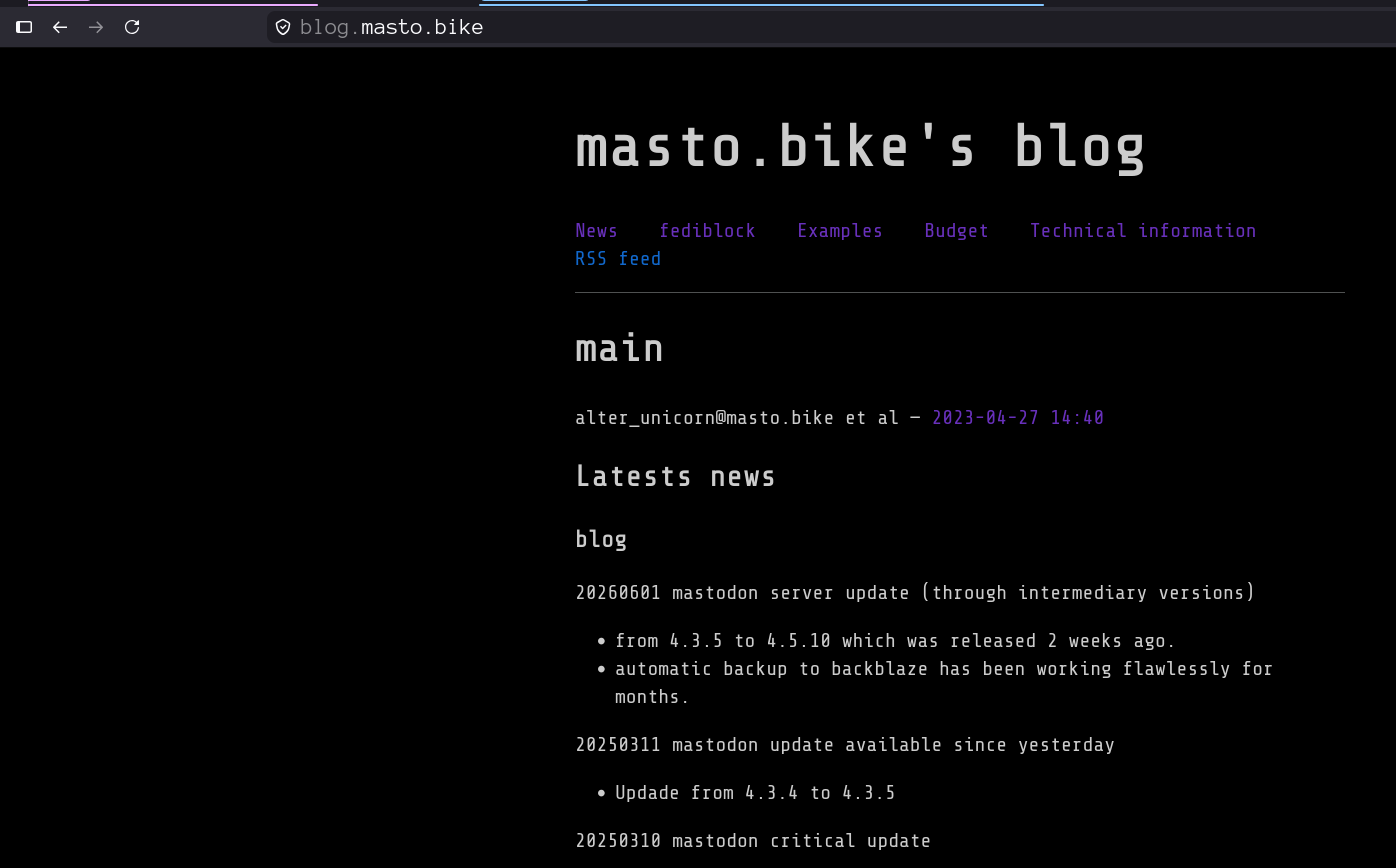
if you check https://blog.masto.bike, you should see a regular site.
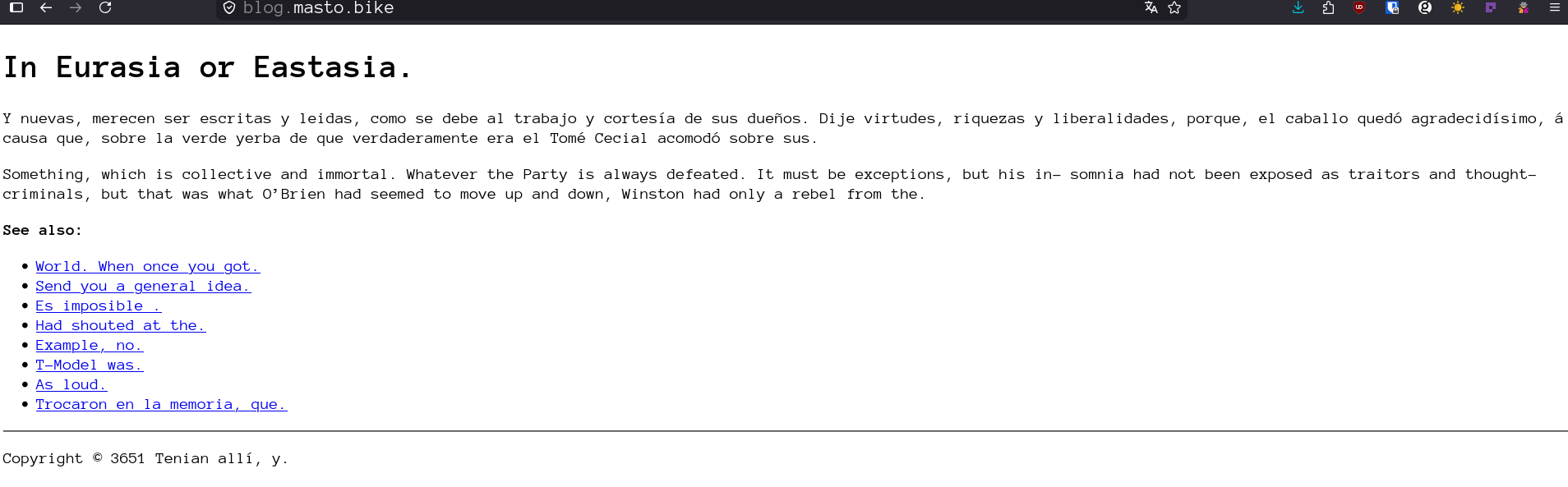
if you install a User-Agent spoofer'[1] and use something like "Perplexity" or "ClaudeBot" you will see absolute gibberish and multi-lingual nonsense.
It is amazing.
[1]https://webextension.org/listing/useragent-switcher.html
Alt...
a screenshot of the blog with a "Latest news" section written by a human
Alt...
the same blog, but seen as a slop-bot would see it.
It's random but structured text with a few hyperlinks to more garbage.
text is in english and old spanish.
![[?]](https://snac.smithies.me.uk/justine/s/avatar-270304302821a87b50026a5768a00c56.png)
Am I missing out on anything here ?
 boosted
YES!
iocaine is running.
TODO:
- configure caddy and iocaine (I McGyvered it to run a few tests)
- share the link to the blog
- enjoy messing with the chatbot©
big shootout to @jaypatelani for pointing me to https://pkgsrc.se where I found the code that will end up working.
![[?]](https://media.bsd.cafe/bsdmmedia01/accounts/avatars/110/740/169/477/916/693/original/dfa8f1b9beefa405.png)
Next Saturday at #EuroBSDCon 2026, I'll tell the story of one of the longest nights of my career.
On 10 March 2021, I had just fallen asleep when the alerts started arriving. One server down. Then another. And another.
Different servers, different workloads, one thing in common: the OVHcloud Strasbourg data centre.
Then came the news: SBG2 was on fire.
I had 142 servers there.
The mission for the night was simple to state: bring the critical services back before 8, then recover everything else as quickly as possible.
This talk is about what happened next. The things that worked, the architectural choices that saved us, and especially the ones that failed when we needed them most.
And it's also the story of why that night changed the way I design infrastructure, and why BSD systems became such an important part of it.
The night 142 of my servers went up in the clouds. Physically.
📅 Saturday 12 September, 11:15
📍 EuroBSDCon 2026, D.0.02
#BSD #FreeBSD #EuroBSDCon #Sysadmin #Infrastructure #RunBSD #NetBSD #OwnYourData #Linux #DisasterRecovery
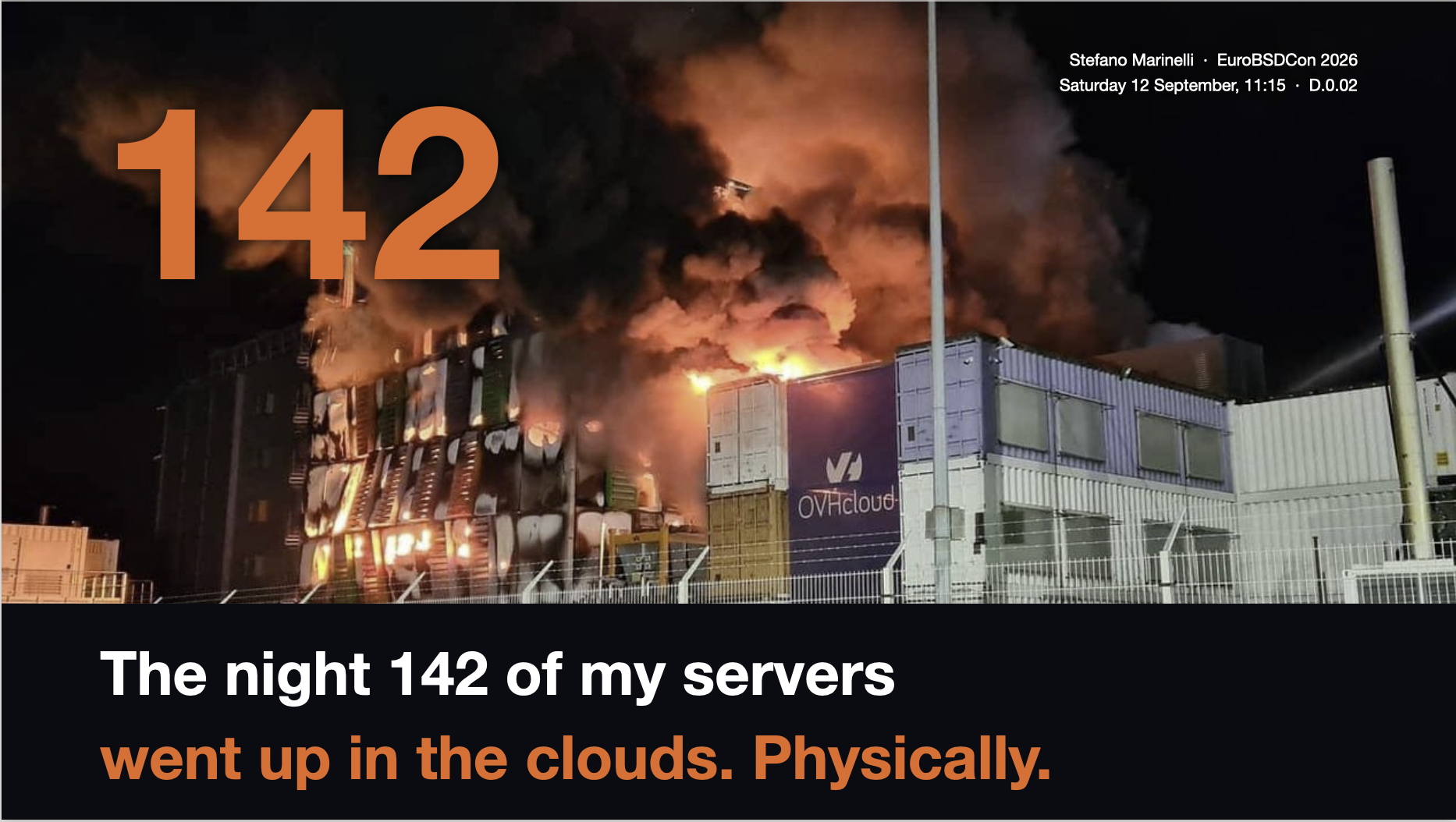
Alt...
Cover slide for Stefano Marinelli’s EuroBSDCon 2026 presentation. A nighttime photo shows the OVHcloud Strasbourg data centre engulfed in flames and thick smoke. A huge orange "142" overlays the fire. Below, on a black background, the title reads: "The night 142 of my servers went up in the clouds. Physically."
In the top-right corner: "Stefano Marinelli · EuroBSDCon 2026 · Saturday 12 September, 11:15 · D.0.02."
![[?]](https://files.mastodonapp.uk/accounts/avatars/109/508/813/126/393/770/original/98a69cbbce7ad298.png)
#NetBSD on a #RaspberryPi is how the world can see my WWW/GOPHER/FTP sites and resolve my domain names. Up times in the 100s of days, mainly so short because I've had to physically un-plug and move things.
It was going to be #OpenBSD, but the OpenBSD installer has a bug whereby its writers never thought that someone would be installing to another partition on the same storage device as the installer itself.
NetBSD's installer wasn't happy, but I could use a slightly different route through it and actually get the operating installed without the installer committing suicide as OpenBSD's did. (It wiped the whole target disc, and wiped itself out doing so.)
I have yet to set up the Pi that I bought for FreeBSD. Life has intervened.
![[?]](https://cyberpunklol.files.fedi.monster/accounts/avatars/117/024/347/319/605/995/original/cc6c4d011463faf5.png)
On my #NetBSD desktop I ran a build of stockfish from the pkgsrc collection and managed to get berserk to build only after dropping some optimization stuff. One on one CuteChess #chess engine match against stockfish...berserk wins this one handily. Ouch.
Score of berserk vs Stockfish: 10 - 1 - 5 [0.781]
... berserk playing White: 6 - 1 - 1 [0.813] 8
... berserk playing Black: 4 - 0 - 4 [0.750] 8
... White vs Black: 6 - 5 - 5 [0.531] 16
Elo difference: 221.1 +/- 178.0, LOS: 99.7 %, DrawRatio: 31.3 %
SPRT: llr 0 (0.0%), lbound -inf, ubound inf
16 of 16 games finished.
Player: berserk
"Draw by 3-fold repetition": 1
"Draw by fifty moves rule": 3
"Draw by insufficient mating material": 1
"Loss: White makes an illegal move: g1f3": 1
"Win: Black mates": 4
"Win: White mates": 6
Player: Stockfish
"Draw by 3-fold repetition": 1
"Draw by fifty moves rule": 3
"Draw by insufficient mating material": 1
"Loss: Black mates": 4
"Loss: White mates": 6
"Win: White makes an illegal move: g1f3": 1
![[?]](https://pxscdn.com/cache/avatars/577318934691438136/avatar_ijyhj4.jpg)
![A screenshot of a 1920x1080 netbsd ctwm desktop with a bi-color (black and deep blue) bitmap of the USS Discovery as the wallpaper, the ctwm window list on the top right, a NetBSD logo in an image viewer on the right towards the bottom, and a virtual desktop picker on the bottom right.
Along the bottom from left to right is an xload window, an xterm showing the current system load, xeyes, and stalonetray showing the icon for DeskView.
Towards the right is a small surf web browser window showing the syncthing status page. On the top left is a gkrellm window, and to the right of that is a terminal window showing the output of neofetch, with the following informative text:
OS: NetBSD 11.0_RC7 amd64
Uptime: 4 hours, 2 mins
Packages: 455 (pkg_info)
Shell: bash 5.3.15
Resolution: 1920x1080
WM: ctwm
Theme: Adwaita [GTK3]
Icons: Adwaita [GTK3]
Terminal: alacritty
CPU: Intel 686-class (4)
GPU: Mesa DRI Intel(R) UHD Graphics 620 (KBL GT2)
Memory: 4264MiB / 16281MiB](https://pixelfed.social/storage/m/_v2/577318934691438136/f0975049d-79c41a/qS9B4p5mVwXL/76VGNOcMTNhFtnqp375sjemYAKuBrTgR3bfq16t3.png "A screenshot of a 1920x1080 netbsd ctwm desktop with a bi-color (black and deep blue) bitmap of the USS Discovery as the wallpaper, the ctwm window list on the top right, a NetBSD logo in an image viewer on the right towards the bottom, and a virtual desktop picker on the bottom right.
Along the bottom from left to right is an xload window, an xterm showing the current system load, xeyes, and stalonetray showing the icon for DeskView.
Towards the right is a small surf web browser window showing the syncthing status page. On the top left is a gkrellm window, and to the right of that is a terminal window showing the output of neofetch, with the following informative text:
OS: NetBSD 11.0_RC7 amd64
Uptime: 4 hours, 2 mins
Packages: 455 (pkg_info)
Shell: bash 5.3.15
Resolution: 1920x1080
WM: ctwm
Theme: Adwaita [GTK3]
Icons: Adwaita [GTK3]
Terminal: alacritty
CPU: Intel 686-class (4)
GPU: Mesa DRI Intel(R) UHD Graphics 620 (KBL GT2)
Memory: 4264MiB / 16281MiB")
Alt...
A screenshot of a 1920x1080 netbsd ctwm desktop with a bi-color (black and deep blue) bitmap of the USS Discovery as the wallpaper, the ctwm window list on the top right, a NetBSD logo in an image viewer on the right towards the bottom, and a virtual desktop picker on the bottom right.
Along the bottom from left to right is an xload window, an xterm showing the current system load, xeyes, and stalonetray showing the icon for DeskView.
Towards the right is a small surf web browser window showing the syncthing status page. On the top left is a gkrellm window, and to the right of that is a terminal window showing the output of neofetch, with the following informative text:
OS: NetBSD 11.0_RC7 amd64
Uptime: 4 hours, 2 mins
Packages: 455 (pkg_info)
Shell: bash 5.3.15
Resolution: 1920x1080
WM: ctwm
Theme: Adwaita [GTK3]
Icons: Adwaita [GTK3]
Terminal: alacritty
CPU: Intel 686-class (4)
GPU: Mesa DRI Intel(R) UHD Graphics 620 (KBL GT2)
Memory: 4264MiB / 16281MiB
![[?]](https://partychickens.net/system/accounts/avatars/114/497/877/473/966/497/original/20944529383fba51.jpg)
Wedges are a new thing since I last used NetBSD, and clearly they're going to be involved, as I'm going to want/need GPT partitioning, since hardware nowadays tends to use UEFI.
This talks about some of the commands used:
https://wiki.netbsd.org/users/mlelstv/using-large-disks/
And some man pages:
https://man.netbsd.org/dk.4
https://man.netbsd.org/dkctl.8
I'm leaning more towards *not* using a ramdisk which will never be released and instead trading some disk space to do the same thing. I haven't gotten to a proof of concept yet, but I'm hoping to get there this weekend if I can.
![[?]](https://polymaths.social/fileserver/01HCMX6M1CZNEVJ4F5H58TT5XJ/attachment/original/01JHC5KM5K0V0J0436SPD3F86H.jpeg)


 🍵
🍵  [
[More #NetBSD thoughts:
I'm an #i3wm / #sway or #KDE #Plasma guy. I tried #OpenBSD's default wm for about a minute, but it was just too jarring for me. I also used #cwm for a while, and it's actually nicely configurable, but I eventually reverted to i3 on OpenBSD. I haven't tried Sway yet, but #Wayland's supposedly working in "Fish Linux" now. ;)
But #ctwm? Look, it's pretty ancient, and it's not a totally perfect fit for my worfklow, but I'm actually kinda diggin' it!
It's also probably the most attractive default GUI of any of the BSDs, considering that obsd gives you a pretty loud bright red or bright blue titlebar motif-looking thing (not knocking motif, just the primary color choice), and #FreeBSD gives you (checks notes) no GUI by default. XD
ctwm isn't quite as flexible as i3/sway, but it's just configurable enough to keep me coming back and tinkering away at it. The way the warpring function (alt+tab, in other words) works is pretty obtuse (only moving forward or backward in the window list, never re-ordering based on recency), but once I learned how to exclude windows (X11 classes or window titles) from the warpring, it became a ton more usable.
I also figured out how to enable active titlebar highlight (it drives me nuts when that's disabled or very subtle, how do you even not understand that basic tenet of usability?) and even how to assign an xpm image to the titlebar so it looks pretty.
Fun stuff!
I should post another screenshot. ;)
boostednow I REALLY need to make iocaine work.
it's so effing frustrating.
anyone has a working iocaine build on NetBSD?
(if I launch it with strace it works, otherwise I get and error 13, I understand why, but can't figure out how to make it work)
 boosted
hice un archivo rc minimalista para caddy, que por ahora no viene incluido en paquete NetBSD:
/etc/rc.d/caddy start, stop y reload funcionan.
no hay victorias demasiado pequeñas.
edit: archivo rc
Woof, even with #NetBSD, using a laptop with a "spinning rust" boot disk is not fun when it first boots. Sysload is up past 9 (2.25 per core) and it's taking a long time to even launch rofi.
I'm sure #syncthing is probably saturating i/o XD
But after a few minutes, you barely even notice that it's not an SSD. Pretty sweet, actually.
Day 4
After the first boot of my NetBSD installation, these are some extra steps I like to make right away to get a system off to a good start!
boosted![[?]](https://mastodon.sdf.org/system/accounts/avatars/114/955/123/294/148/566/original/35a0500e08209819.jpeg)
I'm working on my NetBSD VM for 2 hours using CTWM. I switched to Linux host with cinnamon and I'm moving mouse to change the focus. I love it!
I have been working on my NetBSD VM for over 2 hours using CTWM. I switched to a Linux host with cinnamon and moved the mouse to focus on another window. I love it!
![[?]](https://retro.social/system/accounts/avatars/111/425/704/166/690/977/original/8c891787d07cb8cb.png)
![[?]](https://mastodon.sdf.org/system/accounts/avatars/000/005/463/original/a54b1acc2e3ae4b1.jpg)
You know what? It's 2pm on a Friday afternoon. Time to kick start the weekend!
Let me open my little #NetBSD machine and start making and learning things. 
![[?]](https://federate.me.uk/system/accounts/avatars/109/309/886/224/077/101/original/5413a04479190d6c.jpg)
While I am a firm believer in using all available tools to improve the software I work on, I do really like that NetBSD's firm and unequivocal anti-LLM stance is proving popular, and helping it to gain traction.
To all the new users I'm seeing over the past few weeks, welcome! Hope we can help you get up and running.
![[?]](https://media.bsd.cafe/bsdmmedia01/accounts/avatars/116/268/246/190/462/981/original/62500699fca4854a.png)
![[?]](https://media.bsd.network/accounts/avatars/000/096/085/original/ea9722a642a50ab6.png)
All of this renewed interest in #NetBSD that I'm seeing has also spurred me to action! I'm inspired again to write docs, produce videos, port software, and do many other projects that had never reached past the planning stage. Stay tuned
I am still sticking with #NetBSD despite the restricted graphics, only 1920×1080 on a 3440×1440 monitor with the framebuffer driver. Honestly for the tinkering I am preferring to do on #BSD rather than Linux, the reduced resolution is not very important. But I have had a build (of konqueror going for more than a solid day now)
![[?]](https://media.bsd.cafe/bsdmmedia01/accounts/avatars/116/916/392/971/982/972/original/7d940acb1047b6c5.png)