Search results for tag #NetBSD
![[?]](https://assets.oldbytes.space/assets.oldbytes.space/accounts/avatars/110/420/529/306/906/445/original/355236cce12249af.png)
So I'm starting the task of getting familiar with #NetBSD, on the assumption that it's likely to be among the last refuges of people who reject slop. (#HaikuOS is another option, and recently reached beta 6.)
I'm attempting an install of NetBSD 11.0 on my Thinkpad T41, but seconds into the boot sequence, the laptop screen drops to its lowest brightness level and can't be adjusted while the NetBSD installer is running. The installation instructions are almost impossible to read.
Any idea what's going on there?
![[?]](https://mastodon.sdf.org/system/accounts/avatars/000/005/463/original/a54b1acc2e3ae4b1.jpg)
The tragedy of #Debian accepting AI 'contributions' is that, most of the time, you are accepting stuff that:
a) is someone else's code, with all the potential legal issues (hence #NetBSD stance on it)
b) is of a very dubious quality, since it went through an AI blender
Just remember: an 'AI' does not exist and has no concept of code, quality and correctness -- I feel like we will soon see the first CVE with a CVSS 9.99 score in AI supplied slop vile coding due to this.
Funnily enough, I was never really into #Debian ... I appreciate the quality of the distro, but... I don't know, too many moving parts, I guess.
I will continue supporting #Slackware I'll look into #Guix and, of course, #OpenBSD and #NetBSD as well as #HardenedBSD .
The line is drawn. It is time to choose your side.
![[?]](https://mastodon.sdf.org/system/accounts/avatars/109/331/226/121/432/740/original/932e706977e06d66.png)

![[?]](https://media.bsd.cafe/bsdmmedia01/accounts/avatars/110/740/169/477/916/693/original/dfa8f1b9beefa405.png)
As of today, I believe NetBSD is one of the most important operating systems to consider for your deployments.
With hardware costs rising dramatically, portability and efficiency have become more important than ever. If prices do not come down, we will probably have to adapt and create new kinds of hardware, at lower cost. And NetBSD, by its very nature, will be very easy to port to that hardware.
Does it run on your modern PC? Maybe. Maybe not.
But it runs on your server. On your VPS. On your SBC. On your old computer, which may still have a lot to give, especially if you want to keep ownership of your own data.
And I know something about old hardware still having a lot to give:
https://it-notes.dragas.net/2023/08/27/that-old-netbsd-server-running-since-2010/
No jails or containerisation? smolBSD has already shown that a reduced NetBSD kernel can be so small that it can be started in milliseconds, while also adding the security benefits of virtualisation. A different concept, certainly. But one that already exists and can already be used.
Linux itself has opened up to AI. That is a choice I will not comment on.
But from now on, for those who do not want LLM-generated code in their operating system, there are essentially two options: fork Linux (!!!), or choose something different.
And NetBSD is that something different.
Already in 2024:
“...code generated by a large language model or similar technology (e.g. ChatGPT, GitHub Copilot) is presumed to be tainted (i.e. of unclear copyright, not fitting NetBSD's licensing goals) and cannot be committed to NetBSD.”
#NetBSD #RunBSD #smolBSD #IT #SysAdmin #OwnYourData #ModernTech
![[?]](https://rpi0w.stefanomarinelli.it/media/e7ed6ce8-3995-439e-8168-674a22629598/image.jpg)
...let's lower the barriers even further!
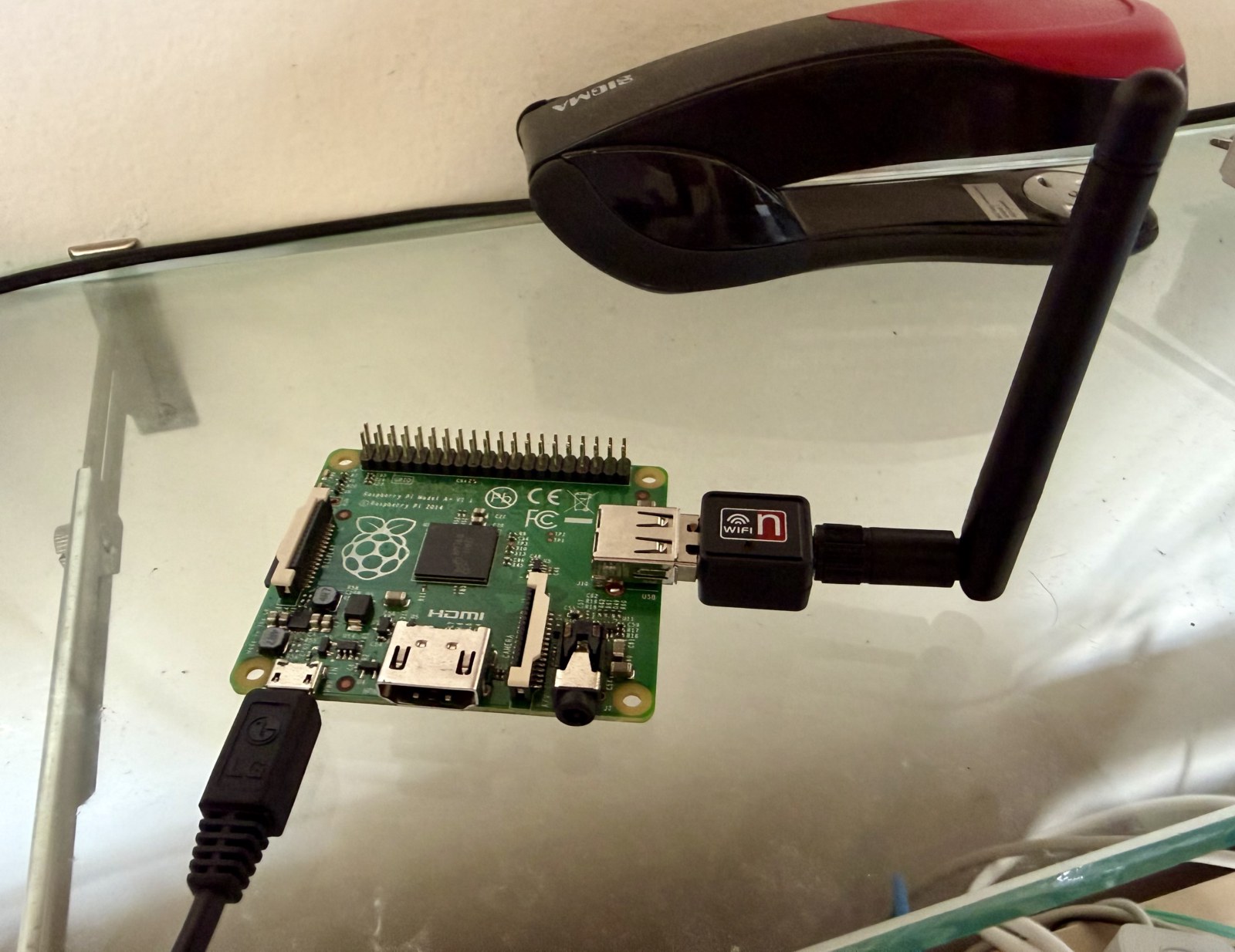
Now this instance is running on a Raspberry Pi A+ (1 core @ 700 MHz, 256MB RAM), so even less than the Raspberry Pi Zero W it was running on before.
On NetBSD, of course!
#littleFedi #NetBSD #RunBSD #OwnYourData #Decentralization #OwnYourVoice
Alt...
The Raspberry PI A+ that is currently powering this instance.
...let's lower the barriers even further!
Now this instance is running on a Raspberry Pi A+ (1 core @ 700 MHz, 256MB RAM), so even less than the Raspberry Pi Zero W it was running on before.
On NetBSD, of course!
#littleFedi #NetBSD #RunBSD #OwnYourData #Decentralization #OwnYourVoice
![[?]](https://sok.egois.org/fileserver/01CSWPCN0VH4EPVZ79WGNWY3V6/attachment/original/01KW8QY63CC0D6K0CGGNRG8CX9.png)
![[?]](https://d35e9bfo1msux2.cloudfront.net/accounts/avatars/109/535/770/898/980/239/original/fe47a9c6a062442b.png)
Right. I've done the same. I've been more forthright than the #pkgsrc people.
The #xmlto in #slashpackage here removes 'type' completely, gets rid of all of the other #Bashisms that I can find, uses sh as the interpreter, and in a modicum of testing (re-building the nosh manual set) works with dash on #Debian and the #FreeBSD and #NetBSD Almquist shells.
It also defaults the wwwbrowser configuration setting to www-browser (as used in Debian's alternatives system).
https://github.com/jdebp/slashpackage/tree/trunk/textutils/xmlto-0.0.29
![[?]](https://cyberpunklol.files.fedi.monster/accounts/avatars/117/024/347/319/605/995/original/cc6c4d011463faf5.png)
 boosted
![[?]](https://indiepocalypse.files.fedi.monster/accounts/avatars/117/102/576/716/677/162/original/cea2ad95dd7a18df.png)
Upstream wasn't experienced/use NetBSD enough to want to merge it (fair), so pushed my fork of susmb (a FUSE implementation of SMB v3) for NetBSD support to Codeberg here: https://codeberg.org/gourd753/susmb-netbsd
If I can hammer out one remaining issue (the PERFUSE_BUFSIZE environment variable needing to be an arbitrary size for large file transfers to work) I'll see about trying to get a netbsd package for it but atm it's too finicky for me to feel comfortable with that.
![[?]](https://static.chinwag.net.au/accounts/avatars/000/000/001/original/b02e2e0cd4f0ffe5.jpg)
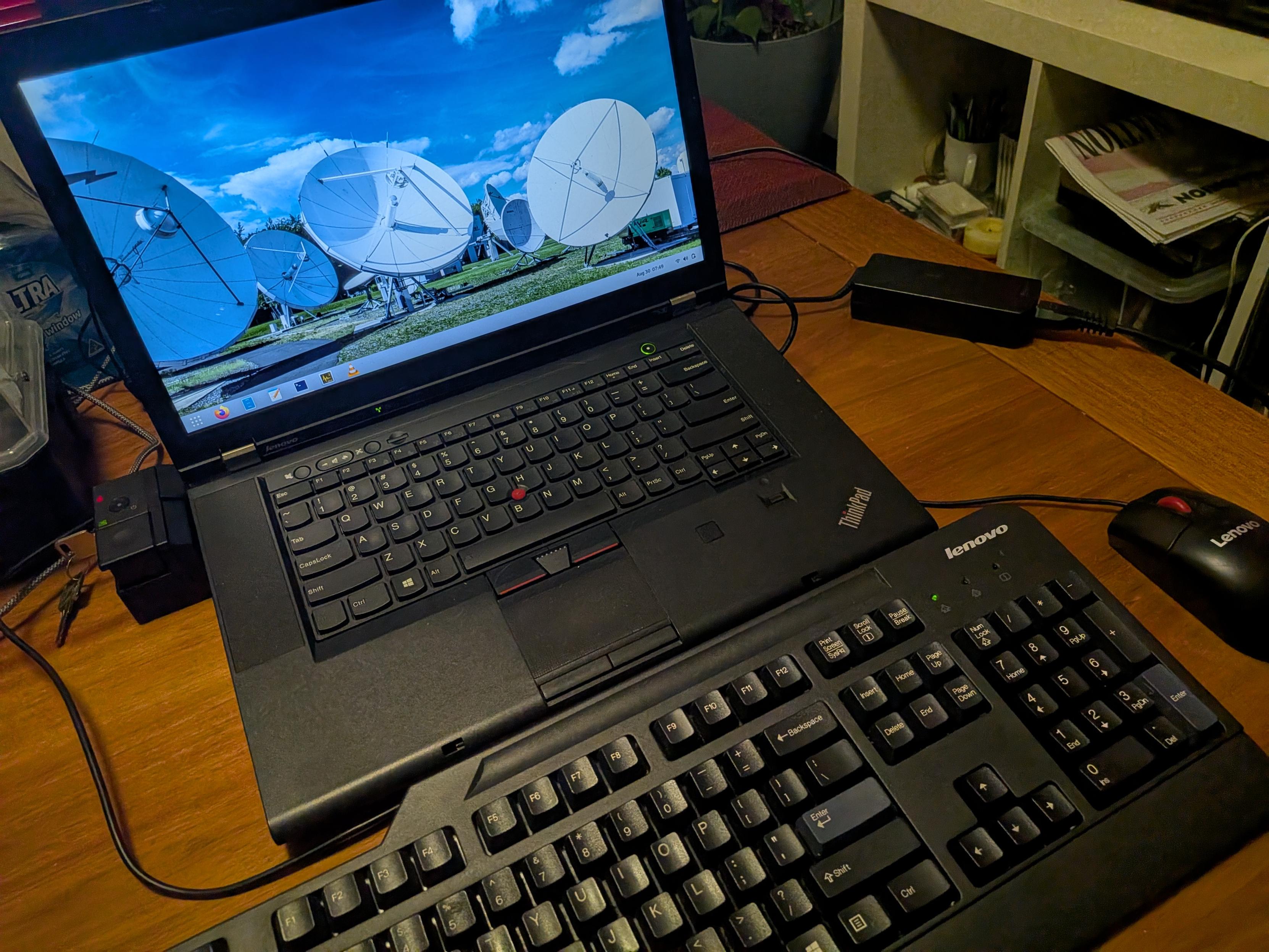
Most of this setup has been progressively pulled out of ewaste piles over a period of several years and I think it's finally time for it to run NetBSD and fulfil its true destiny.
Is a computer from 2012 actually "retro"? Well ... it will be when I'm done with it.
#retrocomputing #thinkpad #NetBSD
Alt...
A ThinkPad T530 at a gnome desktop attached to a dock with a key lock on the side, and a Lenovo keyboard and mouse set in front
The #xmlto people did actually try to remove the #Bashisms themselves, over a decade ago. But they left it still auto-configuring to pick bash instead of changing that as well. Which is what it does if one builds from vanilla source today.
https://pagure.io/xmlto/issue/3/
Then, 10 years later, the change happened that put the bashism back in that creates the #NetBSD noise, perhaps because they did not go the whole way and make it a /bin/sh script, which would have highlighted that.
Found it. pkgsrc is explicitly setting the XMLTO_BASH_PATH environment variable (amusingly, entirely ignoring the strong hint in the variable name) before running configure . I was looking for a patch; but this isn't being done with a patch.
Since I've patched out all of the type -p and type uses (sometimes being used in wildly overcomplex ways) and replaced them with command -v, I wonder whether I can do the same.
I added #xmlto to my #slashpackage tree because I wanted to patch out the 'type -p' thing that causes a complaint on #NetBSD every time the tool is run.
Oddly, building from vanilla source makes it a bash script, as (from reading the Fedora issues list) the authors actually intend. It isn't supposed to be a POSIX sh script. bash has type -p .
Yet the installed-from-package xmlto on NetBSD has /bin/sh as the interpreter, hence the complaint about the #Bashisms.
I wonder what's going on.
![[?]](https://polymaths.social/fileserver/01HCMX6M1CZNEVJ4F5H58TT5XJ/attachment/original/01JHC5KM5K0V0J0436SPD3F86H.jpeg)


 🍵
🍵  [
[Any idea how to create a keybind for super+. (period)?
This doesn't seem to work at all:
"." = mod4 : all : !"~/bin/emoji-picker"
Pressing super+. just gives me a period, and there's nothing in ~/.xsession-errors to indicate that it triggered anything at all.
Nevermind! Found the solution, derp:
"period" = mod4 : all : !"~/bin/emoji-picker"
#NetBSD is famous for being able to run on any hardware imaginable, yet somehow I've not been able to install it successfully on even the most bog-standard machines.
boosted![[?]](https://come-from.mad-scientist.club/fileserver/01G93WTH6KZY3Y5M42ECBBX3YJ/attachment/original/01M3P0F5RJNEJ15ANJABZ124H6.png) algernon makes a deriver [he/him (they/them works too)] » 🌐
algernon makes a deriver [he/him (they/them works too)] » 🌐
@algernon@come-from.mad-scientist.club
mouse makes rocks do math (forge & CI & NetBSD edition) [SENSITIVE CONTENT]
Come to think of it... what if I packaged #iocaine properly for #NetBSD, and submitted it to pkgsrc?
Or if not that, if I provided something pkgin can install (preferably a binary)?
I have a nix flake already, because NixOS is what I use. I have a Debian package, because that's been often requested, and was relatively simple to do. Both NixOS and Debian have a stance on LLMs I do not agree with - NetBSD has a much more reasonable policy. Thus, it feels like I should provide a package for that OS too.
I'll do that for 4.x, later.
boosted![[?]](https://ftp.ieji.de/accounts/avatars/116/578/734/142/392/173/original/bdc54fb8637b820c.jpg)
@chadmccullough This saddens me as well, I recently started testing NetBSD for this reason, but I was holding out hope on this Debian vote, as it has been my preferred OS distribution for decades.
Oh, well. Time to put more energy into the testing of/transition to NetBSD. I also just updated my software donations rotation, replacing Debian with the NetBSD foundation.
Wrote a patch to get SUSMB, a FUSE implementation of SMB working on #NetBSD, and running into an issue where files larger than a certain size hang the driver. This appears to be related to the "PERFUSE_BUFSIZE" environment variable, and some forum posts I've seen indicate this is an issue across PERFUSE given it came up with NTFS-3G.
Does anyone here with more NetBSD experience than my full uh, week lightly toying with this have any experience with this?
boosted![[?]](https://media.bsd.network/accounts/avatars/000/006/949/original/9592eac6e5018e39.png)
We've all been there, but the #NetBSD way is different. Get the architecture right the first time. Why spend years fixing technical debt when you can build a stable, portable foundation from the start?
Reject automated bloat. RTAM( Read The Awesome Manual). Write code yourself. Run NetBSD.
#runBSD #UNIX #SoftwareEngineering #Craftsmanship #CodingMeme #OperatingSystems #antiai #noai

![[?]](https://media.tech.lgbt/accounts/avatars/109/093/165/028/047/640/original/7463f84b80dc117a.jpg)
If your i915 GPU glitches like in the post above under your #NetBSD 11, try creating an X config with X -configure, then change the device type from intel to modesetting in a freshly created xorg.conf.new, and then try running with this new config. This change has completely fixed visual snow and glitches on my Comet Lake GT2
![[?]](https://furry.engineer/system/accounts/avatars/109/995/467/052/390/224/original/051c72e3747f535d.jpg)
I put herbstluftwm on the NetBSD laptop. I haven't configured it yet beyond setting the mod key, but it's nice so far. I keep almost using tmux keybinds, but that's not right!

Alt...
A screenshot of a tiling window manager. Three frames are shown, one of which is divided in half. The biggest frame shows fastfetch displaying basic system information, the second biggest frame shows Firefox open to one of my old posts with a cute picture of an Andean mountain cat with big paws, & the smallest one is the one that's divided in two. In one half of the divided frame are a terminal window stacked under a GLX gears window so it can't be seen & in the other half is a terminal window showing XWD about to be executed & have its output, which is this screenshot, directed into a new file. The GLX gears window shows an animation of three 3D rendered primary colored gears. Each window & frame is bordered by a green line to separate them from eachother.
![[?]](https://assets.chaos.social/accounts/avatars/108/198/383/090/213/558/original/92bec86704400a34.jpg)

![[?]](https://todon.eu/system/accounts/avatars/108/195/195/683/530/949/original/8174cd7215c979ba.png)
Thanks to community driven projects like @netbsd we can take back the joy and ethics in computing. I'm in! ❤️🤗
Thank you for this wonderful operating system, and for keeping it away from Big tech LLM / GenAI.
#noAI #LLM #NetBSD
https://www.netbsd.org/developers/commit-guidelines.html
Alt...
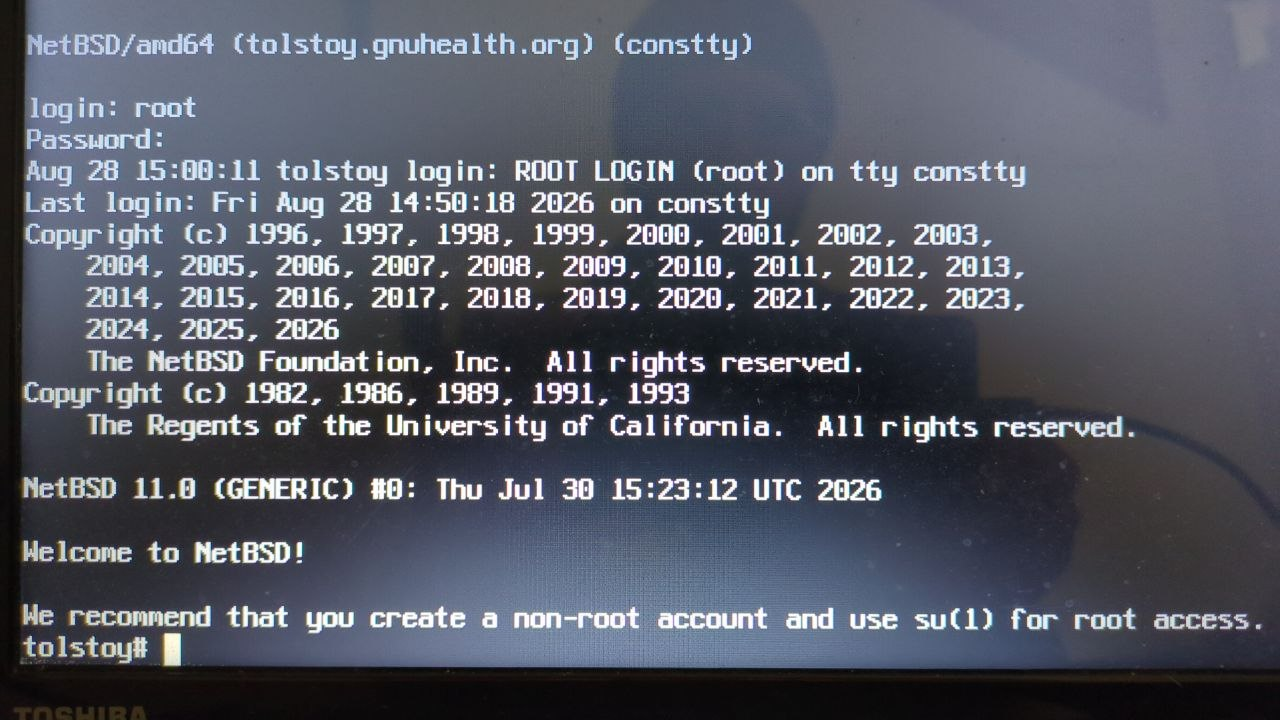
Picture taken to a laptop screen showing the console screen from a NetBSD 11 operating system.
Some of the text:
NetBSD/amd64 (tolstoy.gnuhealth.org) (constty)
login: root
Password:
Aug 28 15:00:11 tolstoy login: ROOT LOGIN (root) on tty constty
Last login: Fri Aug 28 14:50:18 2026 on constty
Copyright (c): 1996... 2026
The NetBSD Foundation, Inc. All rights reserved.
...
NetBSD 11.0 (GENERIC) #0: Thu Jul 30 15:23:12 UTC 2026
Welcome to NetBSD!
...


![[?]](https://mastodon.longlandclan.id.au/system/accounts/avatars/109/573/513/395/599/946/original/d9f62920e1e1edbb.jpg)
6 months ago, I stood up a #Matrix server using synapse and #OpenBSD as an experiment for Brisbane WICEN.
Matrix is great, feels a lot like Slack in terms of how it operates from the user. The fact it supports end-to-end encryption out-of-the-box is good for those that need that.
Not so great is its insistence that this be mandatory: the user has to be knowledgeable enough to back up their private key somewhere and know how to upload it back in, or have an existing client logged in that can "vouch" for any new client that logs into their account. I feel this will confuse and confound some of the less technical members of our group, so maybe not quite the holy grail I was after, but very close.
I won't ditch the server just yet, but time to evaluate something else: #XMPP. I've just installed #NetBSD (because, stuff LLM slop) on a VM, and I'll start working through getting ejabberd going.
XMPP isn't as far ahead on the many-to-many video chat that Matrix is (still in the design phase for XMPP, whereas Matrix Call has a working proof-of-concept based on LiveKit), but it is stable and well supported, so we'll give it a look.
![[?]](https://pleroma.anduin.net/media/e42775318fd38a77b2c02300192e27e61861443424849feef9767918512fac8b.png?name=blob.png) boosted
boosted![[?]](https://zia.io/media/73f8b57df59d9e60491c2f17dda35f7da87b0cb509ccf119ffe3a70d89251985.jpg)
@stefano They’re wonderful little machines! It’s amazing how much we can do with so little energy and minimal computing resources. #NetBSD is great with modest hardware :)
Mine takes two watts, but that’s because it has ethernet. Still, I love that we can run whole servers off of small solar panels meant for charging phones.
#Retrocompuing #OS2 #Slowcomputing #EuroBSDCon2026

Alt...
Memtest86 version 4.10 running on the machine, testing all of the 15 (really 16) MBs of RAM.
This post received a lot of comments and reactions, which is great!
It also proved that my little Raspberry Pi Zero W, powered by NetBSD, could handle the load.
Now - to help me test how much load it can tolerate - please boost and react to this post! 🚀
Yesterday’s post received an unexpected amount of appreciation, and the little Raspberry Pi Zero W didn’t even flinch.
#littleFedi #Fediverse #OwnYourData #NetBSD

Alt...
Screenshot showing the post’s engagement figures: 51 replies, 672 boosts, 55 quotes, and 890 favourites. For each reply, it re-generated the blog, too.
boosted![[?]](https://masto.bike/system/accounts/avatars/109/298/328/498/155/315/original/70dbdf0cef9f4ef2.png)
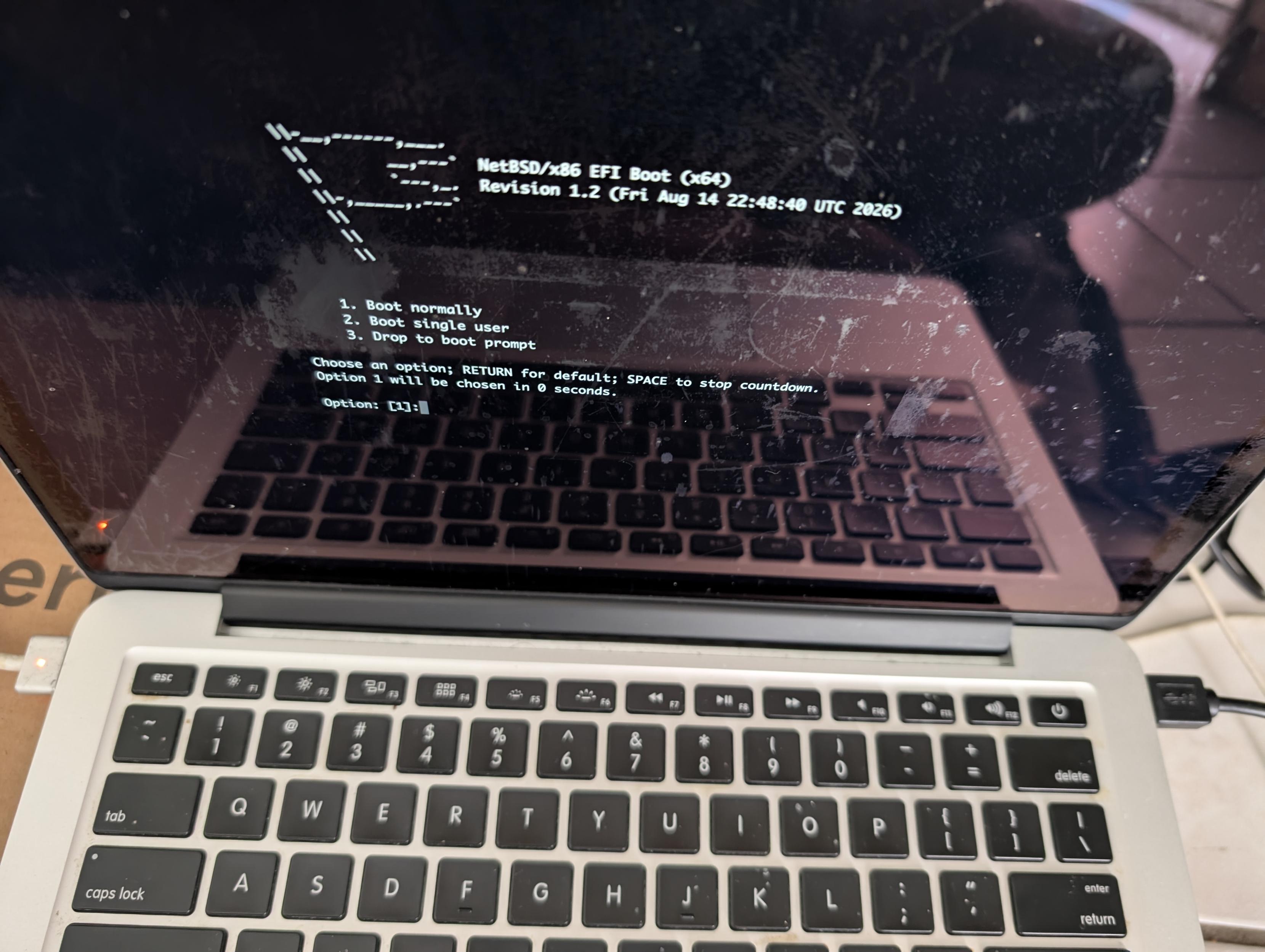
2015 MacBook Pro running NetBSD.
old hardware having the time of their life.
Alt...
the screen and keyboards of a MacBook Pro while booting NetBSD.
Here's the #slashpackage for #Debian #dash 0.5.12.
As a bonus, I've added a small patch that sets up a DASH_VERSION variable and defaults PATH correctly (if unset) on #NetBSD, which neither Debian nor Xu dash actually do. If you know the #pkgsrc dash person, please let xem know.
https://github.com/jdebp/slashpackage/tree/trunk/shells/dash-0.5.12-debian
The Z, Korn, Bourne Again, and Watanabe shells all have similar xxSH_VERSION variables.
I've build Debian #dash on #Debian, #FreeBSD, and #NetBSD . There are some slight differences between it and Xu dash (building both with libedit enabled).
Xu dash reads the locale settings at process startup, for example. Debian dash does not.
When (interactive) standard input is a pipe, Debian dash just reads it. Xu dash creates a second pipe at file descriptors 10 and 11 and tries to do odd things with tee(2).
Xu dash knows how to F_DUPFD_CLOEXEC. Debian doesn't.
So now I'm thinking of building a non-Debian Debian dash. What a weird thing to write!
https://tty0.social/@JdeBP/117166557290914957
Even weirder would be a Debian Xu dash.
#NetBSD and #FreeBSD have the original (BSD) #AlmquistShell that dash came from in the first place, of course, so a non-Debian Debian/Xu dash is not particularly useful.
#netbsd boostedIt's interesting that M. Xu is maintaining two parallel dashes, though. It's not even as though the Debian dash has not tracked Xu dash. There are two different, current, maintained, and significantly divergent, flavours.
https://salsa.debian.org/debian/dash/-/commits/debian/unstable/src/input.c?ref_type=heads
https://git.kernel.org/pub/scm/utils/dash/dash.git/log/src/input.c
I actually haven't tried building the Debian dash on a BSD. I should try it. (#FreeBSD+#OpenBSD ports and pkgsrc use the Xu dash.)
@meluzzy
#Unix #UnixShells #Debian #AlmquistShell #dash #NetBSD