Search results for tag #Leadership
![[?]](https://media.hachyderm.io/accounts/avatars/116/580/040/333/101/968/original/460dbb1a82fed4cd.jpg)
🔋 The ARC motivation model is part of Self Determination Theory, which shows there are two kinds of motivation: Intrinsic and Extrinsic. Intrinsic motivations are ones that come from the person themselves; they enjoy completing the task. For example, in my own case, I enjoy writing glossary entries. Extrinsic motivation comes from outside the person, perhaps someone else imposes a deadline on you for a task.
- Autonomy is the ability to act on our own values and interests. We need to feel that we have choices. This explains why being a bus driver is one of the more stressful jobs people have.
- Relatedness is our need to care about and be cared about by others.
- Competence is our need to feel effective at meeting everyday challenges and opportunities. It also comes from a sense of growth.
When we lose one ARC element, the others diminish as well. If someone is micromanaged at work, they might suffer a domino effect. Their autonomy is limited which might prompt them to think, "Am I being micromanaged because I lack competence?"
What motivates you? What does ARC tell you about your motivation?
![[?]](https://tomsgedankenblog.social/wp-content/uploads/2022/10/cropped-wp-1666202986272-4.jpg)
#LINKSDERWOCHE |39/2026: Produktivität, Lean, Agile, Management und Leadership

PRODUKTIVITÄT
Ja, aber … | Die Bedeutungen des Wörtchens „aber“
Bei der Wortkombination „Ja, aber …” ziehe ich schnell eine Augenbraue hoch. Zustimmung mit Einschränkung? Die meisten Menschen werden an dieser Stelle wahrscheinlich aufhören, weiterzudenken. Man kann es aber auch anders sehen, so wie Dan Rockwell. Er sieht im „aber” einen Indikator, um tiefer zu bohren. Vorausgesetzt, man lässt sich darauf ein. Mit großer Wahrscheinlichkeit spielen die von Dan Rockwell benannten sieben Bedeutungen dieses „Abers” eine gewichtige Rolle. Das ist ein guter Einstieg, den man mit der 5-Why-Methode vertiefen kann. Dabei fragt man immer weiter nach dem „Weshalb”, bis es sich nicht weiter aufdröseln lässt. Das Schöne dabei ist, dass die vermeintliche Einschränkung des „Abers“ dadurch schnell zu einem Rahmen wird, innerhalb dessen man durchaus Handlungsspielräume hat, die im ersten Moment nicht gesehen werden. Probiert es ruhig mal aus! Ich habe damit sehr gute Erfahrungen gemacht.
https://leadershipfreak.blog/2026/10/02/the-7-meanings-of-but/
Verantwortlichkeit | Verantwortungsübernahme beginnt, bevor die Arbeit startet
Ein Thema, das mir besonders am Herzen liegt und das ich immer wieder aufgreife, ist die aktive Übernahme von Verantwortung. Dies spiegelt sich im zweiten verlinkten Blogartikel von Dan Rockwell wider. Ich persönlich sehe in der aktiven Verantwortungsübernahme keinen Einbahnverkehr, sondern einen permanenten Austausch zwischen den Beteiligten mit dem Ziel, gemeinsam zu lernen und die Dinge besser zu machen. Dazu muss man so früh wie möglich über Hindernisse, Fallstricke und Erwartungen sprechen. Genau hier setzt der verlinkte Beitrag meines Erachtens sehr gut an, da er Verantwortung als Vereinbarung definiert und das „Scheitern” einer solchen als Ausgangslage für eine neue, bessere Vereinbarung sieht. Das ist echte Verantwortungsübernahme.
https://leadershipfreak.blog/2026/09/30/reject-backwards-accountability/
Obsidian | Buch erscheint in Kürze
Für Freunde von Obsidian – oder diejenigen, die es werden wollen – gibt es eine neue, interessante Buchpublikation. Das Buch von Thomas Mathoi wird in Kürze im Buchhandel erhältlich sein. Ich freue mich besonders darauf, denn ich lese nicht nur seit Langem seinen Blog, der auch immer wieder als Quelle für Obsidian-Kniffe verlinkt wird, sondern kenne ihn auch schon seit einiger Zeit persönlich. Wir hatten vor vielen Jahren auf dem für mich unvergesslichen Barcamp in Dornbirn die Gelegenheit, uns kennenzulernen. Schade, dass es diese Veranstaltung nicht mehr gibt. Sie war für mich jedes Jahr der Höhepunkt. Diese Zeiten sind leider vorbei, und auch die Barcamp-Welle hat stark nachgelassen.
https://www.mathoi.at/2026/09/30/obsidian-wissen-aufgaben-und-projekte-managen/
Nein-Sagen | Weshalb ein gelegentliches Nein deutlich besser als ein beständiges Ja ist
Da hat mich Edgar Rodehack aber direkt erwischt. Ja, auch ich gehöre zu den Menschen, die aus Begeisterung für eine Idee oder aus Verpflichtungsgefühl zu schnell „Ja” sagen und Zusagen treffen, die sie besser nicht getroffen hätten. Nicht, weil ich nicht helfen will, sondern weil mir am Ende die Kapazitäten hierfür fehlen. Da ich meine Verpflichtungen sehr ernst nehme und nicht einfach die Zügel schleifen lasse, bin ich in der Vergangenheit des Öfteren an die Grenze des Leistbaren gegangen. Inzwischen habe ich dazugelernt und sage öfter „nein”, auch wenn es mir schwerfällt (wenn mir das Thema beispielsweise sehr wichtig erscheint). Niemandem ist geholfen, wenn ich „Ja” zu etwas sage, es am Ende aber nicht „liefern” kann oder mich so übernehme, dass ich auf „Verschleiß” fahre. Nicht-Ziele zu definieren, kann hierbei übrigens sehr hilfreich sein.
https://www.teamworkblog.de/2026/09/wer-immer-ja-sagt-dessen-nein-ist.html
Kreative Lösungsfindung | Die Walt-Disney-Methode einfach erklärt
Denkblockaden dürften uns allen irgendwann bekannt sein. Manchmal sieht man vor lauter Bäumen den Wald nicht mehr. Hier helfen bewährte Techniken wie die Walt-Disney-Methode, die Lars Richter kurz und prägnant beschreibt, sicherlich weiter. Und nein, sie geht nicht auf den Visionär Walt Disney zurück. Zumindest hat er sie nicht erfunden. Aber er war sicherlich die Inspiration dahinter. Das deckt sich zumindest mit dem, was ich über Walt Disney gelesen habe. Er war wohl tatsächlich des Öfteren in der Lage, die verschiedenen Perspektiven immer wieder selbst einzunehmen.
https://scamper.blog/walt-disney-methode/
LEAN
Wissenstransfer | Der Toyota Weg für den Wissenstransfer
Eines der zentralen Probleme bei der Wissensvermittlung in Organisationen ist, dass sich vieles an Wissen nicht sinnvoll verschriftlichen lässt, um es weiterzugeben. Dazu gehört beispielsweise Erfahrungswissen. Bei Toyota hat man eine Art Mentoring entwickelt, bei dem jeweils ein erfahrener Kollege bzw. eine erfahrene Kollegin einen Neuling unter die Fittiche nimmt. Und das nicht nur für ein paar Tage, sondern über deutlich längere Zeiträume. Spannend ist auch, dass der Mentor nicht der direkte Linienvorgesetzte ist, wodurch ein informellerer Rahmen entsteht. Ebenfalls spannend ist, dass die Mentoren darauf geschult und trainiert werden, mit coachenden Techniken die Problemlösungskompetenz der „Neulinge” zu aktivieren. Der Bericht von Frank Noto enthält darüber hinaus noch weitere Aspekte, die verdeutlichen, was unter Respekt gegenüber Menschen im Kontext des TPS verstanden wird. Auch die langfristige Denkweise, die ggf. auch kurzfristige Verluste in Kauf nimmt, spiegelt sich hier sehr schön wider.
https://www.lean.org/the-lean-post/articles/toyotas-answer-to-knowledge-walking-out-the-door/
AGILE
Wertmaximierung | Wenn das Team nicht an der Wertmaximierung arbeitet …
Achtung, meine Alarmglocken schrillen laut. Bei der Überschrift „Hilfe, mein Team arbeitet dauernd an Stories, die gar nicht wichtig sind” hatte ich direkt einige Projekte vor Augen, in denen ich mich bereits austoben durfte. Die Ursachen können tatsächlich sehr vielfältig sein: Mangelnde Klarheit in der „Zielsetzung”, unklare „Teamprozesse”, fehlende Unterstützung durch einen Produktverantwortlichen usw. – die Liste ließe sich noch erweitern. Noch schlimmer wird es, wenn das Ganze nicht in den zugehörigen Teamretrospektiven oder Kaizen-Meetings auf den Tisch kommt und besprochen wird – sofern es diese überhaupt gibt. Irgendwie muss ich dabei immer an unsere Freunde von der Lean-Fraktion denken, die eine klare Ausrichtung am Bedarf des „Auftraggebers” mit Fokus auf wertschöpfende Arbeit propagieren. Mehr zum Thema gibt es bei den Produktwerkern zum Anhören, bevor ich Gefahr laufe, wieder ganz woanders herauszukommen.
https://produktwerker.de/hilfe-mein-team-arbeitet-dauernd-an-stories-die-gar-nicht-wichtig-sind/
Engpassverschiebung | Wenn Dank KI der Engpass nicht mehr die Entwicklung ist …
In den letzten Tagen ist mir wieder bewusst geworden, wie zeitlos die 14 Prinzipien des Toyota Way auch nach über 20 Jahren noch sind. Sie könnten ein wunderbarer Kompass für das sein, was wir – nicht nur in der Softwareentwicklung – durch die KI erleben. Der Blogartikel von Yuval Yeret ist ein Beispiel dafür, wie sie wirken könnten. Mit KI lässt sich Software schneller entwickeln, testen und weiterentwickeln. Der Engpass verschiebt sich dabei von der Entwicklung hin zum Business. So der Autor. Und damit liegt er nicht ganz falsch. Ganz im Sinne von „Entwicklung nach Bedarf” verschiebt sich der Engpass, den es zu lösen gilt, im Wertstrom deutlich. Es entstehen übrigens auch andere Probleme, bei denen uns die konsequente Anwendung des Toyota-Wegs helfen könnte. Da sind wir allerdings bei einem anderen Thema, nämlich nicht wertschöpfende Arbeit, die entstehen kann, zum Beispiel „Überproduktion” von Code. Nur mal so nebenbei. Das ist aber ein anderes Thema.
https://www.scrum.org/resources/blog/ai-made-engineering-faster-why-not-business
Product Owner | Was PO besser nicht tun sollten …
Nach dem kleinen Ausflug zur Thematik „Wertstrom und KI” widmen wir uns wieder den Problemen agiler Teams. In dem konkreten Artikel von Mary Iqbal, den ich hier verlinke, geht es um die Rolle des Product Owners in Scrum-Teams. Zur Erinnerung: Jede Rolle in einem Scrum-Team hat einen Fokus – und das aus gutem Grund. Zusammen als Team erstellen die Rollen das Endergebnis. Und dafür sind sie gemeinsam verantwortlich. Dieses Zusammenspiel birgt viele Fallstricke, auch wenn Scrum ein leichtgewichtiges Rahmenwerk ist. Einige dieser Fallstricke, die sich auf die Rolle des Product Owners beziehen, werden im Beitrag gut widergespiegelt. Beispielsweise gibt es Product Owner, die ständig das „Wie” der Umsetzung definieren wollen – das ist jedoch die Aufgabe der Fachleute im Team. Oder die Vorstellung, dass der Product Owner alle Anforderungen selbst schreiben sollte. Na, kommt Ihnen das bekannt vor?
https://www.scrum.org/resources/blog/5-things-product-owner-shouldnt-be-doing
Metriken | Messen was wirklich relevant ist
Der Blogpost von Dominik Maximini ist aus zwei Gründen sehr interessant für mich: Einerseits benennt er ein Problem, mit dem wir häufig konfrontiert sind, und andererseits stellt er einen simplen, aber effektiven Ansatz vor, der übrigens mal wieder aus dem Lean-Kontext stammt. Das Problem lässt sich damit zusammenfassen, dass wir Leistung im Management (und analog in Teams) mit den falschen Kennzahlen messen. Wir orientieren uns an „Finanzkennzahlen”, die zwar als „Indikatoren” für die finanzielle Gesundheit dienen, aber nicht wirklich sichtbar machen, wie gut tatsächlich werthaltige Ergebnisse erzielt werden und weshalb. Bei der Suche nach einer besseren Metrik zur Messung der Managementleistung hat er die 5-Why-Methode angewendet. Eine simple Methode, die im Toyota-Produktionssystem zum Standardrepertoire der Ursachenforschung gehört. Laut seiner Analyse lässt sich Managementleistung übrigens über „die Anzahl unangenehmer Überraschungen“ messen, denn das ist der Job des Managements: Rahmen schaffen, damit Mehrwert (für den Kunden) erzeugt werden kann..
MANAGEMENT UND LEADERSHIP
Führung als Beziehungsaufgabe | Weshalb der Aufbau von Vertrauen im Team Führungsaufgabe ist
Zur Führung gehört Beziehungsarbeit. Das gilt auch innerhalb eines Teams. Ein Team ist nur so gut, wie die Beziehungen innerhalb des Teams (aber auch zu anderen Teilen des Systems Organisation) funktionieren. Die Aufgabe der Führung ist es, innerhalb des Teams den Rahmen zu schaffen, damit es auch ein Team werden kann und nicht nur eine lose Ansammlung von Mitarbeitenden. Ein Team muss jedoch nicht gleich eine Familie werden. Es geht um eine vertrauensvolle Zusammenarbeit, denn nur so können die Bälle innerhalb des Teams hin- und herfliegen. Genau hier setzt der Blogartikel von Alen Ganic an. Kein Hexenwerk. Vieles ist bekannt. Nur leider wird es nicht immer wirklich (vor-)gelebt. Noch einmal: Gute Führungsarbeit ist auch Beziehungsarbeit.
https://blog.gembaacademy.com/2026/10/02/building-trust-among-team-members-a-leaders-responsibility/
Innere Kündigung | Weshalb bei Führungskräften die Alarmglocken schrillten sollten
Liebe Führungskräfte, der Artikel von Christine Schmitt richtet sich an euch. Denn die innere Kündigung ist oft ein Problem schlechter Führung und fehlender Wertschätzung. Wer die Warnzeichen nicht ernst nimmt und nicht darauf reagiert, sollte sich nicht wundern, wenn sie sich ausbreitet. Bedauerlicherweise sind viele Führungskräfte bis heute in erster Linie „Verwalter” und haben nicht verstanden, dass Führung – wie weiter oben bereits zum Ausdruck gebracht – kontinuierliche Beziehungsarbeit ist. Fehlende Wertschätzung ist ein Grund dafür, dass Menschen in die innere Kündigung gehen. Überhaupt ist fehlender „Respekt” für mich mittlerweile das Alarmzeichen. Das beginnt im Bewerbungsverfahren und endet mit dem Ausscheiden aus dem Arbeitsverhältnis. Und das schlägt sich auch auf den wirtschaftlichen Erfolg einer Organisation durch.
https://t2informatik.de/blog/innere-kuendigung-im-team/
#Agile #Leadership #Lean #LinksDerWoche #Management #Produktivität
![[?]](https://files.mastodon.social/accounts/avatars/115/828/875/319/585/768/original/e9435f1e3dedb156.jpeg)
If you're interested in Agile, creativity, and innovation, don't miss IIL's aptly named article, “Agile. Creativity. Innovation.” I'm honored that it highlights me. | https://scottgraffius.com/blog/files/agile-creativity-innovation.html | #Agile #Creativity #Innovation #ProjectManagement #Leadership
🎧 The "Spotify Model" probably isn't a model and definitely isn't what is currently practiced at Spotify today. (Some suggest it never was.) It was made famous in a video by Henrik Kniberg, where he explains how work was organized into Squads, Tribes, and Guilds. Many people see the structure and try to mimic it in their organization. Worse, many attempt to get the supposed benefit by renaming existing organizational structures with the same labels. As a result, most attempts at the Spotify Model are in fact Cargo Cult.
Structure isn't the most important. Culture will eat any structure. (Hint: that's why renaming your Teams as "Squads" and calling Departmental Managers "Chapter Leads" didn't help.)
You can't copy and paste someone else's approach to Agile. Their approach grew from their people and their culture. In addition, all attempts to document a culture are simplifications that are missing details that were important. Instead of copying the Spotify model, or model from another random company, grow your own Agile model. It is the only long-term path to success.
Has your organization renamed its teams "Squads"? What else changed?
![[?]](https://files.techhub.social/accounts/avatars/110/085/687/174/728/787/original/dcd6b1fd643ada09.png)
#scrum #scrumteam #dev #developer #qa #scrummaster #productowner #leadership #management #executives #priorities #toppriorities #toppriority #unrealisticexpectations #spookyseason #october #scrumhumor #agilehumor #agile #Meme #memes #Humor #humour
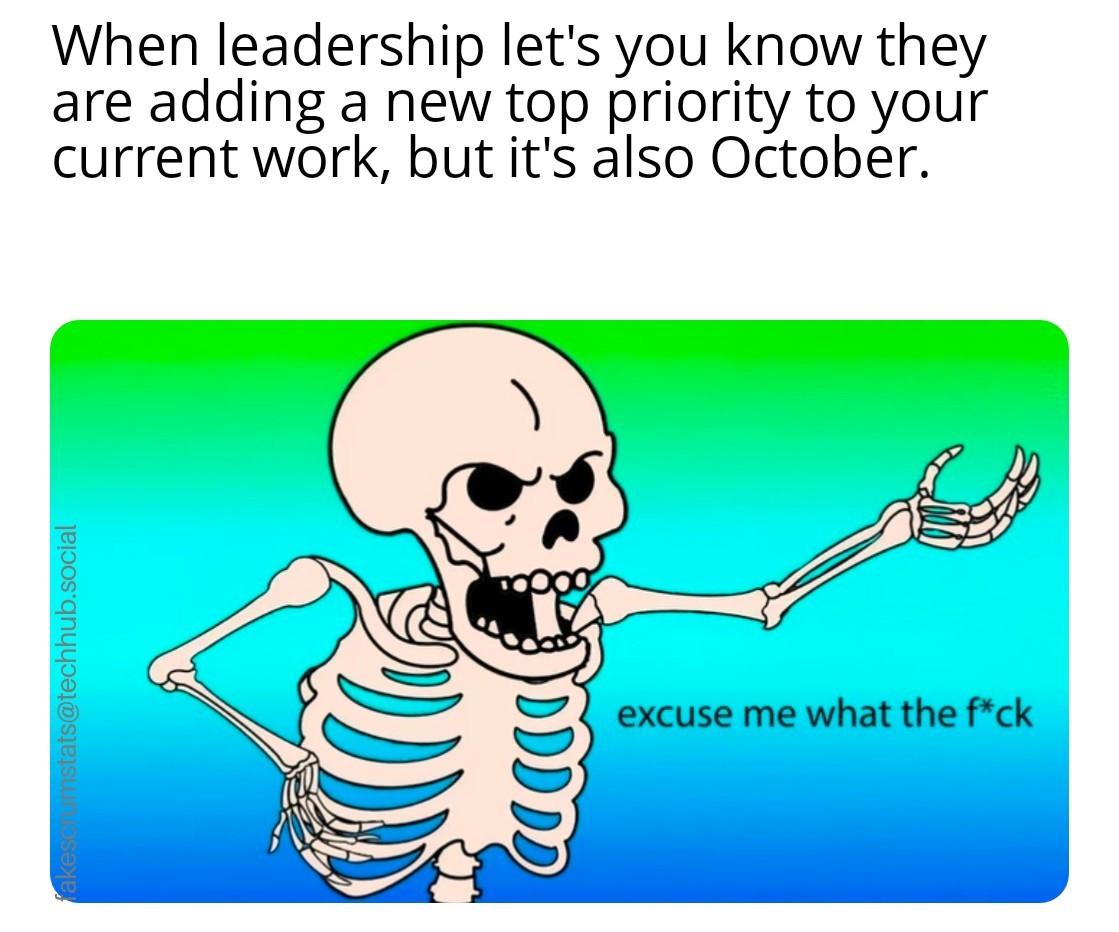
Alt...
Picture of a skeleton with its hand extended out and complaining "excuse me what the f*ck"
Caption: When leadership let's you know they are adding a new top priority to your current work, but it's also October.
Explore https://scottgraffius.com for unique resources and actionable insights on #technology and #business, including #AI, #Agile, #ProjectManagement, #Teamwork, #Leadership, and more. Here's an example:
🔗 Strategic alignment talk at PMI Silicon Valley: https://scottgraffius.com/blog/files/scott-m-graffius-speaking-at-pmi-silicon-valley.html

![[?]](https://files.mastodon.social/accounts/avatars/109/355/050/369/648/745/original/01d3bd58da9b00e4.png)
THE ART OF STRATEGY by Erik Schön is on sale on Leanpub! Its suggested price is $13.95; get it for $9.95 with this coupon: https://leanpub.com/TheArtOfStrategy/c/LeanpubWeeklySale20260922 #leadership #enterprise_management #agile #business_and_management #strategy
#LINKSDERWOCHE | 38/2026: Produktivität, Lean, Agile, Management und Leadership
PRODUKTIVITÄT
Verhaltensbewertungen | Verhaltensbewertungen aus Vermutungen heraus vermeiden, in dem man sich auf die Stärken konzentriert
Eines der großen Probleme, mit denen wir alle ständig zu kämpfen haben, ist die Versuchung, andere zu „bewerten”. Wir interpretieren ständig mögliche Motivlagen, Gründe und Ursachen, wobei wir uns meist auf extrem dünne Informationen stützen. Dabei laufen wir, wie Dan Rockwell es beschreibt, Gefahr, es auf uns oder andere Personen zu beziehen. Das ist keine gute Idee, weil wir so sehr schnell zu Trugschlüssen gelangen können. Dan Rockwells Idee ist es, dem entgegenzuwirken, indem man die offenkundigen Stärken der Person als „Linse“ nutzt und die Interpretationsspielräume auf diese Art und Weise einschränkt. Ob es funktioniert, muss ich erst einmal ausprobieren.
https://leadershipfreak.blog/2026/09/21/judgment-based-on-fabrications/
Adaptives Vertrauen | Klarer Fokus und doch anpassungsfähig
Ich ziehe den Hut vor Menschen, die selbst unter großer Unsicherheit klare Haltung zeigen. Nicht im Form von Sturrheit, sondern bewusst und reflektiert. Sie nehmen eine klare Position ein, vertreten diese – sind gleichzeitig offen genug diese zu hinterfragen und an neue Erkenntnisse anzupassen. Unter Unsicherheit erlebt man leider oft zwei Extreme: Starres beharren ohne Anpassung an neue Erkenntisse oder eben extrem Unsicherheit, die dazu führt, dass gar keine Entscheidungen getroffen werden. Beides nicht wirklich ideal. Aber genau diese Extreme lassen sich oft bebachten. Wer klare eine Hypothese vertritt, sie auf Basis neuer Erkenntisse anpasst und seine Entscheidungen ggf. ehrlich korrigiert agiert in diesem Sinne adaptiv. Eigentlich nichts weltbewegendes und doch immer wieder ein Thema. Dan Rockwell überträgt das in seinem Beitrag hier auf unser Verhalten als Individuum, was dem manchen vielleicht sogar aus dem Kontext von agilen Methoden bekannt vor kommen mag.
https://leadershipfreak.blog/2026/09/22/adaptive-confidence
Nicht-Ziele | Verhindern, dass das Schiff zu tief liegt …
In der aktuellen Podcast-Folge spricht Ivan Blatter über „Nicht-Ziele” als Zeitmanagement-Strategie, die dabei hilft, das „Schiff nicht zu überladen”. Es gibt immer wieder viele Ideen, Ansätze und Initiativen, die spannend und verfolgenswert sind, die wir im Augenblick aber nicht leisten können oder bei denen wir im Augenblick nicht absehen können, ob wir diese tatsächlich leisten können. Genau hier greift das Nicht-Ziel als reflektierte Entscheidung darüber, was in den nächsten Monaten nicht stattfinden soll. Damit schließen wir nicht aus, diese Dinge später aufzugreifen. Die Idee ist spannend. Ich muss sagen, dass ich bisher nicht mit Nicht-Zielen gearbeitet habe. Dabei habe ich in anderen Kontexten bereits gute Erfahrungen mit der negativen Abgrenzung, also der Frage, was wir nicht tun wollen, gesammelt.
https://share.transistor.fm/s/02aa2674
Gleichzeitigkeiten | Eine Gesprächstechnik für mehr gegenseitiges Verständnis
Einen sehr spannenden Beitrag hat mir Houssam Hamade zugeschickt. Es geht um eine Gesprächstechnik. Das Zwiegespräch. Das Sprechen über Gleichzeitigkeiten. Allein schon sich bewusst zu machen, dass Mensch „gleichzeitig“ zwei vermeintlich konträre Positionen einnehmen kann. Dieses sich bewussst machen, führt dazu, dass wir hoffentlich offenen miteinander in Dialog treten. Polarlisieren, dass wir doch alle so oft wahrnehmen und als störend empfinden, lässt sich dadurch aufbrechen, vorausgesetzt dass die jeweilgen Dialogpartner auch offen und bereit dazu sind, sich auch das Zwiegespräch einzulassen, weil dabei durch die Gleichzeitigkeiten bewusst wird, dass man sich in vielen Dingen doch näher steht als man denkt.
https://houssamhamade.net/2026/07/31/der-trick-mit-den-gleichzeitigkeiten/
LEAN
Poka Yoke | Wenn der Mensch zum reinen „Fehlerfaktor“ wird
Im Lean-Kontext bedeutet Poka Yoke, Fehler gar nicht erst entstehen zu lassen, indem Prozesse und Abläufe so gestaltet werden, dass Fehler gar nicht erst entstehen können. Das ist per se eine gute Idee, die aber im Extremfall einen Haken hat, auf den Götz Müller hinweist. Nämlich dann, wenn der Mensch zur Störgröße wird und zum reinen Bediener, der am Ende gar nicht mehr versteht, was da gerade passiert. Ein Schelm, wer dabei nicht sofort an die KI-Debatte denkt. Pardon, ich kann nicht anders.
https://www.geemco.de/artikel/wenn-poka-yoke-menschen-ersetzt/
AGILE
Wirksamkeit im Unternehmen | Fünf Dinge die Wirksamkeit in Unternehmen erzeugen
Bei der Podcastfolge von Marc Löffler zum Thema „Impact” musste ich an die 14 Prinzipien des „Toyota Weges” nach Liker denken. Das Buch dazu ist mir vor Kurzem wieder in die Hände gefallen, als ich in meinem Buchregal gestöbert habe. Erstaunlich, was man so alles im Laufe der Jahre zusammenträgt. Aber das ist ein anderes Thema. Zurück zum Podcast von Marc Löffler. Es geht um Wirksamkeit. Wirksamkeit, die wir als Organisation erzielen. Er fasst fünf Dinge zusammen, die seiner Meinung nach echten Impact erzeugen, und erklärt, wie man diese in der eigenen Organisation erkennen kann. Ich bin persönlich der Meinung, dass sich alle fünf von Marc benannten Punkte tatsächlich in den bereits erwähnten 14 Prinzipien des Toyota-Weges wiederfinden, die vor über 20 Jahren definiert wurden. Spannend. Allerdings bin ich der Meinung, dass Liker sogar noch ein paar weitere Dinge im Blick hat, die nicht minder wichtig sind.
https://passionateteams.com/e/funf-dinge-die-unternehmen-mit-echtem-impact-ausmachen
Scrum Protokoll und Scrum Agenda | Das eine lässt sich leicht kopieren, das andere leider nicht
Woran scheitern viele Scrum-Implementierungen? Ralph Jocham bietet mit seiner Unterscheidung nach „Protokoll” und „Agenda” eine gute Erklärung hierfür. Oft wird das Scrum-Protokoll implementiert, während die „Agenda” nahezu komplett vernachlässigt wird. Mit anderen Worten: Es steht Scrum drauf, weil es Sprints, Retrospektiven, Reviews usw. gibt, aber die Idee, Mehrwert zu erzeugen, also echte Ergebnisse, die tatsächlich auch kritisch überprüft werden, findet nicht wirklich statt. Das empirische Prüfen der Hypothese jedes Sprints findet nicht statt. Damit gibt es auch kein organisationelles Lernen. Weshalb ist das so? Der Scrum-Leitfaden ist relativ leichtgewichtig und das Protokoll lässt sich leicht kopieren. Die Idee dahinter jedoch nicht. Und genau da liegt ein Missverständnis, dass leider zu oft auftritt: Protokoll und Agenda kann man nicht trennen.
https://www.scrum.org/resources/blog/scrums-protocol-easy-copy-its-agenda-not
MANAGEMENT UND LEADERSHIP
Change Management | Woran Transformationen oft scheitern
Ich durfte Olaf Hinz vor vielen Jahren kennen und schätzen lernen. Schade, dass es das PMCamp Dornbirn nicht mehr gibt. Dort habe ich viele spannende Menschen wie Olaf Hinz persönlich getroffen und so manche Erkenntnis im Austausch mitgenommen. Olaf ist einer der ersten Menschen, die mir zum Thema Change Management einfallen. Daher war ich natürlich neugierig, was er im Interview mit Bernd Geropp über das Scheitern von Transformationsprojekten erzählt. Für mich immer wieder ein interessantes Thema. Spannend ist, dass wir immer wieder die gleichen Themen wälzen. Change Management oder Transformationen sind eben nicht zweckrational, sondern hoch komplex und damit immer wieder herausfordernd.
https://www.mehr-fuehren.de/warum-transformationen-scheitern/
Veränderungen | Wenn sie so implementiert werden, dass sie nicht mehr zurückgenommen werden können
Jede Entscheidung hat Konsequenzen. In irgendeiner Form. Die Frage ist, wer die Konsequenzen in der Organisation spürt. Diejenigen, die sie getroffen haben, oder jemand anderes? Und darin liegt die Krux. Wenn die Konsequenzen nicht dort spürbar sind, wo die Entscheidung getroffen wurde, funktioniert die Rückkopplungsschleife nicht. Das klingt trivial, ist aber ein Kernproblem in fast jeder Organisation, die ich kenne. Wenn Entscheidungen nicht spürbar werden – und zwar bei den Personen, die sie treffen –, unterbleibt das „Adaptieren und Anpassen“ im Sinne des Lernens, wie man die Dinge besser macht. Das lässt sich auch an einem anderen Beispiel gut zeigen. Wenn wir einen Standard definieren, diesen aber beständig ignorieren und das Abweichen vom Standard nicht reflektieren, wird der Standard niemals weiterentwickelt. Es hat ja keine Konsequenzen. Daniel Dubbel reflektiert das Thema etwas ausführlicher als ich es hier tue und kommt zu dem Schluss, dass eine Entscheidung, die keine spürbaren Folgen hat, den ersten Test nicht bestanden hat.
https://www.lean-agility.de/2026/09/einbetonieren-von-veranderungen.html
Konsequenzen | Wenn Konsquenzen nicht spürbar sind …
Jede Entscheidung hat Konsquenzen. In irgendeiner Form. Die Frage ist, wer spürt die Konsquenzen in der Organisation? Diejenigen, die sie getroffen haben oder jemand anders. Und da liegt die die Krux. Wenn die Konsequenzen, nicht dort spürbar sind, wo die Entscheidung getroffen wurde, funktioniert die Rückkopplungsschleife nicht wirklich. Klingt trivial, ist aber ein Kernproblem in fast jeder Organisation, die ich kenne und erlebt habe. Wenn Entscheidungen nicht spürbar werden und zwar bei den Personen, die sie treffen, unterbleibt das „adaptieren und anpassen“ im Sinne eines Lernens, wie man die Dinge besser macht. Das lässt sich auch an einem anderen Beispiel gut zeigen. Wenn wir einen Standard definieren, diesen Standard beständig ignorieren, aber das Reflektieren des Abweichens vom Standard unterbleibt, wird der Standard niemals weiterentwickelt. Es hat ja keine Konsquenzen. Daniel Dubbel reflektiert das Thema etwas ausführlicher als ich hier und stellt fest, wenn eine Entscheidung keine spürbaren Folgen hat (also Konsequenzen nach sich zieht), hat sie den den ersten Test schon nicht bestanden.
https://www.inspectandadapt.de/das-muss-konsequenzen-haben/
#Agile #Leadership #Lean #Management #ProduktivitätThe Future of Digital Health by Dr. Bertalan Mesko is the featured bundle of ebooks 📚 on Leanpub!
Link: https://leanpub.com/b/thefutureofdigitalhealth
#Medicine #Leadership #Investment #Digital_transformation #Business_analysis

![[?]](https://media.hachyderm.io/accounts/avatars/110/372/528/571/829/161/original/fff0f95f5580438f.jpg)
Organisational Dysfunction of the Day
Better leaders is the answer
Context: The organisation has invested heavily in leadership development. There are programmes, frameworks, coaching, 360-degree feedback, and a clear leadership model on the intranet. The managers are well-intentioned, many of them skilled, and they take their responsibility seriously. And yet the teams below them are still not performing the way everyone hoped. Engagement is middling, decisions are slow, and the best people keep leaving. Some even because of their manager. Leadership quality is clearly not the bottleneck, so what is? In many industries supervisors are expected to know the craft they oversee. Not so in most IT organisations, where the manager's job is people and process, not technology. That gap has been growing.
OST explains: The problem is not the leaders; it is the existence of the role itself. DP1 as bureaucracy requires leaders because control and coordination are handled by a layer above the real productive work, be it managers in the line, project managers, product managers or even architects. You therefore need good ones, and training them makes sense within that logic. But no amount of leadership quality fixes the structural problem that the people doing the work are not in control of it. In DP2, the need for managerial roles largely disappears because coordination and control are handled by the group itself. The resources currently spent on developing managers should instead go into developing the self-managing capacity of the teams. That means redesigning who holds the role, not training the people currently in it.
Organisational Dysfunction of the Day
Involvement theatre
Context: Some architects, project leads, or managers want to do things properly. They genuinely believe in collaboration and know the teams have valuable knowledge. So they organise workshops, like EventStorming sessions, design sprints, or other types of collaborative design workshops. People are invited, post-its go up, discussions happen, and there is real energy in the room. Then the session ends, the outputs are photographed, the facilitator disappears with the material, and a few weeks later, a design document or architecture proposal lands in the team's inbox. It looks nothing like what people thought they were building together. When questions are raised, the answer is that the workshop inputs were "taken into account." The teams learn quickly that the workshops are not really about designing together. They are about being consulted. Next time, fewer people will engage seriously. The post-its get sparser. The energy in the room is noticeably lower, even hostile.
OST explains: This is one of the most common misapplications of participative techniques in DP1 organisations: design authority is retained above, while the appearance of participation is layered on top to legitimise decisions already made or soon to be made elsewhere. OST explains why it fails on two levels. First, Bion's basic assumptions: the moment a person with authority enters the room, even a well-meaning independent facilitator, people shift into dependency or fight/flight, so the workshop never produces genuine collaborative design, regardless of how it is facilitated. Second, Fred and Merrelyn Emery were explicit that it is only when people design their own work that they develop the motivation, responsibility, and commitment to implement it effectively. A design imposed on a group, even one consulted, will never have the ownership that a design created by the group has. Involvement theatre does not just fail to produce good design; it actively corrodes trust in the collaborative process, making genuine participation harder to achieve each time. As Kurt Lewin warned, people cannot be trained for democracy by autocratic means.
![[?]](https://www.urbanmind.net/photo/profile/hackaday.png?ts=1741950956)
DMAIC for Technology Delivery: From Business Problem to Operational Outcome
Simplicity isn't something you install once and forget. It's both a principle and a value. Whenever you make a change, ask "What is the simplest way this could be done?" That applies at every level, from small coding decisions up to an organization's structure.
Simplicity is hard, because the natural cognitive bias is to add, not take away. Our default approach to improving a product, system, or organization is to add something more. Enhance, boost, augment: these all imply that increasing size also increases strength or value. We rarely notice an opportunity to subtract, and it's rarely what gets rewarded or praised.
Why does this matter? Complex systems are more likely to break. The financial crisis of 2007/8 is a good example: the mortgage system had become so complex that no one understood the whole thing, not even at a high level. Everyone assumed someone else was doing the due diligence.
In software development, we spend more time reading and understanding code than writing it. Rush through development without taking time to simplify, and there's a price: the next person spends far more time understanding code that wasn't written with simplicity in mind, because the author wanted to save 10 minutes. Worse, complexity in code is a key source of bugs.
What's one area in your work where complexity is masking a deeper issue? Then ask, "What if we simplified this?" The answer might surprise you.
My late father used to say, "Marvin Minsky promised me AI would be coming in a generation." Minsky was trying to develop intelligence that could compete with human intelligence. I'm still waiting.
At its core, GenerativeAI takes the text you give it and rolls a giant set of dice to predict the next word in your sentence. It works fairly well because it's been trained on a huge volume of text, effectively the entire internet and most of the world's books. There is no magic. These models are just prediction machines.
The hype and language used to describe GenAI makes it hard to understand what it's good at and what it can't do. Leaders are mandating its use without understanding what they're asking for.
If a child makes a mistake and you ask how it happened, their explanation is based on the actual series of thoughts and events. If a model makes a mistake and you ask it to explain, the explanation is entirely made up. The model has no self-awareness and doesn't understand what a mistake is, let alone that it made one. It comes up with a plausible explanation, because its job is to generate plausible text in response to a prompt.
Even more important, a child learns from the mistake and updates their understanding of how the world works. AI can't learn, because it doesn't change. Once a model's training is finished, it stops learning. Every conversation starts with the same knowledge as the last.
I'm not anti-tool. Understanding the failure modes is the prerequisite for using them without making larger mistakes.
Next time your manager tells you to use AI, ask them how many dice they want you to roll. :-)
The American Management Association features my “Phases of Team Development” IP in its "Leadership Skills and Team Development for Technical Professionals" course
🔗 https://scottgraffius.com/blog/files/ama-23.html
#AmericanManagementAssociation #ProjectManagement #Teamwork #Leadership #Agile #Agility
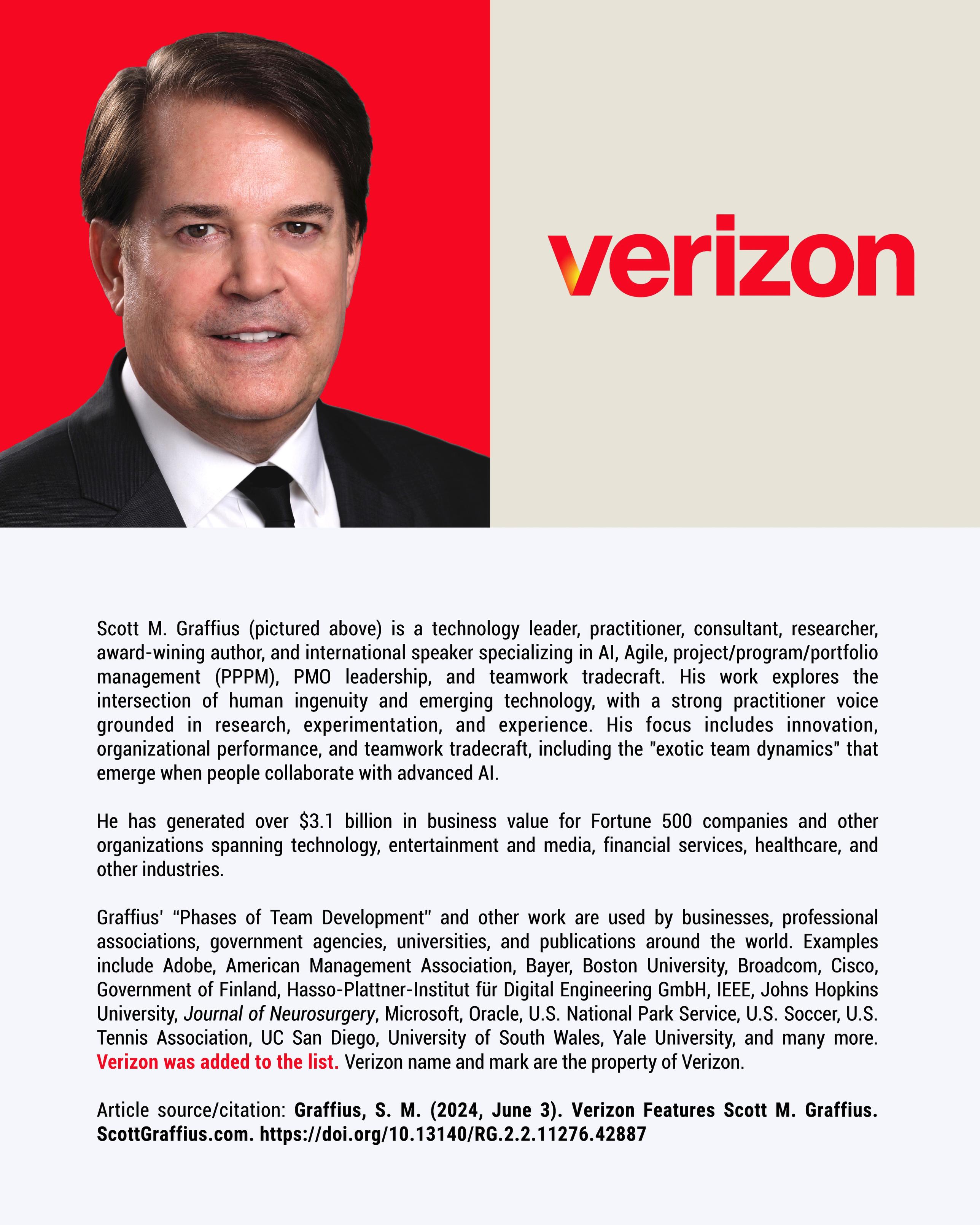
Businesses, professional associations, government agencies, universities, and publications use my "Phases of Team Development" resource on teamwork tradecraft. I'm pleased to share that Verizon was added to the list!
https://www.scottgraffius.com/blog/files/verizon-features-scott-m-graffius.html
#Tech #Agile #Teamwork #Leadership
![[?]](https://mastodon.sdf.org/system/accounts/avatars/109/339/160/193/570/873/original/cc1d9f719030d63f.png)
Today is the last in my series about the INVEST method of writing user stories.
https://www.edyouragilecoach.com/t-is-for-testable/
You should be able to test anything that you do.
#GhostGang #SoftwareDevelopment #business #leadership
🏴☠️ 🐻
Imagine working with an immigration lawyer to prepare an application several hundred pages long, then the decision comes back in under a minute, with the officer looking at several files at once. How would you feel if you were the applicant?
Immigration, Refugees and Citizenship Canada measures how long it takes officers to process visa and immigration applications. Should be a win, right? Not so fast.
The backlog is real. But pretending an officer can review multiple applications simultaneously defies how human brains work. The system shows a point-and-click Approve or Deny screen with 3-4 applications displayed at once. Some run over 200 pages, so applicants are getting denials citing a missing birth certificate that was actually attached, or insufficient funds the application clearly proves they have.
One former immigration officer explains that in recent years, the only thing that matters is getting the file processed and the backlog cleared: a local optimization.
Fairness aside, this approach clogs the system with appeals. Instead of clearing the backlog faster, it creates a new one. The local optimization became a systemic problem.
We've seen this before in call centres, measuring how fast agents handle calls. Give an agent a simple problem, they'll help you quickly. Give them a complex one, and some will find a way to lose the call. The complex customer becomes someone else's problem.
#LINKSDERWOCHE | 37/2026: Produktivität, Lean, Agile, Management und Leadership, Politik und Gesellschaft
PRODUKTIVITÄT
Übersicht | Vorgänge und Projekte auf dem Schirm behalten
Ich glaube, dass viele Menschen – zumindest im beruflichen Kontext – den Fehler machen, zu versuchen, Aufgaben zu verwalten. Aufgaben befinden sich auf der operativen Ebene. Sie befinden sich in einem permanenten Fluss. Da wird es schwer, strategisch zu organisieren. Der Begriff „Projekte”, den David Allen über GTD für die übergeordneten Themen verwendet, ist manchmal missverständlich. Zumindest kommt es mir so vor. Jan Fischbach spricht in diesem Kontext immer gerne von „Vorgängen”. Das ist an sich gar nicht schlecht, allerdings zucken viele innerlich zusammen, weil es sich für sie nach „preußischer Verwaltung” anhört (sie war oder ist übrigens besser als ihr Ruf). Losgelöst vom Begriff ist die Grundidee nach wie vor richtig und funktioniert in vielen Kontexten, in denen ich unterwegs bin, sehr gut. Und zwar vom Informations- bis zum Wissensmanagement. Das Ganze lässt sich übrigens auch sehr gut mit Kanban (und dem eher unbekannten Kamishibai) abbilden. Zusammen mit einem Obeya kann es als Gesamtsystem wunderbar visualisiert werden – im Sinne des von Jan Fischbach thematisierten Leitstands – und so in der „Dokumentenablage“ gespiegelt werden. Wichtig ist, das System möglichst einfach zu halten. Es sollten nur wenige Kategorien und eine einfache, flache Struktur verwendet werden. Sonst wird es wieder unübersichtlich. Dann funktioniert es nicht für uns als Individuum, sondern sehr gut im Team und in einer größeren Organisation.
https://www.teamworkblog.de/2026/09/viele-vorgange-und-projekte-mit-einem.html
Obsidian | Kanban mit Obsidian-Bases
Noch habe ich es selbst noch nicht ausprobieren können, da die anstehende Version 1.14 für Obsidian noch nicht ausgerollt ist. Dennoch, der Artikel von Thomas Mathoi macht mich neugierig. Mein Personal Kanban habe ich zwischenzeitlich in Personal Kanban integriert und mein Personal Obeya soll in Kürze folgen. Geplant ist mit der Version 1.14 Kanbanboards auch ohne Plugins in Obeya zu ermöglichen. Das hat Charme und erleichtert sicherlich den Einstieg für Obsidian-Nutzer in die Visualisierung von Workflows im Sinne eines Kanbanboards. Ich bin gespannt, wie gut es funktioniert, auch wenn meine Erwartungshaltung an die Flexbilität der Visualisierung nicht sonderlich hoch ist. Da kommen aber auch alle üblichen Verdächtigen nicht wirklich an ein haptisches Board an der Wand oder ein digitales Whiteboard heran. Liegt in der Natur der Technik.
https://www.mathoi.at/2026/09/16/kanban-mit-obsidian-bases/
LEAN
Kaizen und disruptive Innovation | Wir brauchen beides, unerschätzen aber Kaizen …
Ich finde den Artikel von Pascal Dennis insofern spannend, als er zeigt, wie sehr wir die Wirkung von Kaizen als kontinuierliches Streben zum Besseren im evolutionären Sinne unterschätzen. Wir feiern die „disruptiven Helden” der Innovation, die (vermeintlich) etwas Neues schaffen, wie Superhelden. Aber was ist mit der evolutionären Verbesserung? Die kleinen Minischritte mit ihren kaum merklichen Veränderungen sind mindestens genauso wichtig wie die vermeintlich supertollen neuen Ideen, die meist gar nicht so neu sind, sondern oft auf bestehenden Ideen basieren. Nur am Rande bemerkt: Diese feiern zufällig erst jetzt ihren öffentlichkeitswirksamen Durchbruch.
https://blog.leansystems.org/2026/09/kaizen-abracadabra-innovation.html
Reifegradmodelle | Wen sie in die Irre führen
Mir ist über die Lean Knowledge Base eine gelungene Erinnerung daran ins Blickfeld gerückt, dass wir Reifegradmodelle nicht zu sehr überbewerten sollten. Das Besondere daran ist, dass das Reifegradmodell nicht grundsätzlich verteufelt wird, sondern unser Umgang mit ihm im Fokus steht. Zur Erinnerung: Es sind Modelle. Sie stellen eine Referenz dar, die uns dabei hilft, etwas einzuordnen und zu erkennen. Sie sind niemals allein aussagefähig. Es braucht auch immer den Kontext. Ein Reifegradmodell hilft, Widersprüche und mögliche Handlungsfelder zu erkennen – nicht, sie zu verursachen. Gute Reifegradmodelle helfen uns, bessere Fragen zu stellen. Sie sind aber nie Selbstzweck. Es geht nicht darum, um jeden Preis den nächsten Reifegrad zu erreichen (selbst wenn er nicht zum Kontext passt), sondern herauszufinden, wo mögliche Potenziale liegen, die gehoben werden könnten.
https://leanbase.de/publishing/post/warum-reifegradmodelle-organisationen-in-die-irre
Kata | Routinen ohne Weshalb sind inhaltsleer
Persönlich habe ich reflektierte Routinen sehr zu schätzen gelernt. Dass ich das Wort „reflektiert” davorsetze, hat einen guten Grund, wie man sich denken kann. Routinen sind reproduzierbare, bewährte Praktiken im Sinne einer Gewohnheit. Im Lean-Kontext spricht man gerne von Kata. Sie haben einen Zweck und Grund. Aber der Zweck und Grund kann sich im Laufe der Zeit verändern, sodass eine perfekt ausgeführte Routine dennoch „Quatsch” sein kann. Es ist ein leeres Ritual ohne Lerneffekt. Da muss ich mich immer wieder daran erinnern, dass eine Routine – wie jeder andere Standard auch – nichts anderes als eine Arbeitshypothese ist, die so lange gilt, bis sie durch eine bessere abgelöst wird. Ganz abgesehen davon soll eine Routine uns beim Lernen unterstützen. Wird sie zum Selbstzweck, dann wird sie zum stumpfen Schwert ohne Mehrwert. Gerade deshalb ist es wichtig, sich immer wieder zu vergegenwärtigen, weshalb es die Routine gibt. Dann macht die Routine im Sinne einer Kata auch Sinn. In diesem Sinne bin ich voll und ganz bei Götz Müller. Eine perfekte Choreografie, die den Zweck jedoch ausklammert, ist keine Kata im Sinne von Lean.
https://www.geemco.de/artikel/wenn-kata-zur-choreografie-wird
AGILE
Moderation | Wie neutral muss ich als Moderator sein?
Michael Schenkel fragt: „Muss Moderation neutral sein?” Ich formuliere die Frage um: Kann sie überhaupt neutral sein? Unter uns gesagt, kann niemand vollkommen neutral sein. Der Unterschied besteht darin, sich dessen bewusst zu sein. Besser ist es, sich zu fragen, welche Aufgaben die eigene Rolle als Facilitator hat, wie man diese Rolle im jeweiligen Kontext am besten ausfüllt und was dies jeweils bedeutet. Denn ich habe immer auch einen Auftrag, der mich zwingt, in dieser Rolle Entscheidungen zu treffen. Damit bin ich wieder beim Artikel von Michael Schenkel, der das sehr gut herausarbeitet. Das Ganze erinnert mich irgendwie an die hohe Kunst der Gastgeberschaft, bei der ich als „Gastgeber” immer wieder verschiedene „Rollen” und „Positionen” einnehme, um den Raum und den Rahmen zu schaffen, der Austausch ermöglicht. Und das ist die eigentliche Kunst. Ein spannendes Thema.
https://t2informatik.de/blog/wie-neutral-muss-moderation-wirklich-sein/
Scrum | Mehr Besprechungen durch Scrum?
Ein Klassiker. Scrum führt zu mehr Besprechungen. Wirklich? Ja, wenn man es zusätzlich zu bestehenden Besprechungsrunden einführt. Drehen wir doch mal den Spieß um! Was wäre, wenn alles, was wir mühsam in vielen anderen Besprechungen erarbeiten, in effektiv geführten Scrum-Meetings stattfinden würde? Viele Besprechungen wären überflüssig. Kein Scherz. Ich habe das so oft erlebt. Und das gilt sogar dann, wenn die Stimmung ursprünglich gegen Scrum war. Das Problem sind nicht die Scrum-Meetings. Es ist vielmehr die Art und Weise, wie Kommunikation und Austausch gelebt werden, die sich immer wieder als Problem herausgestellt hat. Zu viele Besprechungen sind zu wenig ergebnisfokussiert und zu sehr mit „Selbstdarstellung” gefüllt. Wenn wir den Fokus bei Besprechungen auf das Ergebnis und die Zusammenarbeit richten, werden eben diese oft viel gescholtenen endlosen Runden schlagartig zielführender. Das ist eine spannende Erfahrung, die ich immer wieder mache. Ralph Jocham stößt in ein ähnliches Horn.
Scrum Master | Sich obsolet machen ist nicht das Ziel
Chee-Hong Hsia trifft einen Nerv. Gute Scrum Master (und vergleichbare Facilitator-Rollen) haben zwar den Anspruch, Menschen zu befähigen, ihre Probleme selbst zu lösen – eine Idee, die übrigens aus dem Lean-Kontext stammt –, aber sie machen sich damit nicht obsolet. Sie schaffen den Rahmen und den Raum, sodass sie sich bei vielen Dingen zurücknehmen können und Teams eigenverantwortlich agieren können. Damit werden sie nicht überflüssig, sondern verschieben ihren Fokus. Den „Führung” braucht es immer. Als Impulsgeber, Motivatoren und Unterstützer. So gewinnen sie den Raum, den sie brauchen, um neue Ideen und Fertigkeiten zu entwickeln. Diese tragen wiederum dazu bei, dass Teams die nächste Entwicklungsstufe erreichen können. Organisationen müssen sich beständig weiterentwickeln. Weil sich ihr Umfeld fortentwickelt. Und dafür braucht es immer wieder jemanden, der dabei begleitet, unterstützt und befähigt.
Roadmap | Kollaborativ zur Roadmap
Ich werde nicht müde, immer wieder zu betonen, dass es für Scrum Master, Agile Coaches und vergleichbare Rollen sehr wertvoll sein kann, bei Bürgerbeteiligungen und Partizipationsprozessen zu hospitieren. Denn dort lernt man viele gute Methoden kennen, die bei der Arbeit mit Gruppen im beruflichen Kontext sehr hilfreich sein können. (Kleine Info: Im Kontext des bürgerschaftlichen Engagements begann übrigens vor fast 20 Jahren meine Reise in die Agilität.) Darunter auch die Methode des Gallery Walks, die Maria Iqbal in ihrem Blogartikel beschreibt. Wir erinnern uns: Es geht um gute Zusammenarbeit. Und genau hierfür sind viele Moderationstechniken aus dem Bereich des bürgerschaftlichen Engagements gedacht. Im Blogartikel wird der Gallery Walk genutzt, um eine realistische IT-Roadmap zu entwickeln.
https://www.scrum.org/resources/blog/gallery-walk-it-roadmap
Customer Journey Map | Eine kleine Anleitung
Wie kommt entwickelt man eigentlich eine Customer Journey Map? Diese Frage beantwortet Lars Richter aus Sicht eines Solopreneurs. Übrigens locker übertragbar auch in andere Bereiche. Die einzigen, die eventuell stolpern könnten, sind die Kollegen im Bereich der öffentlichen Hand. Gerade im hoheitlichen Bereich könnte es schwierig werden, den Kunden zu identfizieren, den der ist nun mal die Allgemeinheit. Mit etwas Transferleistung lässst sich das Ganze aber auch hier adaptieren und trägt zu einem besseren Verständnis bei, wie zum Beispiel Prozesse ausgestaltet werden sollten. Daher bin ich ein großer Freund der Customer Journey – auch über die Produktentwicklung hinaus. Der Blick von rechts nach links (also ausgehend von der Frage, was will ich für wen mit welchem Zweck erreichen) hilft tatsächlich so manchen Knoten auch bei prozessualen Fragen zu lösen. Zugegebenermaßen, man macht es viel zu selten.
https://scamper.blog/customer-journey-map/
Erfolgsgeschichten | Wen Scrum funktioniert
In den letzten Tagen ist mir wieder einmal bewusst geworden, dass wir – zumindest in Deutschland – sehr gut darin sind, das Negative zu sehen und das Positive auszublenden. Dabei wissen wir, wie wichtig positive Narrative für uns sind. Als Motivator, Energiespender und Hoffnungsträger. Natürlich müssen wir auch über das Scheitern reden, aber genauso wichtig ist es, über das zu sprechen, was gut funktioniert. Und uns überrascht hat. Ich war zum Beispiel überrascht, dass Scrum im Kundenservice erfolgreich war – ich hätte hier eher eine Domäne von Kanban vermutet. Aber mal ganz ehrlich: Wenn es funktioniert, ist mir das Framework schnuppe. Gerade in der explorativen Phase eines Veränderungsprozesses kann Scrum sehr gut unterstützend wirken. Diese Erfahrung durfte ich auch schon machen. Im Regelbetrieb wurde dann stärker auf Kanban in Verbindung mit der Verbesserungskata gesetzt. Na, fällt was auf? Genau. Eine methodische Zusammenarbeit statt Gegeneinander, je nach Bedarf und Kontext. Aber zurück zur Geschichte von Felix Stein. Es gibt Hoffnung. 😉
https://www.lean-agility.de/2026/09/agile-success-stories-scrum-im-kundenservice.html
Backlog | Wenn die KI die Anforderungen schreibt, aber das Verständnis fehlt
Ich lese oft über KI im Kontext des Backlog-Refinements. Alles gut. Als Hilfe eingesetzt durch aus sinnvoll. Und doch bleibt ein dickes „Aber“ übrig. Um es mit Mike Cohen auszudrücken: „Eine gut geschriebene Geschichte kann immer noch die falsche Geschichte sein.“ Und genau diese Gefahr besteht, wenn wir uns zu sehr auf die „Maschine“ verlassen. Sein Fazit ist für mich treffend: Der Mensch bestimmt, was den Mehrwert ausmacht und die Maschine hilft uns die Informationen zu „strukturieren“. Das Verstehen, was sich dahinter verbirgt, können wiederum nur die Menschen im gemeinsamen Austausch. Nicht die KI. Die Versuchung ist groß, aber Geschwindigkeit und Menge allein, liefern die Qualität und das Verständnis.
LEADERSHIP UND MANAGEMENT
Teamreife entwickeln | Ein Team befähigen ist das Ziel
Vermutlich hört man es bei mir immer wieder heraus: Ich schätze eine Führung, die befähigt und Menschen in die Lage versetzt, Probleme und Hindernisse selbst zu lösen. Behandelt erwachsene Menschen wie erwachsene Menschen und habt Vertrauen in ihr Können. Und dann werdet ihr sehen, wie vieles plötzlich funktioniert. Leider beobachte ich oft genug das Gegenteil und bekomme das auch so zurückgespiegelt. Gefühlt sogar deutlich häufiger als früher. Und das gerade jetzt, in Krisenzeiten, in denen wir dieses Potenzial eigentlich bräuchten. Ich würde mir mehr Führung im Sinne von Dan Rockwells Beitrag wünschen, die es den Teammitgliedern ermöglicht, zu wachsen und sich zu entwickeln. Das ist meiner Meinung nach ein echter Booster.
https://leadershipfreak.blog/2026/09/17/how-to-develop-mature-team-members/
Fähigkeiten entwickeln | An konkreten Fertigkeit arbeiten bringt zum Ziel
Ein weiterer Impuls von Dan Rockwell hat mich positiv überrascht. Wir reden ja gerne davon, Führungskompetenz oder „Leadership“ zu entwickeln. Was wäre, wenn wir dabei viel zu groß denken? Wenn es eigentlich darum geht, einzelne Fähigkeiten zu entwickeln? Fähigkeiten, die zwar zur Führungskompetenz beitragen, aber auch für sich allein schon wertvoll sind. Konkrete Fähigkeiten. Das ist richtig, denn damit sehen wir schneller Wirksamkeit und auch schneller konkrete Ergebnisse. Kleinere Ziele, schnellere Ergebnisse, früheres Feedback. Moment, das klingt ja nach … ups … nach Agilität. Pardon, musste sein. Das ist eigentlich ein offenes Geheimnis. Nur übersehen wir es zu oft. Die Verbesserung der Kommunikation ist ein großes Thema und ich bin mir sicher, dass jeder von uns innerhalb dieses Feldes Stärken und Schwächen hat. Und es ist ein großes Feld. Lieber erst mal kleiner anfangen und es richtig umsetzen, dann steigt auch die Erfolgschance.
https://leadershipfreak.blog/2026/09/16/stop-developing-your-leadership/
Reorganisation | Wenn Reorganisation zum Motivator werden kann
Olaf Hinz widmet sich dem Thema Reorganisation. Ein großes Wort dafür, dass sich jede Organisation eigentlich beständig neu erfinden muss, um sich an geänderte Rahmenbedingungen anzupassen. Wo ich ihm voll zustimme, ist, dass eine gelungene Reorganisation ein Motivationstreiber auf allen Ebenen ist. Das durfte ich selbst schon mehrfach erleben. Mein persönlicher Favorit als Meta-Modell ist die Verbesserungskata, da sie dabei hilft, den Prozess mit Rhythmus, Ziel, Zwischenzielen, Feedbackzyklen und klarem Wirkungsfokus klarer zu machen. Das passt auch ganz gut zu seinen fünf Fragen. Aus meiner Beobachtung ist es wichtig, dass die Antworten auf diese fünf Fragen transparent gemacht werden und immer wieder Teil des Prozesses sind.
https://www.hinz-wirkt.de/lotsenblog/artikel/6842-wenn-reorganisation-gelingt-ist-sie-ein-motivator/
Satire | Führungskräftecodes oder Floskelsprech statt Klarheit
Mit Humor lässt sich auch manches Kritische sagen. In der aktuellen Folge des Agentursatire-Blogs von Buddy Müller schwingen mehr als eindeutig kritische Untertöne in Richtung Führung mit. Meister Konfus war bei der Lektüre sehr erfreut. Phrasendrescherei in der Führung statt Klarheit und Transparenz? Ja, was will man mehr? Mit Blick auf Veränderungen und Reorganisationen ist es genau das, was wir brauchen, damit Veränderungen nicht positiv wirken können. Ganz im Sinne von Meister Konfus gilt es, die Mitarbeiter zu verwirren, Klarheit zu vermeiden und am besten keinerlei Richtung aufzuzeigen.
https://agentursatire.blog/2026/09/18/folge53-fkk/
POLITIK UND GESELLSCHAFT
Zur Rubrik | Weshalb ich sie für wichtig halte
Vielleicht ein paar Worte zu dieser Rubrik (Politik und Gesellschaft), weil mir der eine oder andere zurückspiegelt hat, dass die Themen dieser Rubrik nicht wirklich zum Rest der Links der Woche passen. Nun, ich bin da gänzlich anderer Meinung. Politik und Gesellschaft – das ist das Meta-System, in dem wir uns bewegen. Dieses Meta-System geht uns alle an. Es spielt direkt in unseren Alltag hinein, privat und beruflich. Für dieses Meta-System tragen wir alle, jeder einzelne von uns, Verantwortung. Und genau deshalb habe ich diese Rubrik auch in die Links der Woche aufgenommen. Man sehe es mir nach, aber es geht uns alle an, was in unserer Gesellschaft passiert. Wir können nicht neutral sein und bleiben. Man sehe mir daher bitte nach, wenn ich diese Rubrik weiterhin als Teil meiner Links der Woche sehe.
Offene Gesellschaft | Eine offene Gesellschaft braucht offene Denkmäler und diese brauchen uns als Zivilgesellschaft
Für mich ist Erinnerungskultur gelebte Verantwortung im Sinne von „Prophylaxe“. Echte Verantwortung bedeutet, dass man sich auf die Spurensuch begibt. Nicht weil man der Schuldige ist, sondern weil man danach strebt die Dinge besser zu machen und für die Zukunft lernt, um Fehler in Zukunft zu vermeiden. Daher sind mir Gedenkstätten und ihr Arbeit extrem wichtig. Übrigens, es gibt nicht nur Gedenkstätten, die den Opfern von Autokratie und Diktatur gedenken, sondern die auch vergessene Demokratiegeschichte wieder lebendig machen. Ein positive Narrativ erzählen. Diese sind gewissen Kreisen ebenso ein Dorn im Auge, wie die Erinnerungsorte für Opfer von Diktatur und Krieg. Und hier sind wir alle gefragt. Hier. Jetzt. Heute. Und gerade deshalb ist ein Angriff auf unsere Denkmäler und Ort der Erinnerung immer auch ein Angriff auf unsere Gesellschaft. Wir haben es in der Hand.
https://www.demokratiegeschichten.de/offene-denkmaeler-offene-gesellschaft/
AfD-Verbot | Verschwinden dann die Wähler der Nicht-Alternative?
Ich mache keinen Hehl daraus. Eine Partei, die so offen rechtsextremistische Thesen verbreitet wie die „Alternative für Deutschland“, gehört verboten. Eine Demokratie darf keine Toleranz gegenüber Intoleranz zeigen, die darauf abzielt, jegliche Toleranz und Freiheit abzuschaffen. Nun könnte man einwenden, dass ein Verbot nicht dazu führt, dass die Wähler verschwinden. Der Volksverpetzer zeigt meines Erachtens sehr genau auf, dass dieses Argument nicht greift. Die „Nicht-Alternative“ erzeugt ihre „Zielgruppe“ selbst. Sie schafft es geschickt, das Narrativ zu bestimmen, für das es in weiten Teilen nicht einmal empirische Belege gibt. Ganz im Gegenteil. Und genau diesen Prozess gilt es zu unterbrechen. Dann haben wir die Möglichkeit, ein Gegennarrativ zu setzen, denn es gibt durchaus Anknüpfungspunkte.
https://volksverpetzer.de/analyse/afd-verbot-waehler-verschwinden/
#Agile #Gesellschaft #Leadership #Lean #Management #Politik #ProduktivitätThe Ishi Spiral by Gareth Holebrook is free with a Leanpub Reader membership! Or you can buy it for $0.99! https://leanpub.com/the-ishi-spiral #leadership #leadership_agile #personal_transformation #selfhelp
Put GenAI usage into someone's performance review and you'll get exactly what you asked for.
Some organizations now incorporate AI usage into performance reviews. What could go wrong? One team member generates multiple new features with 1000+ line pull requests, then drowns the rest of the team in review overload. Measuring individual productivity has always been a bad idea. Measuring it in an organization using AI is worse.
If GenAI is an amplifier, it amplifies both the good and the bad. Measure velocity or individual productivity, and it gets amplified. Measure AI usage, and people will find a way to trigger it: you'll get a large bill from Anthropic or OpenAI to celebrate your "success," while drowning in AI-generated technical debt and security flaws.
Two things from my Reading Rabbit Hole this issue: Bryan Finster argues AI is a "High Pass Filter" for software delivery, amplifying strong practices and exposing weak ones (https://bryanfinster.substack.com/p/ai-is-a-high-pass-filter-for-software). I think even the evidence for "amplifies strong practices" is thin, everyone claims it, nobody shows the data. And "Potemkin Understanding in Large Language Models" (https://arxiv.org/html/2506.21521v2) shows these tools don't understand what they're doing. They're very good mimics.
Focus on the product and the team, not the individual. Don't measure AI usage or velocity.
Not anti-AI. Studying where it breaks isn't anti-AI, it's the precondition for using it well.
If your organization is setting GenAI adoption targets, what behaviour is it actually incentivizing?
Every issue of my newsletter includes a Reading Rabbit Hole like this one.
#AIinSoftwareDevelopment #Leadership
https://agilepainrelief.com/newsletter/?utm_source=mastodon&utm_campaign=archive-reshare
During British rule of India, a bounty was offered for every cobra killed, to reduce the population. It backfired: people started breeding and killing cobras for income. In 2002, British officials in Afghanistan paid farmers $700 per acre to destroy opium crops. The result: farmers planted opium so they'd have something to burn.
"What is measured is managed" is a famous quote I can't find clear attribution for (often mis-attributed to Peter Drucker). The damage this mindset has done over the past century is amazing.
I've seen salespeople with regional bonuses fight over who gets credit for a large sale, undermining each other instead of building client relationships. In one organization, we had an annual award for whoever was best at solving difficult customer problems. Those same people were so busy solving problems that they were also creating the quality problems that became next year's fires.
The more metrics you have in place, the more likely they are to come into conflict. Quarterly sales bonuses often lead to discounts, because locking in a sale for the bonus is worth a 20% cut, even if it hurts overall profit. They also pressure product teams to push work out the door by quarter-end, and quality always suffers.
Two questions before you add another metric:
- Can we eliminate one first?
- What are the second-order effects? (Systems Thinking)
We'll never predict all the ways a measurement changes the system it measures. Only measure what matters.
I've long said, and research supports it: a fragile organization that goes faster will be knocked over by the slightest wind.
Most of the oxygen in the online conversation right now is being swallowed by AI hype. AI is a valuable tool, but when misapplied it makes organizations more fragile, not more resilient. The current fascination with using AI to produce code faster concerns me when it becomes a general crutch rather than a tool used in specific, select ways.
Attempts to speed up a system without first ensuring quality, alignment on strategy, and focus on the actual bottleneck just pile up more of the wrong thing, probably full of defects.
What makes organizations fragile:
- Focusing on speed over quality
- Adopting new technology without understanding its impact throughout the system
- Heavyweight change management process
- Involving every stakeholder in every decision
- Standardization overkill
- Centralization of decision making
Resilience isn't an afterthought. It isn't a fixed characteristic, it's something we constantly work on.
Not anti-AI. We study the failure modes so we can avoid the traps. Without that, we're flying blind.
Where have you seen things that make your organization more fragile?
We ask business people to make big plans, but to succeed, they must break those plans into small bites.
My blog talks about the importance of being small.
https://www.edyouragilecoach.com/s-is-for-small/
🏴☠️ 🐻
#LINKSERWOCHE |36/2026: Produktivität, Lean, Agile, Management und Leadership, Politik und Gesellschaft
PRODUKTIVITÄT
Obsidian | Reine chaotisch Ablage reicht (doch) nicht
Ich nutze die „chaotische” Ablage teilweise, indem ich Verstichwortung verwende. Unter anderem in meinem E-Mail-Postfach, aber auch in Obsidian. Allerdings nicht nur, denn ich habe auch eine sehr schlanke Ordnerstruktur. Sie ist an meine aktuellen Bedürfnisse angepasst. Diese Erkenntnis teile ich offenbar auch mit Thomas Mathoi, der sich mit Obsidian deutlich besser auskennt und es auch deutlich effektiver zu nutzen scheint als ich. Dass er die Allgemeinheit an seinen Erkenntnissen und Erfahrungen teilhaben lässt, finde ich super. Regelmäßig bekomme ich von ihm Anregungen zur Verbesserung meines eigenen Systems. Sein aktueller Erfahrungsbericht gibt mir erneut einen Impuls, meine Ablage (nicht nur in Obsidian) insgesamt zu überdenken.
https://www.mathoi.at/2026/09/09/ordner-in-obsidian-ganz-ohne-gehts-doch-nicht/
Keine Zeit? | Das ist die falsche Frage, denn Zeit hat man nicht – man nimmt sie sich
Wir haben nicht zu wenig Zeit, sondern wir nehmen uns keine Zeit für die Dinge, die uns wichtig sind. Ich weiß nicht mehr, wo ich diesen Satz aufgeschnappt habe. Aber er trifft den Nagel auf den Kopf. Es ist eine Frage, was uns wichtig ist. Gut, ich lerne gerade, dass es manchen Menschen tatsächlich schwerfällt, Prioritäten zu setzen, weil der zugehörige Filter irgendwie anders funktioniert (ADHS-Betroffene werden verstehen, was ich meine), aber im Grundsatz ist es so. Was wir vermutlich – zum überwiegenden Teil – oft viel zu wenig tun, ist, uns die Frage zu stellen, was für uns wirklich wichtig ist. Denn Zeit hat man nicht – man nimmt sie sich. Und manchmal brauchen wir eine Erinnerung daran. Eine solche Erinnerung hat mir Anna Koschinski in meinen RSS-Reader gespült. Vielen Dank dafür.
https://anna-livia.de/keine-zeit/
Routinen | Unterschätzt, aber sehr wertvoll
Routinen werden – zumindest aus meiner Sicht – zu wenig wertgeschätzt. Ich bin ein Mensch, den Routinearbeit sehr schnell langweilt und nervt. Und doch habe ich Routinen zu schätzen gelernt. Als Entschleuniger, als Erinnerung, inne zu halten und zu reflektieren, als „Gewohnheit“, die mich dazu bringt, Dinge besser zu machen. Genau da setzt der Blogartikel von Dan Rockwell ein Stück weit an. Er hebt die Bedeutung gesunder Routinen hervor, die wir viel zu sehr unterschätzen. Das deckt sich mit meiner eigenen Erkenntnis. In den letzten Wochen habe ich begonnen, mir ein paar neue Routinen anzugewöhnen, weil sie mir guttun. Man sollte sie nicht unterschätzen.
https://leadershipfreak.blog/2026/09/10/a-routine-that-changes-everything/
Hebelfrage | Wenn wir den richtigen Hebel setzen, erreichen wir mehr …
Ivan Blatter hat erneut eine für mich sehr spannende Podcastfolge veröffentlicht. Er überträgt das Hebelprinzip ins Selbstmanagement. Eine sehr passende Metapher, die er gekonnt auf den Arbeitsalltag und das Zeitmanagement überträgt. Die zentrale Frage lautet: Was ist der Hebel und wo ist der Ansatzpunkt, der uns am ehesten voranbringt? Die Hebelfrage lautet: Was macht alles andere einfacher oder sogar überflüssig? Im Podcast geht er darauf tiefer ein. Ich bin gespannt, wie gut es mir gelingt, die Idee in meine Arbeitsabläufe zu integrieren. 😉
https://share.transistor.fm/s/6fefc937
LEAN
A3 ohne Denken | Wenn der A3-Report zum Formalismus verkümmert
Der A3-Report ist ein hervorragendes Werkzeug, um Verbesserungen zu ermitteln. Wie immer kommt es allerdings darauf an, wie man das Werkzeug nutzt. Ich sehe im A3-Report-Format eine Visualisierungshilfe, die das Nachdenken unterstützt, und nutze es entsprechend, wenn es zum Einsatz kommt. Dass dies jedoch nicht unbedingt der Fall ist und vermutlich oft nicht der Fall ist, verdeutlicht mir der Beitrag von Götz Müller. Er zeigt genau auf, was schiefgehen kann, wenn das A3-Format nicht als Werkzeug zum Denken genutzt wird, sondern zu bloßem Formalismus verkümmert.
https://www.geemco.de/artikel/a3-ohne-denken/
AGILE
Agile Grundlagen | Weiterhin von Bedeutung
Gegenwärtig vertreten immer mehr agile Vordenker die Meinung, dass der Einsatz von KI die bisherigen Rahmenwerke und die damit verbundenen Rollen überflüssig macht. Abgesehen davon, dass ich diese Meinung nicht teile, stimme ich Marc Löffler im Kern zu, dass die agilen Grundlagen bestehen bleiben. Unabhängig vom rasanten technischen Wandel, der sicherlich manches beschleunigt und vereinfacht, aber eben auch an anderer Stelle zu ganz neuen Herausforderungen führt, die exploratives, reflektiertes und vermutlich auch bewusst entschleunigtes Arbeiten notwendig machen werden. Wie Marc sehe ich keine Methodenkrise. Methoden wurden und werden immer noch zu Wunderwaffen verklärt, die sie nie waren und nie sein werden.
https://passionateteams.com/e/back-to-basics-%e2%80%94-was-bleibt-und-was-jetzt-kommt
WiP-Limit und KI | Wenn sich der Engpass verschiebt
Wie ich bereits erwähnt habe, bin ich nicht der Auffassung, dass die Rahmenwerke und Methoden wie Scrum oder Kanban obsolet werden. Gerade wenn wir tatsächlich mit KI mehr Arbeit erledigen können, besteht die Gefahr, dass wir mehr nicht wertschöpfende Arbeit produzieren. Wie Maria Iqbal richtig erkennt, können wir zwar manche Dinge schneller erledigen, überlasten aber an anderer Stelle unsere Prozesse, indem wir die Menge der parallelen Arbeit erhöhen. Es ist großartig, wie aktuell die Idee von Kanban immer noch ist. Durch den Einsatz von KI verschiebt sich der Engpass ggf. an eine andere Stelle, sodass wir entsprechend reagieren müssen.
https://www.scrum.org/resources/blog/ai-changed-bottleneck-your-wip-limits-should-change-it
Melongengrün | Hindernisse beim Namen nennen, nicht verschleiern
Hm, das von Steven Deneir angesprochene Problem ist mit Sicherheit kein typisch „agiles” Problem. Der Status „melonengrün” (außen grün, innen …) ist ein Indiz für ein strukturelles Problem. „Keine Probleme zu haben, ist das größte Problem von allen”, sagte schon Taiichi Ohno. Er war einer der Väter der Toyota Production Systems. Probleme und Hindernisse müssen beim Namen genannt werden, damit man sie lösen kann. Außerdem enthalten sie immer auch die Lösung des Problems und damit die Möglichkeit zur Verbesserung und Innovation, die ungenutzt bleibt. Ganz zu schweigen von der Unmenge an nicht wertschöpfender Arbeit, die damit verbunden ist.
https://www.scrum.org/resources/blog/reality-doesnt-need-your-permission-escalate
Backlog | Priorisierung wird zum Nullsummenspiel, Löschen hingegen hilft
Ich bin auf einen Blogartikel von Ralph Jocham aufmerksam geworden, der mich nachdenklich stimmt. In den agilen Prinzipien heißt es: „Einfachheit ist essenziell und damit die Kunst, die Menge der nicht erledigten Arbeit zu maximieren.” Irgendwie haben wir das Lean-Prinzip im Kontext agiler Ansätze nicht gut genug vermittelt. Zumindest wird mir das beim Lesen seines Blogartikels klar. Da muss ich mich auch an die eigene Nase fassen. Wir investieren extrem viel Zeit in die Priorisierung und das Refinement von PBIs. Aber ganz selten stellt jemand die Frage, ob etwas auch zum Ergebnis beiträgt und, wenn nicht, ob wir es nicht einfach „löschen” sollten. Genau das ist etwas, das ich durch die Beschäftigung mit dem Toyota Production System zu schätzen gelernt habe. Was trägt wirklich zum Ergebnis bei und was nicht? Das Weglassen dessen, was nicht zum Ergebnis beiträgt, und das Beibehalten dessen, von dem wir sagen können, dass es uns weiterbringt. Übertragen wir das Ganze auf unsere Backlogs, spüren wir einen echten Effekt, denn Priorisierung ist am Ende ein Nullsummenspiel, das Entfernen nicht-wertschöpfender Arbeit jedoch nicht. Es bringt uns weiter.
https://www.scrum.org/resources/blog/reordering-your-backlog-zero-sum-deleting-it-not
Product Owner | Eine Rolle im Bedeutungswandel?
Ich persönlich messe Rollentiteln nicht allzu viel Bedeutung bei. Wichtiger ist, wie sie mit Inhalt befüllt werden. Das wird in der Tat auch immer wichtiger, weil die Rolle des Product Owners, die lange mit Scrum assoziiert wurde, sich inzwischen so stark verbreitet hat, dass man nicht mehr davon ausgehen kann und muss, dass sich dahinter auch ein PO im Sinne von Scrum verbirgt. Das kann mit Blick auf das Erwartungsmanagement aller Beteiligten schnell zur Herausforderung werden, wie ich immer wieder feststellen muss. Daher finde ich den Podcast der Produktwerker zum Thema „Product Owner ohne Scrum – Widerspruch oder inzwischen oft Alltag?” sehr interessant. Er spricht ein Thema an, das sich in der Praxis deutlich wiederfindet.
https://produktwerker.de/product-owner-ohne-scrum-widerspruch-oder-inzwischen-oft-alltag/
MANAGEMENT UND LEADERSHIP
Verdauliche Transparenz | Auf die Balance kommt es an
Ich bin zwar ein großer Freund von Konzepten wie der psychologischen Sicherheit. Ich lege sehr viel Wert auf Transparenz und Authenzität. Und doch wird es mir langsam zu viel es Guten. Den wie so oft, macht das richtige Maß den entscheidenden Faktor aus. Daher hat mich der Blogartikel von Ralf Lanwehr und Elena Grobbel direkt angesprochen. Führung soll Richtung gebe, Führung soll Klarheit schaffen und Klarheit soll Sicherheit vermitteln. Gleichzeitig braucht es Transparenz, Authenzität und Verbundenheit. Beides muss im Gleichgewicht sein, damit es Wirkung zeigt. Genau das ist es, was die beiden Autoren mit verdaulicher Transparenz überschrieben haben. Diese Balance. Die Überbewertung eines Aspektes ohne sein Gegengewicht, führt funktioniert nicht. Und genau dies ist, auf was es ankommt.
https://t2informatik.de/blog/verdauliche-transparenz/
Entschleunigte Führung | Weshalb Entschleunigung zu besserer Führung führt
Langsamkeit ist etwas positives? Ja, ist es. Und wir bräuchten mehr davon. Klar, ich lese ständig, dass die KI alles noch schneller macht. Noch mehr in weniger Zeit ermöglicht. Ist das aber immer erstrebenswert? Ich finde nicht. Zeit für Reflexion, Zeit um Wachsen, Zeit um etwas zu verstehen, Zeit um etwas zu durchdenken ist unglaublich wichtig. Und das gilt auch für das Thema Führung. Gute Führung befähigt, sie bevormundet nicht. Gute Führung, ist entschleunigt und schafft Raum für Reflexion und Wachstum. Und genau darum geht es auch im folgenden Beitrag von Dan Rockwell:
https://leadershipfreak.blog/2026/09/07/the-go-slow-leader/
POLITIK UND GESELLSCHAFT
Die Farben der Demokratie | Schwarz-Rot-Gold – unsere Demokratie, unsere Farben – wir lassen sie uns nicht wegnehmen!
Ich mache keinen Hehl daraus, dass ich von der sogenannten „Alternative für Deutschland” nichts halte und sie sogar als autokratischen Sauhaufen ablehne. Es ärgert mich kolossal, dass sich eine Partei, die die Werte des Grundgesetzes derart mit Füßen tritt, ausgerechnet mit den Farben des Grundgesetzes, der Frankfurter Paulskirche und der Verfassung der Weimarer Republik schmückt. Nein, sie haben nicht das Recht, diese Farben zu tragen. Ganz im Gegenteil. Denn sie vertreten Werte, die genau die Werte, für die diese Farben stehen, beleidigen und in Abrede stellen. Schwarz-Rot-Gold gehören nicht einer rechtsextremistischen Gruppierung. Sie sind die Farben der Demokratie. Sie sind die Farben der Demokraten und Republikverteidiger, wie zum Beispiel des Reichsbanners Schwarz-Rot-Gold, das sich seit 1924 für Republik und Demokratie einsetzt. Und so sollte es sein. Bei jeder Demo für Demokratie und Vielfalt, die sich der „Alternative” entgegenstellt, sollten die Farben der Demokratie neben den Farben der Vielfalt und dem europäischen Sternenkranz sichtbar wehen. Die Botschaft sollte lauten: Unsere Demokratie, unsere Farben – wir lassen sie uns von euch nicht wegnehmen!
https://www.demokratie-geschichte.de/15426/wem-gehoert-schwarz-rot-gold/
AfD-Wähler | Wer eine rechtsextreme Partei wählt ist kein Opfer, sonder Täter
Lutz Heuken schlägt in eine ähnliche Kerbe und benennt klar: Wer eine rechtsextremistische Partei wählt, tut dies nicht aus Protest. Er oder sie wählt bewusst eine verfassungsfeindliche Partei und die Autokratie. Das dürfen wir nicht länger entschuldigen oder verharmlosen. Wir müssen es klar benennen. Ohne Wenn und Aber. AfD-Wähler sind keine Opfer, sondern Täter! Das müssen wir laut und deutlich aussprechen. Wir müssen das laut und deutlich benennen. Demokraten müssen sichtbarer werden. Auf der Straße, im Alltag, im Privatleben, im Beruf. Es liegt an uns. Wir müssen laut und sichtbar werden, in Gespräche gehen und die Fratze des Autokratie der AfD entlarven.
https://www.blog-der-republik.de/afd-waehler-sind-taeter-keine-opfer/
#Agile #Gesellschaft #Leadership #Lean #Management #Politik #ProduktivitätThe Ishi Spiral by Gareth Holebrook is free with a Leanpub Reader membership! Or you can buy it for $0.99! https://leanpub.com/the-ishi-spiral #leadership #leadership_agile #personal_transformation #selfhelp
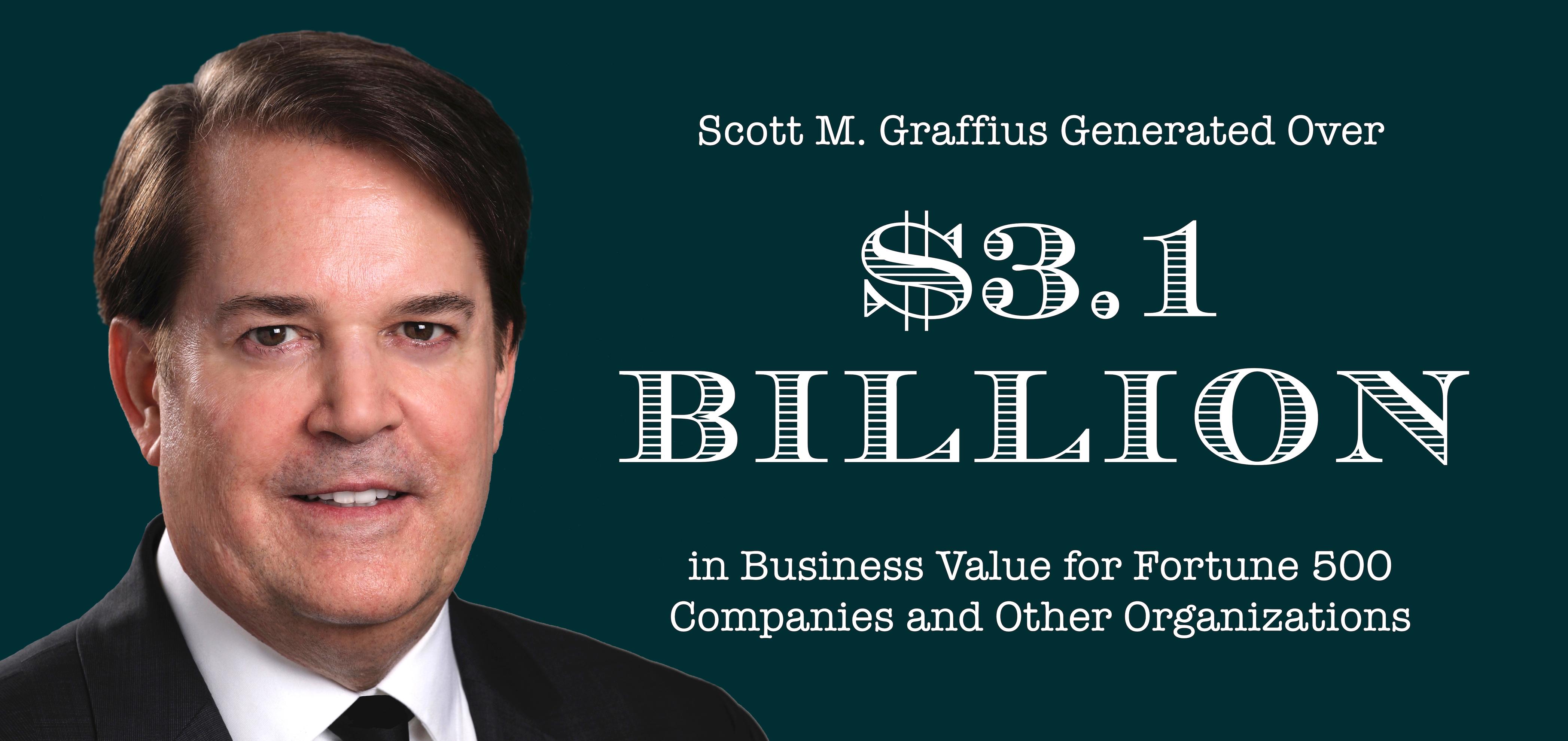
I track the business value I deliver to Fortune 500 companies and other organizations I've served. I previously reported $2.51 billion. It's grown. The updated figure is $3.1 billion.
🔎 Learn more: https://scottgraffius.com/blog/files/scott-m-graffius-generated-over-3-point-1-billion-dollars.html
#AI #Agile #ProjectManagement #Leadership
The Ishi Spiral by Gareth Holebrook is free with a Leanpub Reader membership! Or you can buy it for $0.99! https://leanpub.com/the-ishi-spiral #leadership #leadership_agile #personal_transformation #selfhelp
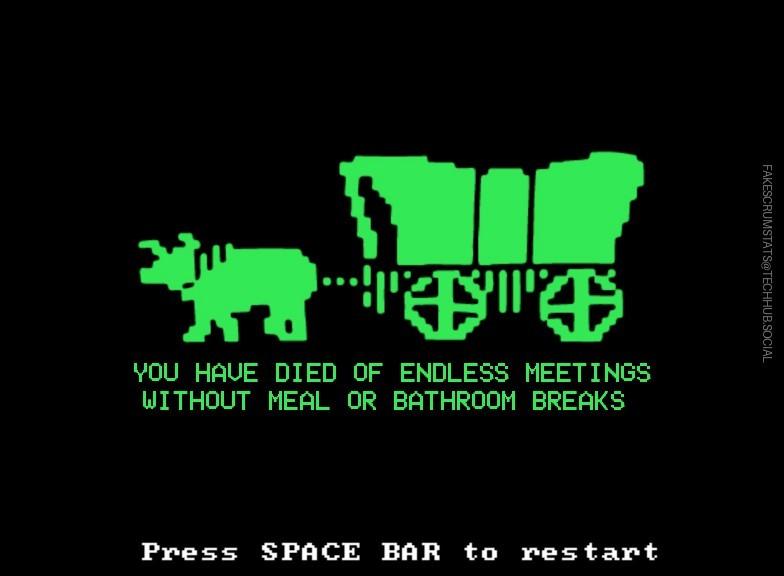
#scrum #scrumteam #dev #developer #qa #scrummaster #productowner #leadership #management #executives #meetings #zoom_meetings #teamsmeetings #longmeetings #longmeetingssuck #endlessmeetings #deathbymeeting #officehumor #officelife #Meme #memes #Humor #humour
Alt...
Oregon Trail video game screenshot that has been altered to read: you have died of endless meetings without meal or bathroom breaks
Things get weird during holiday work weeks. If you missed it, here is my take on why estimation matters.
https://www.edyouragilecoach.com/e-is-for-estimation/
🏴☠️ 🐻
#Business #GhostGang #Agile #Leadership
and
![[?]](https://media.mstdn.social/accounts/avatars/109/287/360/434/605/908/original/aca4453eec34a2ba.jpeg)
The shift from “I’m the best person to solve this” to “I’m the best person to help this team solve this” is not a small one.
Read the full article: Tech Leadership: Be a Multiplier
▸ https://lttr.ai/ArKYG
#SelfLeadership #Leadership #TechnicalLeadership
The Ishi Spiral by Gareth Holebrook is free with a Leanpub Reader membership! Or you can buy it for $0.99! https://leanpub.com/the-ishi-spiral #leadership #leadership_agile #personal_transformation #selfhelp
#LINKSDERWOCHE 35/2026: Produktivitität, Lean, Agile, Management und Leadership
PRODUKTIVITÄT
Konflikte als Information | Wer Konflikte als Indikator Verbesserungen sieht, kann viel bewegen
Konflikte sind ein Signal. Ein Signal, genauer hinzuschauen. Denn Reibung ist ein Indikator dafür, dass es Verbesserungspotenzial gibt. Insofern sind Konflikte gar nicht schlecht. Auch wenn sie nicht immer Spaß machen. Die Kunst besteht darin, den Konflikt zu erkennen und konstruktiv zu nutzen. Genau das ist immer wieder eine Herausforderung, aber eine, die zu bewältigen ist. Zumindest, solange der Konflikt noch nicht allzu hoch gekocht ist. Maik Seyfert gibt ein paar Anhaltspunkte, wie man Konflikte im beruflichen Kontext konstruktiv nutzen und lösen kann. Kein Hexenwerk. Nichts Neues. Aber eine schöne Erinnerung.
https://www.lostconsultants.com/2026/08/31/conflict-at-work-is-information/
Pausen | Ein kleines Reminderle, weshalb echte Pausen wichtig sind – auch wenn sie schwerfallen
Mach eine Pause. Richtig Pause machen. Das ist wichtig. Aber das ist nicht immer einfach. Mein Kopf braucht Beschäftigung, sonst sucht er sich selbst etwas, mit dem er sich beschäftigen kann. Ich habe allerdings gelernt, ihn ab und an in Schranken zu weisen. Pause zu machen. Wenn ich ehrlich bin, gelingt mir das nicht immer. Aber immerhin. Daher kam mir in dem Artikel von Anna Koschinski das eine oder andere doch irgendwie bekannt vor. Dennoch sind Pausen wichtig. Das habe ich in meinem Sommerurlaub gemerkt. Ich habe es tatsächlich geschafft, den Großteil meiner Gedanken auszublenden und abzuschalten. Und es hat mir geholfen, Kraft zu tanken. Also, denkt immer wieder daran: Pausen sind wichtig. Um Energie zu tanken. Auch wenn so vieles nach Aufmerksamkeit schreit.
Nichtwissen als Treiber | Wer sich seines Nichtwissens bewusst ist, sucht nach Erkenntnis
Der Satz „Ich weiß, dass ich nichts weiß“ wird in der Regel dem antiken Philosophen Sokrates zugeschrieben. Und das schon sehr lange. Ob er ihn wirklich gesagt hat, ist schwer zu sagen, denn von ihm selbst gibt es wohl keine schriftlichen Dokumente. Wir müssen uns also darauf verlassen, was seine Schüler über ihn niedergeschrieben haben und was die Jahrtausende überdauert hat. Was sich hinter diesem Satz verbirgt, ist allerdings sehr spannend. In seiner Aussage schwingt Neugier und der Wunsch zu verstehen mit. Eine extrem gute Motivation, wie auch Dan Rockwell schreibt.
https://leadershipfreak.blog/2026/09/02/when-people-dont-know/
Reframing | Situationen umdeuten und wachsen
In dem folgenden Beitrag macht sich Bob Galen Gedanken über „Reframing“. Reframing im Sinne der Umdeutung einer Situation. Eine Fähigkeit, die sehr hilfreich sein kann – nicht nur für Agile Coaches und vergleichbare Rollen. Nicht nur für Agile Coaches und vergleichbare Rollen. Das erhöht die Resilienz. Durch das Verschieben des Deutungsrahmens erschließen sich uns neue Sichtweisen und damit neue Ansätze, wie wir mit vermeintlichen Hindernissen umgehen können. Die vier Stufen des Reframings, die er beschreibt, finde ich dabei besonders interessant. Ich habe mich daher entschieden, den Artikel unter „Produktivität” zu verlinken.
https://bobgalen.substack.com/p/an-agile-coaches-primer-on-reframing
LEAN
Hoshin Kanri | Strategiemanagement auf „japanische Art“
Objektives und Key Results scheinen allen bekannt zu sein. Hoshin Kanri hingegen ist in meinem Umfeld kaum bekannt. Schade eigentlich, denn es ist durchaus ein Ansatz, den man sich für die strategische Steuerung anschauen kann und sollte. Wenn ich jemanden neugierig gemacht haben sollte, dann bitte dem Link zum Artikel von Alen Ganic folgen. Ich persönlich finde den Ansatz interessant, da er eine Integration in die bestehenden Rollen und Strukturen der Organisation ermöglicht, ohne diese – ganz im Sinne des TPS – komplett zu hinterfragen, umzuwerfen und mit neuen Rollen zu überschreiben. Ganz im Sinne eines evolutionären Prozesses. Bei vielen OKR-Implementierungen wird – so meine Beobachtung – leider eine neue Struktur übergestülpt, statt OKRs in die bestehende Struktur zu integrieren. Mir fehlt außerdem die Koppelung mit Verbesserungsbemühungen auf allen Ebenen der Organisation.
https://blog.gembaacademy.com/2026/08/31/how-to-use-hoshin-kanri-to-turn-strategy-into-action/
Nemawashi | Wenn Abstimmung und Einbindung zu viel wird
Wer kennt es nicht? Du kommst mit einer Idee um die Ecke und möchtest sie im kleinen Kreis durchsprechen. Am Ende sitzen plötzlich dreimal so viele Leute mit am Tisch und reden mit, ohne dass etwas dabei herauskommt. Ich bin zwar ein großer Freund davon, zur Vorbereitung möglichst verschiedene Perspektiven einzubinden, und binde daher entsprechende Personen ein. Aber ich weiß auch, dass ab einer bestimmten Grenze – ich muss dabei immer an C. N. Parkinsons Gesetz der 12 denken – nichts mehr entschieden und nichts mehr vorangetrieben wird. Genau dieses Phänomen beleuchtet Götz Müller unter dem Stichwort Nemawashi, einer Praxis aus dem TPS, bei der durch informelle, persönliche Gespräche mit den Interessenträgern ein Konsens geschaffen wird, bevor eine formelle Entscheidung getroffen wird. Das Ziel besteht darin, eine frühzeitige Ausrichtung sicherzustellen, Einwände zu identifizieren und eine reibungslose Genehmigung ohne überraschenden Widerstand zu ermöglichen. Es geht also um die Vorbereitung einer Entscheidung. Wie Götz Müller treffend feststellt, braucht es dafür einen Zweck, und wie so oft ist das „Weshalb” ein sehr guter Kompass, der viel zu oft unterschätzt wird.
https://www.geemco.de/artikel/nemawashi-bis-zum-stillstand/
AGILE
Flow Metriken | Wie Flow Metriken im Umfeldern mit KI-Agenten helfen können
Yuval Yeret nutzt die bekannten Flowmetriken, um aufzuzeigen, dass Geschwindigkeit allein noch nicht zum Ziel führt. Als Aufhänger dient ihm die Entwicklung von Lösungen mit KI. Mithilfe der Flowmetriken möchte er sichtbar machen, wo im Workflow die Herausforderungen bei der täglichen Arbeit mit KI-Agenten zu finden sind. Es sollte eigentlich klar sein: Selbst wenn wir etwas schnell erzeugen können, bedeutet das noch lange nicht, dass wir das Richtige erzeugen und die Übergabepunkte im Arbeitsfluss und der Wertschöpfungskette wirklich gut funktionieren. Ich kann nur immer wieder betonen: Wer ausschließlich auf Geschwindigkeit setzt, darf sich nicht wundern, wenn das Ergebnis irgendwann nicht passt oder Muda an anderer Stelle entsteht. Auf diesen letzten Aspekt geht er leider zu wenig ein, da sein Fokus in erster Linie auf den Flowmetriken liegt.
Produktziele | Bessere Produktziele formulieren mit KI-Unterstützung
Eigentlich hatte ich mir vorgenommen, die zu KI-lastigen Beiträge zu verlinken. Jetzt schiebe ich schon den zweiten hinterher. Aber es ist interessant. Man kann KI sinnvoll als Reflexionshilfe nutzen. Das mache ich auch gelegentlich. Ich schreibe meine Gedanken auf und nutze dann ein LLM, um die Lücken zu identifizieren. Simon Flossmann nutzt das Grundprinzip dahinter für die Formulierung von Produktzielen. Dabei geht es darum, realistische Produktziele zu formulieren, die einen echten Mehrwert für die „Kunden” darstellen. Eine KI kann bei der Analyse möglicher strategischer Daten im oben genannten Sinne hilfreich sein.
MANAGEMENT UND LEADERSHIP
Veränderungsprozesse | Sie scheitern selten an Veränderungen, sondern an fehlender Klarheit
Machen wir uns nichts vor: Veränderungen bedeuten Unsicherheit. Auch wenn wir uns unter dem Stichwort „Change Management” immer wieder der Illusion hingeben, Veränderungsprozesse seien zweckrational steuerbar. Sie sind es nicht. Veränderungsprozesse können hochkomplex werden. Jetzt braucht es Klarheit. Klarheit darüber, was der Zweck ist, welche Leitplanken gelten und welche Erwartungen die Beteiligten haben. Dafür braucht es Führung, wie Jens Elfert schreibt. Führung, die Orientierung gibt und Klarheit schafft. Klarheit im Sinne von Leitplanken, Richtung und Transparenz über Erwartungen. Die Toolbox hierfür ist übrigens gut ausgebaut. Mit der Anwendung und der Umsetzung gibt es jedoch öfter mal Probleme. Das ist nicht überraschend, denn auch die Führungskräfte bestehen nur aus Menschen, die nicht alles perfekt können und wissen. Ein kleiner Tipp: Visuelles Management wie Obeya ist auch in diesem Kontext immer wieder sehr hilfreich. 😉
https://t2informatik.de/blog/warum-veraenderungen-selten-veraenderung-scheitern/
Restrukturierung | Personalabbau ist noch lange keine Restrukturierung
Ich kann mich gut an eine Diskussion vor vielen Jahren erinnern, die ich im Laufe der Jahre immer wieder in ähnlicher Form geführt habe. Wenn es klemmt, dann sind meist die Personalkosten zu hoch und Personal muss gehen. Meines Erachtens ist das sehr kurz gedacht. Oft ist damit auch die Vorstellung verbunden, dass wir durch Personalabbau wieder viel schneller und schlanker werden. Als Freund des Toyota Production Systems weiß ich, dass dem nicht so ist. Man muss schon deutlich mehr tun. Prozesse müssen auf den Prüfstand gestellt werden (was man ohnehin regelmäßig tun sollte), Abläufe und Entscheidungswege müssen kritisch hinterfragt werden (was eigentlich eine Daueraufgabe ist) und man muss im Hinterkopf behalten, dass eine solche Restrukturierung immer auch zu sehr viel Unsicherheit bei vielen Beteiligten führt (ups, da kommt wieder das Thema Veränderungsmanagement ins Spiel). Mit den Worten von Natalia Hoffmann-Demsing: Personalabbau ist noch keine Restrukturierung.
https://t2informatik.de/blog/personalabbau-ist-noch-keine-restrukturierung/
Kleinkönigreiche | Wenn das „Kleinkönigreich“ erbittert verteidigt wird
Wenn Ursula Brummack in die Tasten haut, weiß ich: Es wird interessant. So auch bei ihrem Blogartikel „Bürotassengate”. Auch wenn das Beispiel ein bisschen nach Klischee klingt, verbirgt sich doch ein Phänomen hinter der Beschreibung, das mir im Leben schon oft begegnet ist. Gerade wenn es darum geht, Veränderungen loszutreten, können einzelne Gruppierungen ganz schön bärbeißig werden, da sie um den Einfluss fürchten, den man ihnen vermeintlich wegnehmen möchte. Auch hier wäre Führung wichtig gewesen. Eine Führung, die interveniert, verdeutlicht, worum es geht, und macht deutlich, wie wichtig etwas ist. Auch wenn es vermeintlich unwichtig zu sein scheint. Wer Auskömmlichkeit sinnvoll verbessern will, … Ich halte mich lieber zurück 😉
https://brummack.blog/buerotassengate/
Plötzlich Führungskraft | Weshalb es Sinn macht fachliche Karriere und Führungskarriere zu trennen
Als ich den Artikel von Vero Levesque im Blog des Forums „Agile Verwaltung“ gelesen habe, musste ich schmunzeln. Das Peter-Prinzip und andere „Gesetzmäßigkeiten” lassen fröhlich grüßen. Tatsächlich schicken wir nach wie vor Menschen in Führungsverantwortung, die sich aufgrund ihres fachlichen Könnens qualifiziert haben. Das Problem ist nur, dass man sie dann viel zu oft allein lässt und ignoriert, dass fachliches Können und Führung zwei Paar Schuhe sind. Leider sind die Karrieremodelle in den meisten Organisationen nach wie vor so ausgerichtet, dass Karriere in erster Linie die Übernahme von Führungsverantwortung bedeutet. Selbst dann, wenn es nicht sinnvoll ist. Es fehlen uns viel zu häufig Führungskräfte, die das Spannungsfeld zwischen Führenden, Geführten, Umwelt und Aufgabe wirklich durchdrungen haben. Sie verstehen sich nicht mehr als Fachexpert:innen, sondern als Servant Leader oder „Gastgeber“ (Hosting Leadership), die in erster Linie Rahmenbedingungen schaffen. Eine Trennung zwischen Fach- und Führungskarriere ist daher für mich durchaus sinnvoll.
https://agile-verwaltung.org/2026/09/03/gut-gemacht-jetzt-wirst-du-leider-chefin/
#Agile #Leadership #Lean #LinksDerWoche #Management #ProduktivitätEngineering as a Leadership System by Martin Hinshelwood is on sale on Leanpub! Its suggested price is $40.00; get it for $24.00 with this coupon: https://leanpub.com/engineering-as-a-leadership-system/c/LeanPublishingDaily20260831 #leadership #organizational_psychology
Today, I continue my series on the INVEST model.
https://www.edyouragilecoach.com/v-is-for-valuable/
🏴☠️ 🐻
#LINKSDERWOCHE | 34/2026: Produktivität, Lean, Agile, Management und Leadership
PRODUKTIVITÄT
Show your Work | Selbstmarketing anders denken
Hui, da hat mich Lars Richter mit seinem Blogpost angefixt, meine Liste der noch zu lesenden Bücher doch wieder zu öffnen, obwohl ich sie (vorläufig) geschlossen hatte, da sie ohnehin schon sehr lang war. Und das mit einem Blogpost, in dem er vier Erkenntnisse teilt, die er daraus gewonnen hat. Das ist sehr interessant, weil vieles davon im Gegensatz zu dem steht, was ich jeden Tag auf LinkedIn wahrnehme. Dort nehme ich immer mehr „optimierte Selbstdarstellung“ wahr, die den vier Learnings deutlich widerspricht. Es wäre schön, wenn sich manche dies zum Vorbild nehmen würden.
https://scamper.blog/show-your-work/
Digital und in Papier | Weshalb digital allein nicht immer der richtige Weg sein muss
Ich arbeite viel digital, aber auch weiterhin viel analog. Darin sehe ich keinen Widerspruch. Meine Arbeitsweise ist sicherlich nicht ganz mit der von Daniel Schimpke vergleichbar. Bulletjournaling habe ich selbst auch schon probiert, aber es hat sich bei mir nicht durchgesetzt. Jeder hat so seine individuellen Vorlieben. Bei mir ist es beispielsweise so, dass ich Gesprächsnotizen und Ähnliches im Laufe des Tages meist erst auf Papier notiere. Ich arbeite auch gerne nach der Ivy-Lee-Methode. Papier ist dafür schneller, ich kann „kreativ kritzeln” und die Tastaturgeräusche fallen weg. Am Ende des Tages fasse ich meine Notizen dann digital in Obsidian zusammen und ergänze alle weiteren Informationen, die ggf. später gebraucht werden. Alles, was nicht mehr relevant ist, wird nicht übertragen. Ähnlich wie bei Daniel Schimpke ist Obsidian daher der langfristige Speicher, das analoge Medium ist der kurzfristige Speicher. Es ist also kein Widerspruch. Ganz im Gegenteil. Es ergänzt sich gut. Wie so oft muss das System allerdings passen. Und das ist eben das für mich passende System.
https://www.kadaschi.de/obsidian-reicht-nicht-warum-ich-trotzdem-ein-bullet-journal-fuehre/
Aufgaben streichen | Altlasten in der ToDo-Liste streichen
Ivan Blatter hat wieder einmal eine tolle Podcast-Folge produziert. Das Thema erinnert mich ein bisschen an das Backlog mancher agiler Teams, das regelrecht überläuft, weil uralte Einträge immer noch darin liegen. Ähnlich ist es bei den ganzen Aufgabenlisten, die man so führt. Da sammelt sich viel Altlasten an, die Aufmerksamkeit binden. Ich habe mir deshalb angewöhnt, meine Themenlisten wöchentlich und meine Aufgabenlisten täglich aufzuräumen. Ich streiche gnadenlos alles, was ich – je nach Flughöhe – schon länger nicht mehr angefasst habe. Frei nach dem Motto: Wenn es wichtig war, kommt das Thema schon wieder hoch. Also weg damit. Hört am besten selbst rein. Auch wenn ich manches schon ähnlich handhabe, habe ich noch ein paar neue Ideen mitgenommen. Man lernt ja bekanntlich nie aus.
https://share.transistor.fm/s/9e9a2bc1
Verantwortlichkeit | Verantwortlichkeit bedeutet Konsquenzen umsetzen
Dan Rockwell trifft öfter mal einen Nerv bei mir. Das muss der Grund sein, weshalb ich seinen Blog regelmäßig lese. Mit dem verlinkten Beitrag auch wieder. Aufmerksame Leser meines Blogs wissen, dass Verantwortungsübernahme ein Thema ist, das mir sehr wichtig ist (und bei dem ich mich selbst regelmäßig an die eigene Nase fasse). Verantwortung zu übernehmen bedeutet für mich nicht, die Schuldfrage zu klären, sondern Konsequenzen abzuleiten. Wenn ich einen Fehler gemacht habe – und das kommt häufiger vor – dann gehe ich den Ursachen auf den Grund und leite Konsequenzen ab. Das klappt zwar nicht immer perfekt, aber auch daran arbeite ich immer wieder. Da muss ich in der Tat noch besser werden. Aber wie sagte meine Frau neulich: Einsicht ist der erste Schritt zur Besserung 😉
https://leadershipfreak.blog/2026/08/24/accountability-needs-consequences/
LEAN
Auslöser und Reaktion | Weshalb wir nicht sofort reagieren sollten
Der Beitrag von Ron Pereira könnte auch unter dem Thema Produktivität eingeordnet werden, da er im Prinzip beschreibt, wie wir besser auf einen Auslöser reagieren, um nicht vorschnell, sondern reflektiert zu handeln. Das passiert mir, wie vermutlich vielen anderen Menschen auch, öfter, als uns lieb ist. Es geht um Selbstregulation im Sinne von Multiple Perspective Advantage (MPA). Die Idee lässt sich wie folgt zusammenfassen: Anstatt sofort emotional auf einen Reiz zu reagieren, tritt man mental zurück und beobachtet sich aus einer anderen Perspektive. Klingt einfach. Leider ist es das nicht immer. Man muss es trainieren. Und selbst dann klappt es in einer stressigen Situation nicht immer, wie wir alle wissen. Aber man wird besser. Pereira überträgt das Ganze auf den Lean-Kontext. Interessanterweise passt das sogar sehr gut zu meiner Selbstbeobachtung der letzten Wochen. Es ist gerade eines der Themen, bei denen ich deutlich besser werden möchte. Zufall? Selektive Wahrnehmung? Auf jeden Fall ein passender Impuls für mich – und hoffentlich auch für einige andere.
https://blog.gembaacademy.com/2026/08/26/the-space-between-trigger-and-response/
Lean Digitalisierung | Erst Prozess verbessern, dann digitialisieren
Es wird bekanntermaßen fröhlich digitalisiert. So richtig, was das Zeug hält. Doof nur, dass in vielen Fällen zwei Dinge zusammenkommen: Erstens werden analoge Prozesse 1:1 digitalisiert und zweitens spielt es oft keine Rolle, was das für die Beteiligten bedeutet. Solche Beispiele hatte ich in letzter Zeit als Betroffener mehrfach. Und ganz ehrlich, am liebsten hätte ich den Verantwortlichen meine Meinung gegeigt. Statt einfacher wurde es komplizierter. Das kann es nicht sein. Wenn man digitalisiert, sollte man die Prozesse aus der Perspektive der betroffenen Menschen betrachten. Man sollte den Prozess von rechts nach links betrachten und sich tatsächlich die Frage stellen, ob dadurch für die Beteiligten irgendetwas einfacher wird. Genau das stellt Alen Ganic dar. So würde ich es mir wünschen. Und so sollte es meines Erachtens sein. Digitalisierung um der Digitalisierung willen ist nicht das Ziel.
Obeya | Kein Selbstzweck, sondern Unterstützung beim Veränderungsprozess
Ich bin bekennender Obeya-Fan und habe früher sogar die Qualifikation als Obeya-Coach erworben, da ich von Obeya sehr überzeugt bin. Leider durfte ich mein Wissen bisher noch nicht im vollen Umfang einsetzen. Schade eigentlich. Das wird hoffentlich noch kommen. Einer der Punkte, die ich in meiner Ausbildung gelernt habe und die auch im Beitrag von Götz Müller zu Obeya von zentraler Bedeutung sind, ist: Ein Obeya ist dazu da, Menschen dabei zu helfen, gute Entscheidungen zu treffen. Darauf kommt es ganz besonders an. Er verändert die Art der Zusammenarbeit. Wenn das nicht der Fall ist, dann stimmt etwas nicht. Visualisierung ist kein Selbstzweck, sondern soll dabei helfen, Kaizen mit Leben zu füllen.
https://www.geemco.de/artikel/wenn-obeya-zum-besprechungsraum-wird/
Menschliche Fehler | Tiefer Bohren statt Schudlige suchen
In seinem Blogartikel zeigt Mark Graban sehr schön, worum es bei den fünf Weshalb eigentlich geht – und das, ohne sie zu erwähnen. Als Aufhänger dient ihm die Aussage, dass ein Fehler auf menschliches Versagen zurückzuführen sei und die Frage, wie es überhaupt zu diesem menschlichen Versagen gekommen sei, nicht weiter hinterfragt werde. Mit anderen Worten: Man hat seinen Sündenbock gefunden und geht der eigentlichen Ursache nicht weiter nach. Genau das machen echte Lean-Enthusiasten und Kaizen-Fans aber nicht. Sie bohren tiefer. Sie wollen verstehen, was dazu beigetragen hat und wie man es künftig verhindern kann. Denn das, was oft als menschliches Versagen abgetan wird, kann künftig vermieden werden, wenn man tiefer gräbt. Es ist anstrengend. Aber es lohnt sich.
https://www.leanblog.org/2026/08/human-error-root-cause/
AGILE
Neurodiversität und Führung | Weshalb wir uns nicht zu voreiligen Einschätzungen hinreißen lassen sollten
Tja, das Thema Neurodiversität beschäftigt auch mich derzeit sehr. Ausgelöst wurde es durch eines meiner Kinder, das – so gehen wir derzeit davon aus – in das Spektrum gehört. Die Beschäftigung damit löst auch bei mir einiges aus. Zum einen, weil ich gelernt habe, dass deutlich mehr Menschen in das Spektrum fallen, als uns oft bewusst ist. Sicherlich wissen auch viele gar nicht, dass sie dazugehören. Auch das ist eine Erkenntnis der letzten Wochen: Über mein Kind lerne ich gerade, dass sogar ich selbst betroffen sein könnte. Leider spricht kaum jemand darüber. Das kann zum Problem werden, weil wir Menschen dann falsch einschätzen. Auch in einem Team. Es ist schön, dass das Thema langsam in die Breite getragen wird und die Sensibilität zunimmt. Danke, Doris Weißgerber. Ein schöner Impuls. Mich hat es auf jeden Fall bestärkt, diesem Thema deutlich mehr Beachtung zu schenken. Auch im beruflichen Kontext.
https://www.teamworkblog.de/2026/08/die-sache-mit-den-faulen.html
Backlogpriorisierung | Wenn Priorisierung nach Aufwand nicht mehr greift …
Ich lese immer öfter, dass KI den Aufwand in vielen Arbeitsbereichen deutlich reduzieren kann. Das hat natürlich zur Folge, dass viele Priorisierungstechniken für das Backlog, die auf Aufwand und Nutzen basieren, nicht wirklich greifen. Wir brauchen also neue Impulse. Die Produktwerker nehmen das Thema in ihrem Podcast auf und bringen unter anderem die Aspekte Lernwert und Umkehrbarkeit ins Spiel. Der Podcast ist auf jeden Fall hörenswert. Gerade die Kombination aus Lernwert und Umkehrbarkeit klingt für mich sehr gut. Ich will nicht zu sehr vorgreifen.
https://produktwerker.de/product-backlog-priorisierung-wenn-aufwand-nicht-mehr-die-bremse-ist/
MANAGEMENT UND LEADERSHIP
Idenitity Leadership | Ein schneller Überblick
Durch den Blog von Daniel Dubbel bin ich auf das Thema „Identity Leadership” aufmerksam geworden. Das Themenfeld war mir – muss ich ehrlich sagen – bisher noch gar nicht bekannt. Der Blogartikel war etwas anspruchsvoller zu lesen, dafür aber sehr aufschlussreich. Das klingt nach einem spannenden Thema. Zumindest für mich. Ich bin ohnehin der Auffassung, dass Führung wesentlich komplexer ist und aus dem Zusammenspiel von Führenden, Geführten und Situation entsteht. Es ist also keineswegs allein die Führungspersönlichkeit, die ausschlaggebend ist. Von daher passt das Modell möglicherweise ganz gut zu meiner These.
#Agile #Leadership #Lean #Management #Produktivität #SelbstmanagementThe Case for Connection: Why Connected Organizations Win: Twelve Practices for the AI Era by Dave Clack 📖 on Leanpub!
Technology doesn't fail companies. Relationships do.
Link: https://leanpub.com/connection
#Books #eBooks #LeanPublishing #SelfPublishing #Leadership
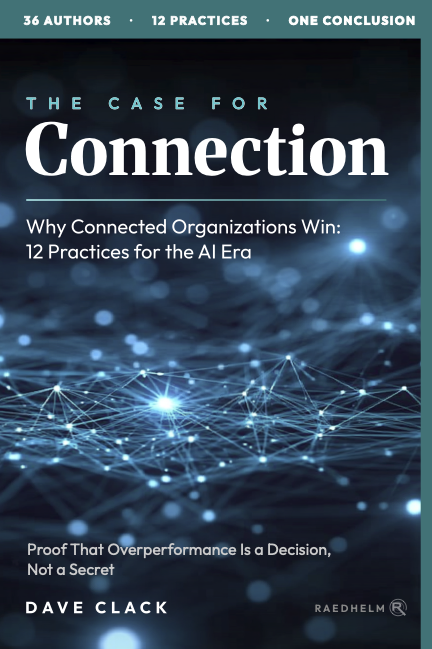
This week, I am discussing the INVEST model and negotiation.
🏴☠️ 🐻
https://www.edyouragilecoach.com/n-is-for-negotiation/
User stories are not the final word, and we talk about them.
Organisational Dysfunction of the Day
Back to the office
Context: The email comes from the top: everyone back in the building, five days a week, starting next month. The stated reasons are collaboration, culture, mentoring the junior staff. Nobody asks why these things were apparently fine for the last three years. Productivity metrics have not moved. The teams that were already strong are still strong, remotely, and the mandate does not distinguish them from the teams that were already struggling. Meetings that ran perfectly well on video are now booked as in-person, and half the room dials in anyway, because someone is travelling, sick, or has children to collect.
OST explains: DP1 is a structure of personal dominance: a master-servant relation in which those above have the right to tell those below what to do and how to do it. That right depends on visibility: a boss coordinates and controls by watching, correcting, and being seen to do both, because the relationship has to be performed, not just held. Remote work leaves decision rights untouched. What it removes is the stage on which those rights are normally performed. A 2026 study led by Adam Grant found that leaders who displayed more power and status were more likely to oppose remote work, and linked the pattern to narcissistic traits. OST already has a structural name for this: egocentrism, one of the three characteristic features of DP1 communication, where individual position rather than the whole task is what has to be protected and displayed. The structural account does not need narcissism to explain the same pattern. Any leader whose authority rests on visible dominance, not on a coordination need the work itself creates, will feel remote work as a loss regardless of personality. The mandate rarely solves a coordination problem that could not be solved another way. What it restores is the stage on which dominance can be seen.
#OpenSystemsTheory #SocioTechnical #OrgDesign #leadership
***
The series has become a book, available now on Leanpub.
http://www.organisationaldysfunctions.com
#scrum #scrumteam #dev #developer #qa #scrummaster #productowner #leadership #management #executives #agilemethodologies #domorewithless #priorities #unrealisticexpectations #Meme #memes #Humor #humour
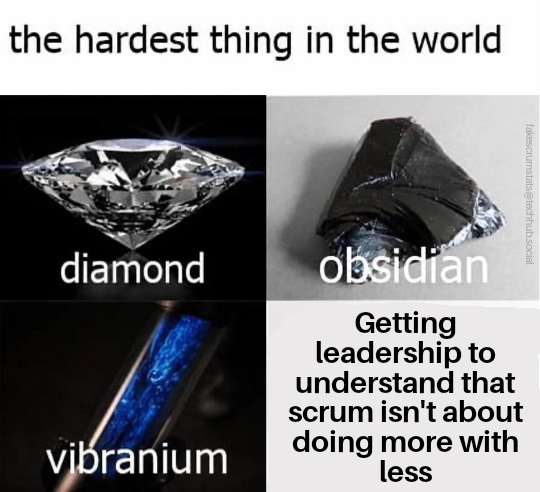
Alt...
Grid displaying the hardest things in the world
Diamond, obsidian, vibranium, and getting leadership to understand that scrum isn't about doing more with less
![[?]](https://m.f-h.co/cosocial-ca/accounts/avatars/112/751/474/529/026/003/original/ae24d7cc1676ebea.png)
Organisational Dysfunction of the Day
The blind decision
Context: The organisation is replacing the system that runs its core operations. A large evaluation project is set in motion: people from the floor who use the current system every day, specialists who understand the technical requirements, a project lead who coordinates the process. Options are assessed, vendors are interviewed, workshops are run. Three candidates emerge. The team prepares a thorough brief, comparing each option across every relevant dimension, and presents it to the CTO with a clear recommendation. The CTO reads it, asks a few questions, and signs off. Everyone moves on. Later, someone wonders what the CTO actually decided.
OST explains: In DP1, formal authority over decisions rises with seniority. By the time a decision of this scale reaches the top, the real judgements have been made by the people who understand the domain. The CTO cannot override a well-argued recommendation from a cross-functional team without triggering a political crisis. They can ask questions, request revisions, delay. But the substance of the decision is beyond their reach, because the knowledge required to make it sits below them in the hierarchy. Herbst, who worked alongside Fred Emery, described this systematically: in DP1, the higher the level, the more purely a person becomes a decision-maker without tasks to perform; the lower the level, the more purely an executor without decisions to make. The decision authority and the decision knowledge are in different places, and the hierarchy ensures they stay there. The CTO signs for an organisation that has already decided.
#OpenSystemsTheory #SocioTechnical #OrgDesign #leadership
***
The series has become a book, available now on Leanpub.
http://www.organisationaldysfunctions.com
It is back to school, and I talk about how an early Bill Murray movie influenced my leadership.
https://www.edyouragilecoach.com/what-bill-murrays-meatballs-taught-me-about-agile-leadership/
🏴☠️ 🐻
![[?]](https://media.newsbeep.org/accounts/avatars/114/866/803/315/323/827/original/767fe3e633c6f7f5.png)
Comprehension as an Architectural Characteristic: A System That Is Not Understood Cannot Evolve Safely
Key Takeaway…
#NewsBeep #News #Artsanddesign #Agile #Architecture #Architecture&Design #ArchitectureICSAET #ArtificialIntelligence #Arts #ArtsAndDesign #CodeReviews #Culture&Methods #Design #Development #Entertainment #EvolutionaryArchitecture #generativeai #InfoQCertificationProgram #Leadership #systemcomprehensionevolutionaryarchitecture #UK #UnitedKingdom
https://www.newsbeep.com/uk/733491/

![[?]](https://files.mastodon.social/accounts/avatars/112/342/617/510/979/081/original/8bb6c11cb1111c15.png)
Prioritäten sind kein Steuerungsinstrument. Sie sind eine Momentaufnahme davon, wer zuletzt laut war: Chef, Kunde, Support.
Deshalb ist die Liste am Montag schon falsch. Nicht weil ihr schlecht priorisiert, sondern weil sich die Lage bewegt und die Liste nicht.
Eisenhower hat das sauber getrennt: „Plans are nothing, planning is everything." Der Plan ist Abfall. Das Planen nicht.
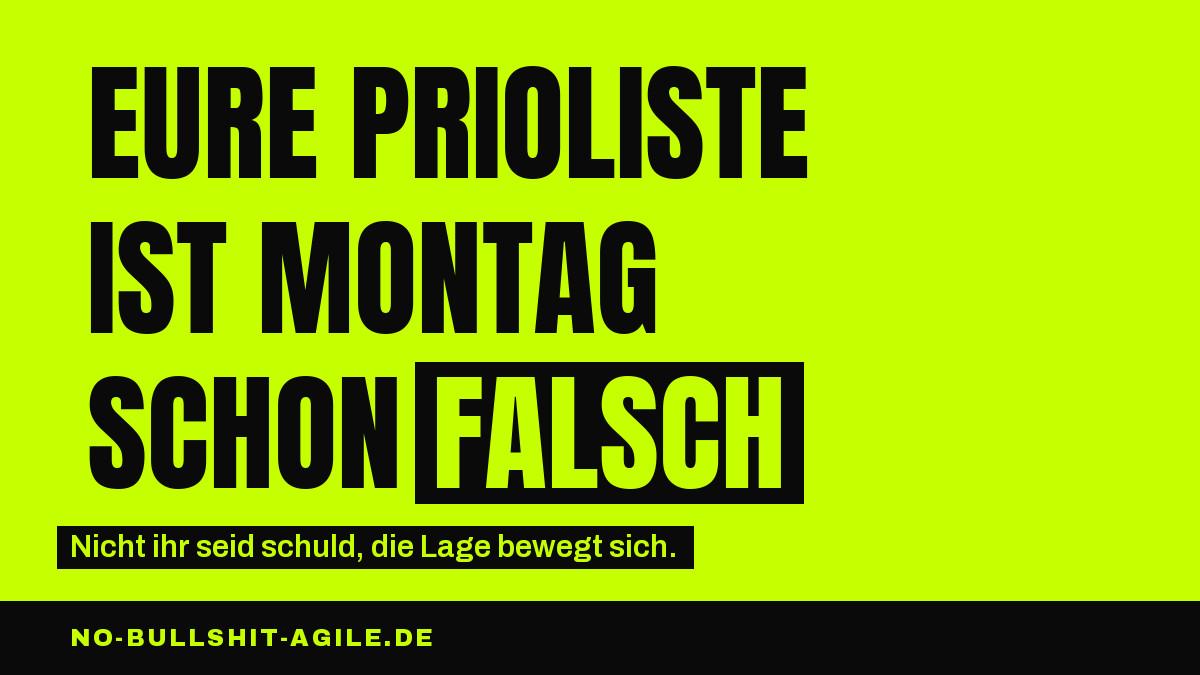
Alt...
Plakat mit schwarzen Versalien auf farbigem Grund: „Eure Prioliste ist Montag schon falsch", das Wort „falsch" invertiert. Darunter: „Nicht ihr seid schuld, die Lage bewegt sich."
📏 The problem with bonuses isn't the money, it's the target.
Goodhart's Law: when a measure becomes a target, it stops being a good measure. Pay a developer for velocity and velocity stops telling you about throughput. Pay a tester for defects found and "quality" detaches from the number.
And most targets are badly chosen to begin with: velocity as throughput, defects as quality. Output isn't outcome. A bonus gets you more of the target; if the target was wrong, that's not what you wanted.
How To Be A Tech Lead by Michael Rice is free with a Leanpub Reader membership! Or you can buy it for $7.99! https://leanpub.com/how-to-be-a-tech-lead #software_engineering #leadership
Amazing CTO by Stephan Schmidt is on sale on Leanpub! Its suggested price is $30.00; get it for $22.50 with this coupon: https://leanpub.com/amazingcto/c/LeanPublishingDaily20260731 #executive_coaching #software_engineering #engineering_management #startups #leadership